Reviewed October 12, 2026 · Adults 21+
Watch the 60-second evidence summary
Silent, caption-led video. All scientific conclusions appear as text.
Two human studies used different enzyme probes and endpoints. Neither establishes a universal interaction or safety rule.
Why the enzyme, probe drug, sampling design, and exact preparation all matter
It is tempting to summarize an interaction study with a sentence such as “kava inhibited an enzyme” or “kava did not interact.” Both shortcuts erase information needed to understand what the experiment actually measured.
Two human kava studies make the problem visible. One reported a change in a chlorzoxazone ratio used to phenotype CYP2E1. A later study examined oral midazolam pharmacokinetics as a CYP3A probe and reported that the tested kava regimen did not affect midazolam disposition. These findings do not conflict: they concern different enzyme endpoints and different measurement designs.
Four questions to ask first
Study one: a four-botanical phenotyping experiment
The 2005 study included 12 healthy volunteers, six of them women. Each participant received four botanical supplements in randomized phases lasting 28 days, with 30-day washouts between phases.
The investigators used four probe traits:
| Enzyme assignment | Probe-derived measurement | Sampling point |
|---|---|---|
| CYP3A4/5 | 1-hydroxymidazolam/midazolam serum ratio | 1 hour |
| CYP1A2 | paraxanthine/caffeine serum ratio | 6 hours |
| CYP2E1 | 6-hydroxychlorzoxazone/chlorzoxazone serum ratio | 2 hours |
| CYP2D6 | debrisoquin urinary recovery ratio | 8-hour collection |
The kava phase supplied a table-reported 138 milligrams of kavalactones per day. Kavalactones are a chemical class of kava constituents; the mixture was administered together rather than as separate isolated compounds.
The significant kava-associated result was an approximately 40% reduction in the two-hour chlorzoxazone metabolite/parent ratio used as the CYP2E1 trait. The reported difference was −0.192, with a 95% confidence interval from −0.325 to −0.060. The other three kava-associated probe traits did not change significantly in this protocol.
What the 40% figure does—and does not—mean
The percentage describes a change in the study’s defined probe ratio. It is not an exact statement that each participant had “40% less CYP2E1 activity.” It is not a medication-dose adjustment, a toxicity threshold, or a number that can be transferred to every kava preparation.
Chlorzoxazone 6-hydroxylation is used as an in-vivo CYP2E1 phenotyping method. Separate method research has measured the metabolite/parent ratio at two hours and documented effects of dose, body size, sampling time, and between-person variability. That does not invalidate the probe; it explains why the measurement must be named accurately.
Study two: a dedicated oral-midazolam experiment
The later study randomized 16 healthy volunteers to receive goldenseal or kava for 14 days, followed by a 30-day washout. Participants received 8 milligrams of oral midazolam before and after each phase.
Instead of relying only on a one-hour metabolite/parent ratio, investigators calculated pharmacokinetic parameters from the midazolam concentration-time profile using standard noncompartmental methods. The report states that midazolam disposition was not affected by the tested kava regimen.
That provides more endpoint coverage for this CYP3A question than a lone one-hour ratio. It still does not establish that every kava product has zero interaction potential with every CYP3A substrate. The result belongs to the study’s manufactured preparation, 14-day regimen, healthy-volunteer population, oral route, probe, and endpoints.
Put the studies side by side
| Study | Main kava finding | Correct boundary |
|---|---|---|
| 2005 multi-enzyme screen | About a 40% decrease in a two-hour chlorzoxazone ratio assigned to CYP2E1 | Ratio-, regimen-, population-, and preparation-specific |
| Later dedicated CYP3A study | Tested kava regimen did not affect oral-midazolam disposition | Does not prove universal absence of CYP3A interactions |
The later CYP3A result does not erase the earlier CYP2E1 signal, because it did not retest that endpoint. The earlier study’s lack of a significant change in its one-hour midazolam ratio and the later full-profile midazolam result point in the same general direction for the two tested preparations. They remain separate experiments rather than proof of equivalence or universal safety.
The mixture is not one molecule
Kava preparations can contain multiple constituents; Kiody’s guide to Kava’s six principal kavalactones and chemotypes explains why a preparation cannot be reduced to one molecule. Six commonly named constituents—kavain, dihydrokavain, methysticin, dihydromethysticin, yangonin, and desmethoxyyangonin—are kavalactones. Neither study tested each one as an isolated human intervention.
The human findings therefore belong to the administered mixtures. They cannot be reassigned to kavain or another single kavalactone, and they cannot be assumed to describe every extract, lot, chemotype, dose, or traditional preparation.
For people taking medicines, interaction questions belong with a qualified health professional who can consider the exact product, medication, dose, health conditions, and other substances involved. NCCIH likewise advises people taking medicines to discuss kava or other herbal products with a health care provider because harmful herb–medicine interactions can occur.
Related evidence guides: Read the compound-level pages for dihydrokavain, methysticin, and kavain. These pages provide constituent context; the whole-product human results discussed above are not evidence that any one of those compounds caused the measured change.
Direct sources
- Gurley et al. — four-botanical human CYP phenotyping study
- Gurley et al. — dedicated oral-midazolam CYP3A study
- Ernstgård et al. — chlorzoxazone CYP2E1 probe-method study
- NCCIH — Kava: Usefulness and Safety
Educational evidence summary only. This article does not provide medical or treatment advice, establish product compatibility or equivalence, guarantee safety, or define a universal interaction threshold or lethal dose.
Accessible video transcript
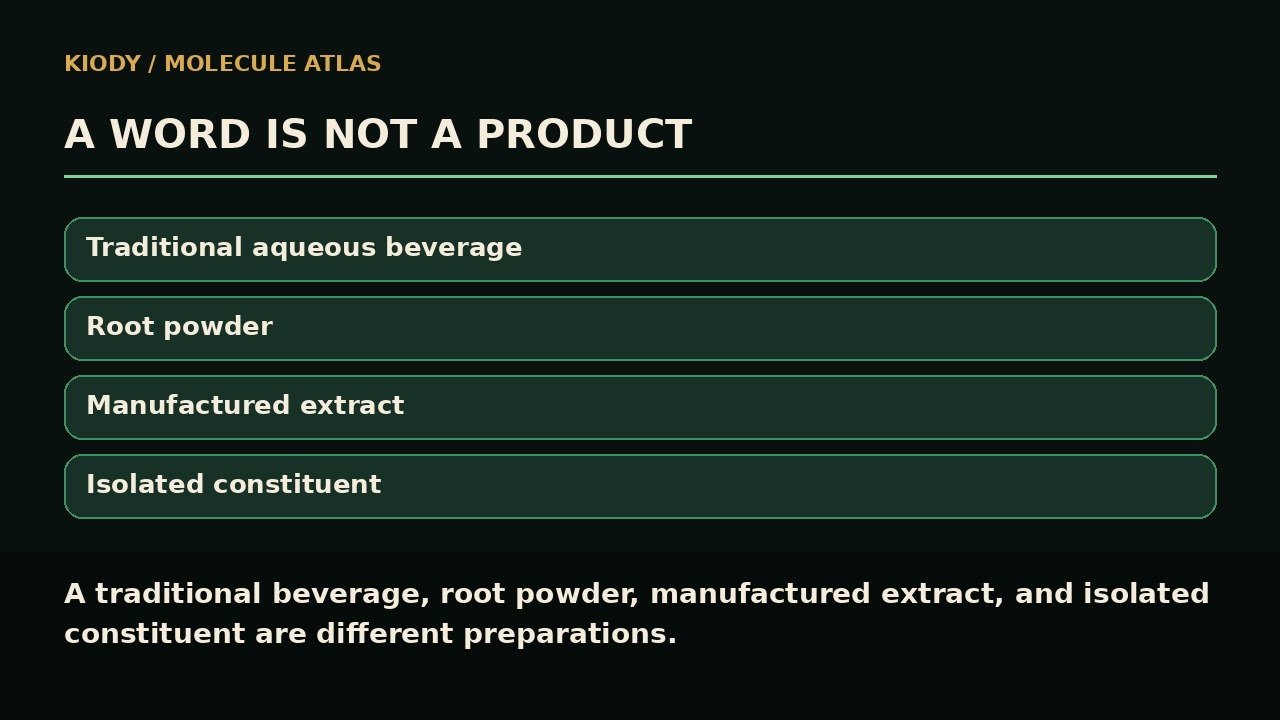
00–10 seconds: A word is not a product
A traditional beverage, root powder, manufactured extract, and isolated constituent are different preparations.
Evidence card: Preparation identity remains attached.
Sources: KCP-S01; KCP-S02
10–20 seconds: Study one
12 healthy volunteers. 28-day extract regimen. A two-hour chlorzoxazone ratio used to phenotype CYP2E1 changed.
Evidence card: Healthy-volunteer probe study; not a clinical outcome trial.
Sources: KCP-S01
20–30 seconds: Read the percentage correctly
About 40% lower probe ratio. This is not an exact universal enzyme reduction, a dosing rule, or a safety threshold.
Evidence card: Magnitude belongs to the defined ratio.
Sources: KCP-S01; KCP-S03
30–40 seconds: Study two
16 healthy volunteers. 14 days. The tested kava regimen did not affect full-profile oral-midazolam disposition.
Evidence card: Product-, route-, population-, and endpoint-specific.
Sources: KCP-S02
40–50 seconds: Why both can be true
The significant ratio result concerned CYP2E1. The later dedicated study addressed CYP3A. Different endpoints.
Evidence card: Cross-study synthesis; not equivalence.
Sources: KCP-S01; KCP-S02
50–60 seconds: The evidence-literate takeaway
Both results belong to manufactured mixtures, not isolated kavalactones or every kava product.
Evidence card: Educational boundary; no medical or guaranteed-safety claim.
Sources: KCP-S01; KCP-S02; KCP-S04
Direct sources
– KCP-S01: Gurley BJ et al. In vivo effects of goldenseal, kava kava, black cohosh, and valerian on human cytochrome P450 1A2, 2D6, 2E1, and 3A4/5 phenotypes. Clin Pharmacol Ther. 2005;77:415-426. PMID 15900287. PMCID PMC1894911. DOI 10.1016/j.clpt.2005.01.009. https://pmc.ncbi.nlm.nih.gov/articles/PMC1894911/
– KCP-S02: Gurley BJ et al. Supplementation with goldenseal (Hydrastis canadensis), but not kava kava (Piper methysticum), inhibits human CYP3A activity in vivo. Clin Pharmacol Ther. 2008;83:61-69. PMID 17495878. DOI 10.1038/sj.clpt.6100222. https://pubmed.ncbi.nlm.nih.gov/17495878/
– KCP-S03: Ernstgard L, Warholm M, Johanson G. Robustness of chlorzoxazone as an in vivo measure of cytochrome P450 2E1 activity. Br J Clin Pharmacol. 2004;58:190-200. PMID 15255802. PMCID PMC1884585. DOI 10.1111/j.1365-2125.2004.02132.x. https://pmc.ncbi.nlm.nih.gov/articles/PMC1884585/
– KCP-S04: National Center for Complementary and Integrative Health. Kava: Usefulness and Safety. https://www.nccih.nih.gov/health/kava