Last reviewed September 15, 2026. Educational content for adults 21+. This article is not medical advice and does not recommend a serving, treatment, drug substitution or combination.
The short answer
This guide to kava kavalactones begins with the distinction that prevents most category errors.
Kava is the plant Piper methysticum and the name commonly given to preparations made from it. Kavain is only one constituent. The best-known kava constituents are kavalactones, not alkaloids. Six kavalactones usually account for most of the kavalactone fraction: kavain, dihydrokavain, methysticin, dihydromethysticin, yangonin, and desmethoxyyangonin.
Those molecules are chemically related, but not identical. Their relative abundance changes with cultivar, plant part, growing conditions, preparation, and extraction. A “chemotype” is a ranked chemical fingerprint; it is not a potency score, a safety grade, or a prediction of how every person will respond.
Laboratory research shows that kavain can positively modulate several human GABA-A receptor subtypes in an expression system without using the classical benzodiazepine binding site. A ten-person human pharmacokinetic study detected five principal kavalactones in plasma after a standardized extract, with peak concentrations generally between one and three hours. Neither finding proves that every kava preparation acts like that study material, and neither makes kava equivalent to a benzodiazepine.
Rare but serious liver injuries have been reported in association with kava products, including cases involving transplantation and death. The record does not establish one universal toxic molecule, one preparation that explains every case, or one lethal dose. Proposed contributors include reactive metabolites, product composition, non-root plant material, solvent extraction, co-medications, dose and duration, individual susceptibility, contamination, and misidentification. The responsible explanation is therefore mechanistic and evidence-graded—not “kava is harmless” and not “one molecule always poisons the liver.”
1. First separate the objects
| Object | What it is | What a study of it can support | What it cannot automatically support |
|---|---|---|---|
| Piper methysticum plant | A cultivated Pacific plant with roots, rhizomes, basal stems, leaves, and other tissues | Botanical identity, plant-part chemistry, cultivation history | Claims about every finished beverage or extract |
| Root/rhizome material | Dried, fresh, peeled, unpeeled, powdered, or otherwise processed underground material | Composition of the sampled material | Composition of leaves, stems, or all commercial lots |
| Traditional aqueous preparation | Root or rhizome material dispersed and extracted in water, often with suspended particles | Evidence about that recipe, cultivar, plant part, and preparation conditions | Evidence about capsules or concentrated solvent extracts |
| Extract | Material enriched by water, ethanol, acetone, supercritical fluid, or another process | Composition and exposure of the specific extract | The composition of ordinary root or every product made with the same solvent |
| Standardized capsule | A dosage form adjusted to a declared constituent amount | Results for that formula and batch | Results for unspecified “kava” products |
| Isolated kavain | One purified kavalactone | Kavain-specific receptor, metabolism, or toxicology findings | Whole-kava effects or the behavior of all kavalactones |
| Non-kavalactone constituent | A chalcone, alkaloid, or other chemical in the sampled plant/product | Compound-specific findings at the tested exposure | Proof that it is present in every root product or caused a clinical event |
Extraction language needs special care. Water, ethanol, acetone, and methanol can be manufacturing inputs. Naming an extraction solvent does not prove that it remains as an ingredient in the consumed product. Conversely, two products both called “extracts” may have substantially different constituent ratios and concentrations.
2. The six principal kavalactones
FDA’s 2020 scientific memorandum reports that 18 kavalactones have been isolated and that six account for about 95–96% of the total kavalactones in kava lipid resin. Kavalactones share a lactone-containing alpha-pyrone scaffold and an aryl substituent, but small structural changes alter polarity, metabolism, and molecular interactions.
| Chemotype number | Constituent | Formula | Structural distinction | Evidence boundary |
|---|---|---|---|---|
| 1 | Desmethoxyyangonin (DMY; 5,6-dehydrokavain) | C14H12O3 | Unsaturated kavalactone without yangonin’s aromatic methoxy group | Often poorly quantified in human plasma; do not infer absence from the plant |
| 2 | Dihydrokavain (DHK) | C14H16O3 | 7,8-dihydro analogue of kavain | Had the largest systemic exposure in one ten-person standardized-extract study |
| 3 | Yangonin (Y) | C15H14O4 | Unsaturated scaffold with an aromatic methoxy group | Detected in the human PK study; target findings remain assay-specific |
| 4 | Kavain (K) | C14H14O3 | Unsaturated kavalactone; frequently used as a mechanistic probe | Positive GABA-A modulation shown in an oocyte expression system; not the whole plant |
| 5 | Dihydromethysticin (DHM) | C15H16O5 | Saturated 7,8 bond plus a methylenedioxy ring | In-vitro CYP and metabolism findings do not alone establish clinical interaction magnitude |
| 6 | Methysticin (M) | C15H14O5 | Unsaturated analogue of DHM with a methylenedioxy ring | In-vitro enzyme effects require human confirmation |
The molecular formulas above identify atoms, not effects. A two-hydrogen difference between kavain and dihydrokavain, for example, does not permit a simple “stronger” or “safer” ranking.
Other constituents are real, but belong in other chemical classes
Kava also contains flavokavains A, B, and C, which are chalcones rather than kavalactones. Trace alkaloids have been reported, including pipermethystine, but their abundance depends strongly on plant part and sampled material. Minerals, amino acids, and other plant constituents also occur.
This matters because “kava alkaloids” is an inaccurate label for the six principal compounds. A toxicology result for a chalcone or trace alkaloid must not be attributed to kavain, and a result for purified kavain must not be attributed to an entire beverage.
Primary identity records: kavain, dihydrokavain, methysticin, dihydromethysticin, yangonin, and desmethoxyyangonin.
3. How to read a kava chemotype
Kava cultivars can be described with a six-digit code. Each digit corresponds to one of the six principal kavalactones:
- desmethoxyyangonin;
- dihydrokavain;
- yangonin;
- kavain;
- dihydromethysticin;
- methysticin.
The digits are arranged from the most abundant to the least abundant compound in the analyzed sample. A hypothetical chemotype 426531 therefore reports kavain first, dihydrokavain second, methysticin third, dihydromethysticin fourth, yangonin fifth, and desmethoxyyangonin sixth.
A chemotype does not report:
- the absolute amount of any compound;
- the total kavalactone concentration;
- serving size or absorbed exposure;
- contaminant or adulterant testing;
- a clinical effect profile;
- a safety ranking; or
- how an individual will metabolize the preparation.
Chemotype also depends on the material analyzed. Cultivar identity matters, but so do plant part, maturity, post-harvest handling, and analytical method. FDA’s review describes more than 200 cultivars and several broad cultivar groupings. Those names are botanical and cultural classifications, not substitutes for batch analysis.
4. Preparation changes the chemical question
Kavalactones have low water solubility. A traditional aqueous drink is therefore not simply a clear molecular solution; it can contain a complex suspension or emulsion of plant particles and lipophilic constituents. Grinding, kneading, straining, water volume, temperature, time, fat content, and plant-to-water ratio can all change what reaches the cup.
In a 2004 comparison, researchers examined a traditional aqueous preparation of a Moi cultivar, organic-solvent extracts, and commercial caplets. Total kavalactone content and relative ratios differed, and the aqueous preparation contained relatively little yangonin. In human-liver microsomes, all preparations inhibited several CYP enzymes, but the aqueous preparation was the least potent of those tested. This was an in-vitro comparison of particular samples, not proof that all aqueous drinks are interaction-free or that all organic extracts are dangerous.
A separate analysis of 28 marketed or prepared samples—including capsules, tinctures, powders, and traditional aqueous suspensions—found large variation in total and relative kavalactones and flavokavains. In that sample set, measured kavalactone amounts sometimes differed substantially from labels. It does not prove that every label is wrong; it demonstrates why the tested product and analytical result have to be named.
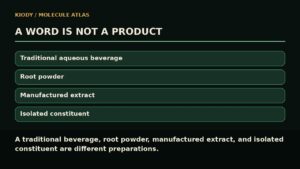
Preparation and formulation ledger for this article
| Category | What is established here | Classification guardrail |
|---|---|---|
| Traditional aqueous beverage | Water extraction/dispersal of specified root/rhizome material; chemistry varies with recipe and material | Water is a preparation input and consumed vehicle, not evidence of a standardized formula |
| Organic-solvent research extract | Ethanol-, acetone-, or methanol-derived laboratory extracts were compared in specific studies | Process solvent is not automatically a retained ingredient |
| Standardized human-PK capsule | Study capsule declared free of flavokavains A and B and delivered quantified total kavalactones | A research formulation; not proof of the formula of every commercial capsule |
| Twenty-eight-product analytical sample | Researchers measured selected marketed/prepared samples | Confirmed measurements for those samples, not the entire market |
| Patent claims and examples | Not evaluated in this article | No patent material is represented as a commercial ingredient |
| FDA-approved pharmaceutical formula | None asserted for kava | Botanical supplement evidence must not be presented as drug approval |
Sources: FDA scientific memorandum on kava, Côté et al., 2004, Mamallapalli et al., 2021, and beverage preparation/chemotype analysis.
5. What happened in the human pharmacokinetic study
The clearest modern human “body journey” comes from a 2022 pharmacokinetic study in ten healthy volunteers. Investigators used a standardized capsule described as free of flavokavains A and B. Participants received a single study exposure containing 225 mg total kavalactones and, in another phase, 75 mg total kavalactones three times daily. Those numbers describe the experiment; they are not consumer dosing instructions.
Absorption
Five kavalactones—DHK, DHM, kavain, methysticin, and yangonin—were measurable over the sampling interval. Their median time to observed peak plasma concentration was generally one to three hours. Desmethoxyyangonin was quantifiable at only a few time points.
Relative systemic exposure
For that capsule and study population, systemic exposure followed the order:
DHK > DHM > kavain > methysticin > yangonin.
That is a plasma-exposure ranking, not a rank of subjective effect, receptor potency, therapeutic value, or safety. The study also reported broadly dose-proportional exposure across the tested range and lower exposure under fed conditions during the multiple-dose phase.
What the study does not answer
Ten volunteers cannot represent every age, liver genotype, medication combination, disease state, pregnancy status, beverage recipe, cultivar, or commercial extract. The study did not establish an effective dose, a lethal dose, equivalence to a prescription medicine, or the pharmacokinetics of all kava preparations.
Primary source: Kanumuri et al., 2022.
6. Kavain and GABA-A receptors: a precise comparison
GABA-A receptors are ligand-gated ion channels. When GABA activates them, the channel conducts chloride and produces rapid inhibitory signaling in mature neurons, often through membrane hyperpolarization or electrical “shunting” that makes excitation less effective. Receptor behavior depends on subunit composition, cellular chloride gradients, and experimental conditions.
In a 2016 study, researchers expressed several human GABA-A receptor subtypes in Xenopus oocytes. Kavain increased GABA-elicited currents across the tested subtypes, with a larger effect at α4β2δ than α1β2γ2L receptors in some experiments. Flumazenil did not block this modulation, indicating that it did not depend on the classical benzodiazepine binding site in that assay. At 300 micromolar, kavain produced negligible direct activation under the reported wild-type α1β2γ2L condition; it mainly changed the response to GABA.
Diazepam and kavain both increased GABA-evoked current in one comparison, and the combined response was greater than either alone but less than additive in that expression system. This is a recombinant-receptor experiment, not a clinical interaction trial. It does not establish that kava “is a natural benzodiazepine,” that the substances are interchangeable, or that a particular human combination is safe.
Primary source: Chua et al., 2016.
7. Metabolism: transformation can create new chemistry
Absorbed kavalactones encounter intestinal and liver enzymes. Oxidation, reduction, demethylation, hydroxylation, and conjugation can produce metabolites with different chemical reactivity and clearance. Older human work detected urinary metabolites after a traditional aqueous beverage, and a study of isolated kavain reported p-hydroxykavain in blood and urine. These studies help identify routes of transformation but do not fully quantify modern product-to-product differences.
One proposed pathway involves oxidation to an electrophilic quinone-like intermediate, often discussed through 6-phenyl-3-hexen-2-one (6-PHO). In laboratory experiments, 6-PHO reacted with glutathione. A corresponding mercapturic-acid conjugate was found in urine from two people after ingestion of powdered root in water. That finding shows that the pathway can occur; with only two participants, it cannot prove that the metabolite causes clinical liver injury or define a dangerous exposure.
Glutathione conjugation is usually a defense: the body attaches glutathione to reactive chemicals to make them easier to process and excrete. Detection of a conjugate therefore signals biochemical exposure, not automatic organ damage. Risk may change if reactive-metabolite formation outpaces detoxification, if glutathione is depleted, or if another exposure competes for protective pathways—but those possibilities need direct human evidence before becoming causal claims.
Primary source: Zou et al., 2005.
8. Drug-interaction evidence: assay first, conclusion second
Interaction claims must name the enzyme, preparation, concentration, and evidence level.
In human-liver preparations
Whole kava extracts and individual kavalactones have inhibited CYP enzymes in microsomal assays. In one commonly cited study, methysticin, dihydromethysticin, and desmethoxyyangonin produced stronger inhibition across several tested enzymes, while kavain did not inhibit those enzymes under the same assay conditions. A separate preparation-comparison study found inhibition of CYP1A2, CYP2C9, CYP2C19, and CYP3A4, with the tested aqueous preparation less potent than organic extracts and caplets.
These are useful hazard signals. They do not, by themselves, predict a clinically important interaction because the concentrations at the enzyme, absorption, protein binding, metabolism, timing, and formulation may differ in humans.
In controlled human probe studies
- In 12 healthy volunteers, 28 days of the studied kava supplement produced an approximately 40% reduction in a CYP2E1 phenotypic measure, while the other probed CYP phenotypes were not significantly changed.
- In a separate 16-volunteer crossover study, 14 days of a standardized kava product did not significantly inhibit CYP2D6 as measured with debrisoquine.
- In 20 healthy volunteers, 14 days of the studied kava supplement did not significantly change digoxin pharmacokinetics, suggesting no strong P-glycoprotein modulation by that formulation under those conditions.
These negative or limited findings matter as much as positive findings. They prevent a blanket claim that kava “blocks all liver enzymes.” They also do not prove that every kava product has no interaction potential.
A focused walkthrough explains why one probe result is not every kava interaction: different enzymes, endpoints, preparations, and protocols answer different questions.
Human sources: Gurley et al., 2005, Gurley et al., 2008, and Gurley et al., 2007.
9. How liver injury could occur—and what remains unresolved
The liver receives absorbed chemicals from the gut, transforms them, conjugates many metabolites, and exports them into blood or bile. Injury can emerge through several broad routes:
- Direct cellular stress: a parent constituent or metabolite disrupts mitochondria, membranes, protein function, or redox balance.
- Reactive-metabolite burden: an electrophile binds glutathione or cellular macromolecules faster than protective systems can neutralize it.
- Immune-mediated/idiosyncratic injury: a rare person-specific response occurs that is not predicted by ordinary dose-response data.
- Metabolic interaction: a co-exposure inhibits or induces enzymes, shifting concentrations or metabolite formation.
- Product-specific factors: plant part, cultivar, adulteration, contamination, extraction, storage, or misidentification changes exposure.
- Host factors: liver disease, nutrition, genetics, age, alcohol exposure, and co-medications alter vulnerability.
These are plausible pathways, not a verdict that each occurred in every reported case.
What case reports show
A 2003 case-series analysis discussed 36 reports associated with predominantly acetonic or ethanolic extracts. Nine patients had fulminant liver failure, eight underwent transplantation, and three died. Latency and cumulative exposure varied widely, and the authors considered idiosyncratic or immunoallergic mechanisms. Case series can identify a serious signal, but incomplete product verification, concomitant medicines, and retrospective causality assessment limit certainty.
Traditional aqueous use cannot be assigned zero risk. Another 2003 report described two hepatitis cases judged probably associated with aqueous kava, while a survey of 27 heavy users found gamma-glutamyl transferase elevations in 23 and minimal transaminase elevations in eight. The authors noted that the enzyme pattern could reflect metabolic enzyme induction rather than hepatocyte injury. That distinction is crucial: a laboratory abnormality is not automatically proof of clinical liver failure.
Regulatory and public-health reviews have therefore treated the association seriously without identifying one universally established culprit. NCCIH’s Kava assessment, last updated April 2025 and rechecked September 15, 2026, states that rare liver injuries associated with various Kava products have included serious and fatal cases, including reports involving both solvent-extracted products and water-prepared beverages. EMA published a final assessment report in 2018 but did not adopt an EU herbal monograph.
Sources: Stickel et al., 2003, Russmann et al., 2003, NCCIH Kava assessment, FDA scientific memorandum, and EMA kava assessment page.
Why pipermethystine is not a complete explanation
Pipermethystine is an alkaloid reported especially in aerial kava tissues. In HepG2 liver-derived cells, 100 micromolar pipermethystine caused a large loss of viability over 24 hours and produced signs of mitochondrial dysfunction and apoptosis. That establishes cell toxicity under those conditions—not a human lethal exposure and not proof that ordinary root preparations contain the same concentration.
A later analysis found about 0.2% pipermethystine in leaves but did not detect it above a 45-parts-per-million quantification limit in the root samples and retained German products tested. The two findings can coexist: pipermethystine can damage a cell model, yet may be absent or minimal in specific root products. It cannot be assigned as the cause of every reported case without product-level analytical evidence.
Sources: Nerurkar et al., 2004 and Lechtenberg et al., 2008.
Why flavokavain B is not a complete explanation
Flavokavain B is a chalcone, not a kavalactone. In one HepG2 study it reduced cell viability with a reported half-maximal inhibitory concentration near 23 micromolar. Flavokavain A was not toxic up to 100 micromolar in that assay, and both compounds also activated cellular stress-response pathways and increased glutathione. These context-dependent results are biologically interesting but do not prove that flavokavain B caused human liver injury or that every kava product contains a clinically meaningful exposure.
Primary source: Pinner et al., 2016.
The honest conclusion
The evidence supports a rare, potentially severe liver-injury signal associated with some kava exposures. It does not support a universal lethal dose, a claim that water preparations are guaranteed safe, a claim that solvent extracts alone explain every case, or a claim that one constituent has been proven responsible in all people.
10. Kava, alcohol, opioids, and sedating pharmaceuticals
This article does not calculate a “safe combination.” Products and people vary, and serious central nervous system effects can develop through multiple mechanisms.
- Alcohol: ethanol changes GABAergic and glutamatergic signaling, impairs judgment and coordination, and at high exposure can suppress protective reflexes and breathing. Kava’s GABA-A modulation in an expression system makes overlapping impairment biologically plausible, but there is not enough controlled human evidence to assign a universal interaction magnitude or waiting interval.
- Opioids: opioid agonists can depress brainstem respiratory drive. Adding another impairing or sedating exposure can make recognition and response harder. This is a mechanistic risk explanation, not evidence that kavalactones are opioids; they are not.
- Benzodiazepines and related sedatives: many enhance GABA-A signaling, often through the classical benzodiazepine site. Kavain’s modulation was flumazenil-insensitive in one recombinant system, showing a mechanistic difference rather than safety of co-use.
- Hepatically metabolized medicines: in-vitro CYP inhibition is preparation-dependent, and limited human probe studies do not cover all products, enzymes, or patient factors.
Anyone who uses medicines, alcohol, or other psychoactive substances should discuss potential interactions with a qualified clinician or pharmacist. Sudden extreme sleepiness, confusion, inability to stay awake, slowed or irregular breathing, blue or gray lips, collapse, seizure, or inability to wake is an emergency; call emergency services. Yellowing of the eyes or skin, dark urine, pale stool, persistent vomiting, unusual itching, or right-upper-abdominal pain warrants prompt medical evaluation.
11. What is known, uncertain, and not established
| Claim | Evidence level | Defensible conclusion |
|---|---|---|
| Six principal kavalactones dominate the kavalactone fraction | Analytical/regulatory review | Correct chemical inventory, with cultivar and method caveats |
| Chemotype digits rank relative abundance | Analytical convention | Useful fingerprint; not an effect or safety score |
| Kavain modulates GABA-A receptors | Recombinant human receptor/oocyte assay | Target-level evidence; not clinical equivalence to benzodiazepines |
| Five kavalactones reached measurable plasma concentrations | Ten-person human PK study of one standardized capsule | Human absorption confirmed for that product and protocol |
| Whole extracts inhibit CYPs | Human liver-microsome assays | Interaction potential; clinical magnitude not established |
| Specific kava products had limited CYP/P-gp effects in probe studies | Small controlled human studies | Product- and protocol-specific findings; not a universal clearance |
| Reactive metabolites and glutathione conjugates form | In vitro plus two-person urinary detection | Metabolic pathway exists; causation of liver injury unproven |
| Severe liver injury has been reported | Case reports, case series, regulatory reviews | Serious signal with variable causality and unresolved mechanism |
| Pipermethystine or flavokavain B explains all cases | Cell studies plus variable product detection | Not established |
| A universal fatal dose exists | No adequate basis | Do not publish one |
12. Three related Kiody guides
- What Is Kava? — plant and preparation overview.
- What Is Kavain? — the compound-level guide to one of Kava’s six principal kavalactones.
- Kiody Learning Center — the broader educational index.
These links were checked on September 15, 2026. Linking these pages does not imply that the products or preparations discussed are chemically equivalent.
Frequently asked questions
Is Kava the same as kavain?
No. Kava is a plant and a name used for preparations made from it. Kavain is one constituent within a mixture of kavalactones and other compounds. Findings for purified kavain cannot automatically be transferred to Kava root, a beverage or an extract.
What are the six principal kavalactones?
They are desmethoxyyangonin, dihydrokavain, yangonin, kavain, dihydromethysticin and methysticin. Their relative abundance varies with cultivar, plant part, processing and the tested product.
What does a Kava chemotype number mean?
A six-digit chemotype orders the six principal kavalactones from most to least abundant in the analyzed sample. It does not state absolute content, serving size, potency, safety or a guaranteed experience.
Does Kava act like a benzodiazepine?
That is too broad. Isolated kavain increased GABA-triggered currents in a recombinant-receptor experiment without depending on the classical benzodiazepine site. This mechanistic comparison does not make Kava a natural benzodiazepine or establish clinical equivalence.
Have kavalactones been measured in human blood?
Yes. A ten-person study detected five principal kavalactones in plasma after one standardized capsule formulation. That result establishes exposure for that study product and protocol, not every Kava preparation.
Does an aqueous Kava beverage have the same chemistry as an extract?
Not necessarily. Preparation changes total constituent content and relative ratios. A traditional water preparation can also contain suspended plant particles, so it is not simply a clear solution of water-soluble molecules.
Does Kava cause liver injury?
Rare, sometimes severe liver injuries have been reported in association with various Kava products. Product verification, co-exposures, individual susceptibility and mechanisms vary, so the evidence does not establish one universal culprit or one risk level for every preparation.
Can Kava be combined with alcohol, opioids or sedatives?
This evidence does not establish a universally safe combination or waiting interval. Overlapping impairment and sedation are biologically plausible concerns, and NCCIH advises against combining Kava with sedative substances such as alcohol or benzodiazepines. People using medicines should consult a clinician or pharmacist.