Dihydrokavain—also written dihydrokawain or abbreviated DHK—is one of the six principal kavalactones used to describe the chemistry of kava root. It is structurally related to kavain, but it is not kavain, not a synonym for kava and not an isolated explanation for the effects of a traditional beverage or modern extract.
DHK deserves its own evidence guide because it was the most systemically exposed kavalactone in a small human pharmacokinetic study of one standardized extract. It has also been examined in rat brainstem preparations, chick behavior models, human-liver microsomes and analytical-method studies. Each experiment answers a different question. None establishes that purified DHK has a clinically proven effect in people.
This article is educational, nonmedical and intended for adults 21 and older. It provides no serving instructions and does not tell anyone to start, stop or replace a medicine.
The central evidence boundary: ten volunteers received capsules containing a flavokavain A/B-free, multi-kavalactone extract. DHK had the highest systemic exposure among the measured kavalactones in that product and study. That does not equal the pharmacokinetics, safety or effects of isolated DHK, traditional water-prepared root or every commercial extract.
Dihydrokavain in one minute
- DHK is one of six major kavalactones that commonly account for most of the kavalactone fraction in kava root material.
- Its molecular formula is C14H16O3, and its molecular weight is approximately 232.28 g/mol.
- It differs from kavain by saturation of the 7,8 carbon–carbon bond, a small structural change that affects analytical identity and metabolism.
- In a ten-person human study of one standardized multi-constituent extract, DHK produced the highest systemic exposure among five consistently quantifiable kavalactones.
- A rat gastric–brainstem experiment found that DHK modulated a GABA-related response. It did not establish human anxiolytic effects or benzodiazepine equivalence.
- Chick and mouse studies are preclinical and route-specific; their findings cannot be converted into human effectiveness or serving guidance.
- Laboratory CYP findings indicate possible interaction questions, not a measured clinical interaction caused by DHK.
- Kava-associated liver-injury reports generally do not establish isolated DHK as the cause, but that uncertainty is not proof that DHK or all products are universally safe.
What is dihydrokavain?
DHK is a chiral, lipophilic alpha-pyrone compound found in Piper methysticum, the South Pacific plant commonly called kava. “7,8-dihydrokavain” specifies that the double bond present at that position in kavain has been reduced. Scientific papers and analytical standards may use kavain/kawain and dihydrokavain/dihydrokawain spellings for the same respective structures.
Its formula is C14H16O3, with a molecular weight of about 232.28 g/mol. DHK contains a methoxylated lactone ring and a phenethyl side chain. The naturally relevant stereochemical form should be specified when purified standards or isolated-compound experiments are discussed because stereochemistry can influence recognition by enzymes and receptors.
The U.S. FDA’s 2020 scientific memorandum lists 7,8-dihydrokavain with kavain, methysticin, dihydromethysticin, yangonin and desmethoxyyangonin as the six compounds that make up most of the kavalactone fraction. A compound’s membership in that group does not mean it occurs at a fixed percentage in every cultivar, plant part or product.
Identity sources: PubChem’s dihydrokavain record and the FDA scientific memorandum on kava.
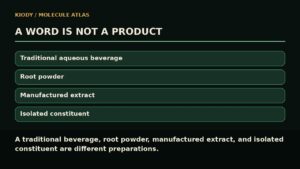
Kava root, beverage, extract and isolated DHK are different objects
| Research object | What it contains | What its evidence can support | What it cannot establish |
|---|---|---|---|
| Authenticated kava root or rhizome | A cultivar- and plant-part-dependent botanical mixture | Chemistry of the sampled material | Composition of every kava lot or product |
| Traditional aqueous beverage | Water-extracted constituents from a specified root preparation | Results for that preparation and context | Results for an organic-solvent extract or purified DHK |
| Standardized capsule extract | Multiple kavalactones within a manufacturer’s specification | Human or laboratory results for the tested extract | Effects of DHK alone |
| Purified dihydrokavain | One structurally and stereochemically defined molecule | Compound-specific assay and animal findings | Clinical effects of whole kava |
| DHK analytical standard | Reference material with documented identity and purity | Retention, response and quantitative calibration | Bioactivity or safety of a consumer product |
This distinction prevents a recurring error. A plasma DHK measurement after a standardized extract proves exposure to DHK from that product. It does not prove that DHK caused every subjective or biological response. Conversely, a purified-DHK experiment cannot describe the pharmacology of a botanical mixture without additional evidence.
For the mixture-level context, see Kiody’s kava kavalactones and chemotypes guide. The related molecule is covered separately in the kavain chemistry and human-research guide.
Dihydrokavain vs kavain
Kavain and DHK share the same basic kavalactone scaffold, but kavain contains a 7,8 double bond that DHK does not. DHK therefore has two additional hydrogen atoms and a slightly higher molecular mass. The difference sounds minor, yet it changes chromatographic retention, mass, metabolic options and measured exposure.
| Compound | Chemotype number | Structural distinction | Evidence point |
|---|---|---|---|
| Dihydrokavain (DHK) | 2 | Saturated 7,8 bond; no methylenedioxy group | Highest systemic exposure in one ten-person standardized-extract study |
| Kavain (K) | 4 | 7,8 double bond | Direct human recombinant GABA-A receptor research exists for purified kavain |
| Dihydromethysticin (DHM) | 5 | DHK-like saturation plus a methylenedioxy group | Different CYP and exposure profile; cannot be substituted for DHK |
| Methysticin (M) | 6 | Unsaturated counterpart to DHM | Separate metabolism and enzyme findings |
| Yangonin (Y) | 3 | Additional aromatic methoxy group | Distinct cannabinoid-receptor laboratory evidence |
| Desmethoxyyangonin (DMY) | 1 | Unsaturated aromatic side chain without yangonin’s methoxy group | Different absorption and enzyme behavior |
A finding for kavain cannot be silently reassigned to DHK. For example, the 2016 human recombinant GABA-A receptor study characterized purified kavain, not purified DHK. DHK has related GABAergic evidence from another experimental system, but the studies are not interchangeable.
How kava chemotype codes describe DHK
Kava chemotype codes rank the six principal kavalactones in decreasing order of measured abundance. In this convention, DHK is number 2. A code beginning with 2 identifies DHK as the most abundant of those six compounds in the tested sample; a 2 in the second position identifies it as the second most abundant.
A chemotype is a rank order, not a percentage. Two samples can share the same six-digit code while having different total kavalactone content and different absolute amounts of DHK. The code also does not report flavokavains, minor constituents, contaminants, microbial quality or extraction solvent.
Labels sometimes turn chemotype folklore into effect promises. The FDA memorandum reproduces reported associations for individual chemotype components, but a code alone is not a controlled human outcome study. Cultivar identity, preparation, total composition and individual exposure remain important.
How much DHK occurs in kava?
There is no universal percentage. The FDA memorandum notes that dried rootstock can vary broadly in total kavalactone content and that cultivar, plant part, plant age, geography and growth conditions change composition. Kavalactones are concentrated in roots, rhizomes and root stems, with concentrations varying across those tissues.
Product studies confirm the same problem. Wang and colleagues developed a stable-isotope dilution UPLC–high-resolution tandem mass-spectrometry method and found significant differences in individual kavalactone abundance across two tested products. A later 28-product characterization also documented variation among powders, beverages, tinctures, capsules and other forms.
These are bounded samples, not universal market estimates. A batch-specific DHK claim requires a validated method, a traceable standard, a defined sample basis and clear units. “30% kavalactones” does not reveal how much of that total is DHK.
Primary analytical sources: Wang et al., 2018 and Mamallapalli et al., 2022.
What the human pharmacokinetic study actually found
Kanumuri and colleagues enrolled ten healthy volunteers and administered capsules containing one flavokavain A/B-free standardized kava extract. The researchers used a validated UPLC–MS/MS method to measure six major kavalactones and two flavokavains in plasma while comparing single and divided oral schedules.
Within that product and study, systemic exposure ranked DHK highest, followed by dihydromethysticin, kavain, methysticin and yangonin. Desmethoxyyangonin was quantifiable at only a few time points. Five kavalactones reached maximum measured concentrations within approximately one to three hours. Food significantly reduced the extent of kavalactone absorption in the multiple-administration portion.
The most accurate conclusion is that DHK was highly exposed relative to the other measured kavalactones after this standardized extract. “DHK has the greatest human bioavailability” is broader than the data justify because product composition, dissolution, formulation and the amount of each compound influence the observed concentration–time curve. The experiment did not administer purified DHK, compare traditional aqueous kava or enroll people with a diagnosed condition.
The study reported NIH support through NCCIH, NIGMS and NCATS grants. Its sample size was small, and the tested material was a purpose-characterized extract. Those facts limit generalization but make it one of the most informative human disposition studies in the field.
Primary source: Kanumuri et al., 2022.
Study design determines what a DHK result means
| Study | Design | Tested material | What it supports | What remains unresolved |
|---|---|---|---|---|
| Yuan et al., 2002 | Isolated rat gastric–brainstem preparation | Kavalactones and purified DHK | Modulation of a GABA-related experimental response | Human receptor occupancy and clinical effects |
| Smith et al., 2001 | Chick social-separation behavioral model | Kava extract and principal kavalactones | Compound- and mixture-level behavioral hypotheses | Human efficacy, exposure and diagnosis-specific outcomes |
| Mathews et al., 2002 | Human liver microsome enzyme screen | Kava extract and individual kavalactones | In-vitro CYP inhibition potential | Clinical interaction magnitude at real human exposure |
| Wang et al., 2018 | Validated analytical method; products, mice and human specimens | Five principal kavalactones including DHK | Quantitation, product variation and cross-matrix detection | Clinical benefit or isolated-compound safety |
| Kanumuri et al., 2022 | Oral pharmacokinetics in ten healthy volunteers | One flavokavain-free standardized multi-kavalactone extract | Human plasma exposure for that product and schedules | Pharmacokinetics and effects of purified DHK or traditional beverage |
The progression from an assay to an animal model to a human extract study can look like a single proof chain, but each stage changes the tested object and outcome. Evidence becomes misleading when those changes are omitted. The strongest current human conclusion is about measured DHK exposure from one standardized extract, not a demonstrated therapeutic effect of the isolated molecule.
Why food and formulation matter
Kavalactones have low water solubility. Particle size, extraction method, excipients, capsule dissolution and meal conditions can change how much reaches plasma and when. The 2022 study’s food effect demonstrates that a compound amount on a label is not identical to systemic exposure.
Formulation also complicates comparisons with traditional beverage research. A capsule containing a standardized dry extract is not the same matrix as kneaded or strained root in water. Organic-solvent extracts, emulsions and purified compounds create still different concentration ratios and absorption conditions.
These differences do not make one preparation inherently superior. They mean that exposure findings must retain the tested matrix. A study of one capsule cannot supply a pharmacokinetic curve for every root powder, instant beverage, tincture or isolated compound.
What does the GABA research show?
Gamma-aminobutyric acid, or GABA, is the principal inhibitory neurotransmitter in the adult human brain. Benzodiazepines act at defined sites on GABA-A receptors, but sharing a broad GABA-related pathway does not make another compound a benzodiazepine.
Yuan and colleagues examined a rat gastric–brainstem preparation and reported that a kavalactone mixture and purified DHK modulated a GABAergic response. The experimental preparation linked gastric afferent input with brainstem circuitry; it was not a human clinical study and did not provide a complete receptor-subtype map.
The paper supports the statement that DHK can influence a GABA-related experimental system. It does not establish that DHK binds the classical benzodiazepine site, produces the same functional modulation as diazepam, or has a demonstrated human anxiolytic effect. Later recombinant-receptor work directly characterized kavain, not DHK, reinforcing the need to keep compound names attached to the correct experiment.
Primary sources: Yuan et al., 2002 and Chua et al., 2016.
What did the chick behavior experiments test?
Smith and colleagues used a chick social-separation-stress model to compare kava extract and principal kavalactones. Follow-up fraction work by Feltenstein and colleagues examined extracts and fractions with different chemical profiles. Fractions richer in DHK were associated with reduced distress behaviors in that model.
This is preclinical behavioral evidence. Young domestic chicks are not miniature human clinical participants, distress vocalization is not a diagnosis, and an active fraction is not purified DHK. Route, mixture composition and species biology all limit translation.
The experiments are useful for generating hypotheses about which kavalactone ratios may contribute to a kava extract’s behavioral profile. They cannot show that DHK treats anxiety, that a DHK-forward chemotype has a guaranteed effect, or that another preparation will reproduce the same result.
Primary sources: Smith et al., 2001 and Feltenstein et al., 2003.
How is DHK metabolized?
Older rat disposition research found that DHK was extensively recovered as metabolites in urine, with aromatic-ring hydroxylation prominent and para-hydroxy-DHK reported as a major product. The FDA review notes that DHK appeared better absorbed than several other kavalactones in that rat experiment.
Human metabolism is not identical. Early analysis of urine after traditional aqueous kava identified multiple kavalactones and transformation products, but complex-mixture exposure makes it difficult to assign every detected compound uniquely to one precursor. Kavain itself can be reduced or hydroxylated into compounds whose names resemble DHK metabolites.
The distinction between an administered constituent and a metabolite matters. Detecting DHK or a hydroxylated DHK-like compound after a kava mixture does not reveal the original product ratio, the amount consumed or which constituent caused an observed effect. Isotope-labeled human studies would be needed for a definitive isolated-DHK mass balance.
DHK and cytochrome P450 interaction research
Mathews and colleagues screened a kava extract and individual kavalactones in human liver microsomes. DHK showed measurable inhibition in parts of the panel, while methysticin, dihydromethysticin and desmethoxyyangonin were generally among the more potent inhibitors for several enzymes. Microsomes are a useful early-warning system, not a living-human interaction trial.
Other studies administered whole kava products to healthy volunteers and measured drug-metabolism probe responses. Those mixture-level results have not been fully consistent across enzymes and products. They cannot be used to assign a clinical interaction specifically to DHK.
For the study designs, measured endpoints, and limits of inference, see Kiody’s human kava probe-study comparison. Those mixture-level findings cannot be assigned to dihydrokavain alone.
Clinical relevance depends on unbound concentration at the enzyme, intestinal versus hepatic exposure, duration, metabolites and the coadministered medicine’s therapeutic range. Therefore an in-vitro IC50 is not a consumer threshold. People taking medicines—especially sedatives or medicines with narrow safety margins—should discuss kava with a clinician or pharmacist rather than relying on a compound-level assay.
Primary laboratory source: Mathews et al., 2002.
How laboratories measure DHK
Validated chromatography is necessary because kava contains structurally related lactones with overlapping ultraviolet spectra. UHPLC can separate the six principal kavalactones before ultraviolet or tandem mass-spectrometric detection. High-resolution MS improves exact-mass confidence, while stable-isotope internal standards help correct for recovery and instrument variability.
Tang and Fields developed a UHPLC-UV method that separated six major kavalactones, three flavokavains and additional components in under 15 minutes, with structural confirmation by LC-UV-MS/MS. Wang and colleagues used stable-isotope dilution UPLC-MS/MS across products, animal tissues and human samples. Kanumuri and colleagues validated a plasma assay with a reported lower quantification limit of 0.25 ng/mL for the targeted compounds.
A certificate of analysis should identify the batch, plant part or extract matrix, method, reference standards, units and individual kavalactone results. A six-digit chemotype and “total kavalactones” are useful summaries but do not replace quantitative DHK data. “Not detected” also means below a method-specific limit, not absolute chemical zero.
Method sources: Tang and Fields, 2019 and Wang et al., 2018.
What does DHK research say about the liver?
It does not support assigning all kava-associated liver reports to DHK. Case reports and official reviews concern varied products, often without complete retained-product authentication, quantitative chemotypes, extraction details, co-exposure control or a test isolating DHK. A kava label or detected kavalactone does not identify a single causal constituent.
Nor does the absence of isolated-DHK attribution prove universal safety. The current NCCIH page states that various kava products have been linked to rare but sometimes severe liver injury, including reports involving alcohol- or acetone-extracted products and some water-prepared beverages. Proposed factors include cultivar and plant-part selection, adulteration, contamination, alcohol, prolonged or large exposure, medicines and individual susceptibility.
The FDA’s 2020 memorandum reviewed product, animal, mechanistic and case-report evidence and took a cautious position on conventional-food use. That document is an official toxicology assessment, not proof that each kavalactone has equal responsibility. The scientifically accurate position is that mixture-level liver evidence cannot establish isolated DHK causation, while product variability and unresolved mechanisms prevent an absolute no-risk claim.
Current official source: NCCIH’s Kava: Usefulness and Safety page, updated April 2025.
DHK is not a benzodiazepine
DHK and benzodiazepines differ in structure, manufacturing, regulatory status, receptor evidence, pharmacokinetics and clinical data. A GABA-related rat preparation does not establish action at the classical benzodiazepine binding site or equivalence in potency, dependence risk, withdrawal, impairment or overdose behavior.
Whole kava products can cause drowsiness and dizziness, and NCCIH advises against combining kava with other sedative substances such as benzodiazepines or alcohol. That advice is based on product-level safety concern; it is not a finding that isolated DHK behaves like a prescription benzodiazepine.
Mechanistic comparisons can be informative only when the tested targets and systems are explicit. “Natural Xanax” and similar phrases collapse a complex botanical, a kavalactone and a regulated pharmaceutical into a false equivalence.
What the evidence does and does not show
| Claim | Evidence-based reading |
|---|---|
| “DHK is kava’s active ingredient.” | Too simple. It is one constituent in a variable botanical mixture containing multiple active compounds. |
| “DHK is just saturated kavain, so the evidence is the same.” | Incorrect. The structural difference changes identity, analytical behavior, metabolism and observed exposure. |
| “DHK has the highest human bioavailability.” | Overbroad. It had the highest systemic exposure among measured kavalactones in one ten-person standardized-extract study. |
| “DHK works like a benzodiazepine.” | Unsupported. A rat GABAergic preparation does not establish benzodiazepine-site action or clinical equivalence. |
| “The human PK study proves isolated DHK’s effects.” | Incorrect. Participants received a multi-kavalactone standardized extract. |
| “A DHK-forward chemotype guarantees a particular experience.” | Unsupported. Chemotype is a rank order, and controlled human outcome data by cultivar are limited. |
| “Laboratory CYP inhibition proves a drug interaction.” | Incorrect. It identifies a question that requires exposure-aware human confirmation. |
| “DHK caused kava-associated liver cases.” | Not established by generic product reports. Most do not isolate constituent-level causation. |
Important evidence gaps
- Controlled human pharmacokinetics of purified, stereochemically defined DHK.
- Human receptor occupancy and target-engagement measurements.
- Direct comparison of traditional aqueous preparations with standardized extracts using matched chemotypes.
- Controlled human outcome studies stratified by quantitative DHK exposure.
- Human interaction studies capable of attributing an enzyme effect specifically to DHK.
- Isotope-traced human mass-balance and metabolite studies for isolated DHK.
- Long-duration safety data tied to authenticated plant part, cultivar, extraction process and quantitative composition.
- Independent replication of behavioral and GABA-related preclinical findings.
These gaps are not evidence that DHK is inactive. They identify what remains unknown between laboratory pharmacology, extract exposure and reliable human conclusions.
Frequently asked questions
Is dihydrokavain the same as kavain?
No. DHK is the 7,8-dihydro form of kavain and has two additional hydrogen atoms. The compounds require separate reference standards and separate evidence interpretation.
What number is DHK in a kava chemotype?
DHK is number 2. Its position in the six-digit code shows relative rank among the six principal kavalactones, not its percentage or serving amount.
Does DHK have human pharmacokinetic evidence?
Yes, but from a multi-constituent extract. Ten healthy volunteers received a standardized capsule product, and DHK had the highest systemic exposure among the consistently quantified kavalactones. Purified DHK was not administered.
Does DHK act on GABA receptors?
DHK modulated a GABA-related response in a rat gastric–brainstem preparation. That supports a preclinical GABAergic signal but does not establish human receptor occupancy, clinical benefit or benzodiazepine equivalence.
Is a DHK-rich chemotype stronger?
“Stronger” is not a single scientific measurement. A chemotype ranks compounds but does not report total concentration, preparation, absorption or a controlled human effect.
Is DHK responsible for kava liver injury?
Constituent-level causation has not been established from generic kava case reports. Product identity, extraction, plant part, co-exposures and individual susceptibility are often incompletely characterized. This uncertainty is not proof of universal safety.
Can DHK or kava be combined with alcohol or sedatives?
NCCIH advises against combining kava with substances that have sedative effects, including alcohol and benzodiazepines. People taking medicines should discuss kava with a clinician or pharmacist.
What should a DHK certificate of analysis include?
It should identify the batch and matrix, name the validated analytical method, report individual DHK with clear units, disclose the reference standard and provide detection or quantification limits. Total kavalactones alone do not establish DHK content.
Bottom line
Dihydrokavain is a principal kavalactone with a clearer human exposure signal than many isolated botanical compounds: in a ten-volunteer study of one standardized, flavokavain-free extract, it produced the highest systemic exposure among the measured kavalactones. That result is scientifically important, but it remains product-specific and cannot establish isolated-DHK effects.
Rat GABAergic work, chick behavior models, metabolism studies and liver-microsome assays add plausible mechanisms and interaction questions. They do not make DHK a benzodiazepine, a proven treatment or the established cause of kava-associated liver cases. The most reliable interpretation keeps root material, aqueous beverages, extracts and purified DHK separate—and ties every claim to the study that actually tested it.
Reviewed September 15, 2026. This educational article is for adults 21+ and is not medical advice.