Last reviewed September 15, 2026. Educational content for adults 21+. This article is not medical advice and does not recommend a serving, treatment or combination.
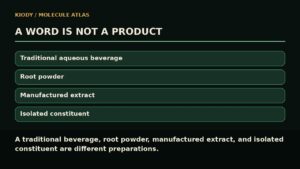
The short answer: kavain is a naturally occurring kavalactone found in Piper methysticum, the plant commonly called kava. It is one molecule within a chemically variable botanical—not a synonym for kava, “total kavalactones,” a traditional aqueous beverage or a concentrated extract. Laboratory research shows that isolated kavain can positively modulate several GABAA receptor subtypes in an experimental system, but it did not use the classical benzodiazepine binding site. A small human study measured kavain after one standardized kava product; it did not test purified kavain as a treatment or establish a universal effect.
The most accurate way to read the evidence is to keep five things separate: the root or rhizome used to make kava, the preparation method, the finished product’s full constituent profile, purified kavain in a laboratory assay, and kavain measured in human plasma. Moving a conclusion from one category to another creates more certainty than the research supports.
Kavain is one constituent of kava, not kava itself
Kava is the common name for Piper methysticum G.Forst., a plant in the pepper family. Kiody’s introductory kava guide explains botanical identity, plant parts, formats and label terminology. Kavain is one lipophilic alpha-pyrone constituent found in the underground material used for kava preparations.
Researchers commonly focus on six principal kavalactones: kavain, dihydrokavain, methysticin, dihydromethysticin, yangonin and desmethoxyyangonin. An FDA scientific memorandum published in 2020 summarized literature indicating that these six account for most of the kavalactone fraction, while additional minor kavalactones have also been identified. That chemical family is only part of the botanical matrix; kava products can also contain flavokavains and other constituents, with amounts affected by cultivar, plant part and processing. Read the FDA scientific memorandum.
| Material or system | Question it can answer | What it cannot establish alone |
|---|---|---|
| Authenticated root or rhizome | Whether kavain occurs in a defined botanical sample and at what measured level | A universal amount for every cultivar, harvest or plant part |
| Traditional-style aqueous preparation | What moved into or remained suspended in that beverage under stated preparation conditions | Equivalence to the starting powder, another recipe or an extract |
| Standardized capsule or extract | The measured kavain and other constituents in that specific product | The chemistry of ordinary root material or every commercial product |
| Purified kavain | Compound-specific structure, receptor, enzyme or metabolism findings | The combined activity or safety of a multi-constituent kava preparation |
| Human plasma after a kava product | Absorption and disposition under that study’s conditions | Which constituent caused a subjective or clinical outcome |
What is kavain chemically?
NIH’s PubChem record lists (+)-kavain with the molecular formula C14H14O3. It belongs to the kavalactone, or kavapyrone, family. Its ring system, unsaturation and aromatic substituent help distinguish it from the other principal kavalactones. View the PubChem record for (+)-kavain.
The sign in “(+)-kavain” refers to optical rotation, not a grade, potency score or positive health outcome. Three-dimensional arrangement matters because biological targets are themselves three-dimensional. A test that does not identify the reference standard or distinguish stereochemical forms may be inadequate for a highly specific claim.
Kavain is relatively lipophilic and has low water solubility. That does not mean an aqueous kava drink contains no kavain. A traditional-style beverage is not necessarily a clear solution; it can carry fine plant particles, droplets and suspended material. Grinding, kneading, straining, water composition, time and temperature can all affect what reaches the cup. For that reason, “water extraction” should not be interpreted as a fixed chemical recipe.
Where kavain appears in kava products
Kavain has been measured in root powders, aqueous suspensions, capsules, tinctures and concentrated preparations. Its absolute amount and its proportion relative to other kavalactones vary. A label that states only “kava” or “total kavalactones” does not reveal the kavain result unless a lot-specific report defines the sample, method, unit and individual analytes.
Mamallapalli and colleagues developed a UPLC–MS/MS method for six kavalactones and two flavokavains, then applied it to 28 products including capsules, tinctures, traditional aqueous suspensions and dried powders. The samples differed substantially in total and relative composition. For some products, the measured kavalactone abundance differed markedly from the label statement. This bounded sample does not show that every kava product is mislabeled, but it demonstrates why format and lot-specific analysis matter. The authors reported no conflict of interest, and NIH funding supported the work. Read Mamallapalli et al., 2022.
A number without a denominator is especially easy to misread. Percent of dry botanical material, milligrams per gram of extract, milligrams per capsule and percent of “total kavalactones” answer different questions. The amount of kavain relative to other kavalactones is not the same as the total quantity present.
What a kava chemotype code does—and does not—mean
Kava literature often assigns the six principal kavalactones digits: desmethoxyyangonin is 1, dihydrokavain 2, yangonin 3, kavain 4, dihydromethysticin 5 and methysticin 6. A chemotype such as 426531 orders those compounds from relatively most abundant to least abundant in the tested material. Kavain is represented by the digit 4.
A chemotype is a relative ranking, not an absolute measurement. Two samples can share the same ordering but contain different total amounts. It also does not prove cultivar identity, geographic origin, “noble” status, safety, effect or quality. Those claims require separate evidence. A defensible chemotype needs a defined sample, adequate analytical separation and a transparent method.
How laboratories identify and measure kavain
High-performance or ultra-performance liquid chromatography can separate kavain from other constituents before ultraviolet or mass-spectrometric detection. A quantitative result should be calibrated against an appropriate reference standard. Method validation should address selectivity, accuracy, precision, linearity, recovery, stability and reporting limits for the relevant matrix.
Matrix matters. Root powder, a cloudy aqueous suspension, an alcohol extract, a capsule and plasma each create different analytical challenges. A method validated for plasma is not automatically suitable for root powder, and a total-kavalactone method does not necessarily identify each molecule. Good reports state the sample type, lot, preparation, extraction procedure, instrument method, result, unit, reference standard and limit of quantification.
“Not detected” means that the laboratory did not detect kavain above the stated boundary in that sample using that method. It does not prove absolute chemical absence. Likewise, a chromatographic peak at a plausible retention time is stronger when supported by a reference standard and appropriate mass-spectral or ultraviolet criteria.
What GABAA receptor research actually found
Chua and colleagues tested purified kavain against recombinant human GABAA receptor subtypes expressed in Xenopus frog oocytes. Using two-electrode voltage clamp recordings, they found that kavain positively modulated the response to GABA across the tested receptor combinations. The pattern was not identical across conditions: the researchers observed greater enhancement in their comparison of an alpha4-beta2-delta receptor with an alpha1-beta2-gamma2L receptor.
At one tested alpha1-beta2-gamma2L condition, kavain alone produced negligible direct activation compared with a maximal GABA response. That distinction matters. The experiment described positive allosteric modulation—changing the response to GABA under the assay conditions—not kavain simply acting as GABA.
The study used recombinant human receptor subunits, but the receptors were expressed in frog oocytes, not tested in human participants. Cell membrane composition, receptor density, exposure concentration and recording conditions all influence the result. It is therefore a mechanistic laboratory study, not proof of a clinical effect from root, a drink, an extract or isolated kavain. The article was published June 22, 2016; the authors reported that their funders had no role in the work and declared no competing interests. Read Chua et al., 2016.
| Study | Design and material | Main contribution | Key limitation |
|---|---|---|---|
| Chua et al., 2016 | Purified kavain; recombinant human GABAA receptors in frog oocytes | Positive modulation across tested subtypes; flumazenil-insensitive mechanism | Mechanistic assay, not a human clinical study or whole-kava test |
| Côté et al., 2004 | Specific aqueous preparation and commercial organic-solvent extracts; in-vitro CYP assays | Preparation-specific composition and enzyme-inhibition differences | Small product set; laboratory inhibition does not establish a clinical interaction |
| Zou et al., 2005 | Kavain metabolism experiments plus urine from two people after root powder in water | Evidence for a reactive intermediate pathway and a urinary conjugate | Pathway detection does not show that kavain caused liver injury |
| Kanumuri et al., 2022 | Ten healthy volunteers; one standardized multi-kavalactone capsule product | Direct human pharmacokinetic profiles for five measurable kavalactones | No purified-kavain arm, long-term exposure or rare-event assessment |
Kavain is not a benzodiazepine
Because both benzodiazepines and kavain can be discussed in relation to GABAA receptors, online summaries sometimes collapse them into one category. The 2016 receptor study directly argues against that shortcut. Flumazenil, an antagonist at the classical benzodiazepine site, did not block kavain’s modulatory effect in the reported experiments. The researchers concluded that kavain did not enhance the receptors through the classical benzodiazepine binding site.
That does not mean the compounds can be considered safely interchangeable or combined. Sharing a broad receptor family does not establish equal binding sites, potency, pharmacokinetics, clinical effects, dependence potential or interaction risk. NCCIH advises against using kava with substances that have sedative effects, including benzodiazepines or alcohol. Review NCCIH’s kava safety overview, updated April 2025.
What the ten-person human pharmacokinetic study showed
Kanumuri and colleagues studied ten healthy volunteers after oral administration of a standardized kava capsule product. The product was reported as free of flavokavains A and B, allowing the investigators to focus on kavalactone disposition while still studying a mixture rather than purified kavain. Plasma samples were analyzed for six principal kavalactones; five were measurable for pharmacokinetic evaluation.
Across the measurable compounds, median times to the observed peak concentration were generally within one to three hours under the study conditions. Overall exposure was highest for dihydrokavain, followed by dihydromethysticin, kavain, methysticin and yangonin. That ranking belonged to one standardized product and one protocol. It does not create a universal rank for root, beverages, powders or other extracts.
The study is important because it provides direct human data rather than extrapolating solely from cells or animals. It is also preliminary: ten participants, one product, short observation, no purified-kavain comparison and no design for long-term safety, rare liver injury, efficacy or population-wide differences. Pharmacokinetic measurements show when and how much of a compound appeared in plasma; they do not identify a medical benefit or prove that kavain caused a participant’s subjective experience. Read Kanumuri et al., 2022.
Absorption is not the same as effect
Finding kavain in plasma establishes systemic exposure under the study conditions. It does not, by itself, show receptor occupancy in the brain, a particular effect, impairment or safety. The relationship among product composition, absorption, free concentration, metabolism and response remains incompletely mapped.
The other kavalactones in the same product also appeared on different timelines and at different exposures. That makes it inappropriate to attribute the overall response to kavain alone. A whole preparation can contain compounds that interact at multiple targets or alter one another’s absorption and metabolism.
What is known about kavain metabolism?
Metabolism converts a parent molecule into other compounds, sometimes through several steps. Zou and colleagues investigated kavain bioactivation and proposed a pathway involving an electrophilic quinone-methide intermediate commonly abbreviated 6-PHO. In laboratory systems, the intermediate could react with glutathione, a cellular nucleophile involved in detoxification.
The researchers also detected a corresponding urinary mercapturic-acid conjugate in two people after they consumed kava root powder mixed with water. That observation supports the existence of the pathway in humans. It does not show how often the pathway occurs, quantify its contribution to ordinary exposure, or prove that it causes liver injury. Two participants cannot establish incidence or susceptibility across a population. Read Zou et al., 2005.
Reactive-metabolite research is useful for generating safety hypotheses. It must be interpreted together with actual exposure, competing metabolic pathways, glutathione availability, product composition, genetics, co-exposures and clinical evidence. A plausible mechanism is not the same as a demonstrated causal chain.
Preparation changes both chemistry and enzyme findings
Côté and colleagues compared a specific aqueous kava preparation with commercial extracts prepared using acetone, ethanol or methanol and with caplet products. They reported differences in the ratios of major kavalactones. In laboratory assays using major cytochrome P450 enzymes, inhibition was more pronounced for the commercial preparations than for the aqueous preparation they tested.
This study is valuable because it shows why “kava” is too broad a material description for mechanistic claims. It does not prove that every water preparation has the same profile or that every extract has the same interaction potential. The experiment assessed enzyme inhibition in vitro, not medication outcomes in a controlled human interaction trial. Read Côté et al., 2004.
For a person taking medication, a product-level interaction question cannot be answered from kavain alone. The full preparation, the concentrations achieved, other kavalactones, non-kavalactone constituents, the companion medicine and individual metabolism all matter. A qualified clinician or pharmacist should evaluate medication questions.
See two product-specific human kava probe studies compared without treating their preparations, enzymes, or endpoints as interchangeable.
Kavain and liver-injury evidence: what can be said responsibly
NCCIH states that various kava products have been linked to rare cases of liver injury, including serious and fatal cases. Early reports involved medicinal or supplement products extracted with alcohol or acetone, while other reports involved water-prepared beverages. Proposed contributors include cultivar or plant-part selection, alcohol, contamination or adulteration, genetic susceptibility, and the amount or duration of use.
That evidence does not establish kavain as the sole culprit. Kava products are multi-constituent and composition varies. Many reports do not preserve and analytically characterize the exact consumed product well enough to isolate one molecule. Conversely, uncertainty about mechanism is not proof of zero risk. The responsible conclusion is that product identity, preparation, co-exposures and individual susceptibility matter, while compound-specific causation remains unresolved.
The 2020 FDA memorandum reviewed published kava safety literature and identified substantial uncertainties in product identity, composition and human exposure. It should not be read as a finding that any individual kavalactone is universally safe or responsible for every reported event.
Kavain compared with the other principal kavalactones
| Compound | Chemotype digit | Structural distinction | Evidence caution |
|---|---|---|---|
| Desmethoxyyangonin | 1 | Unsaturated lactone without the aromatic methoxy group found in yangonin | Its relative rank does not predict a personal effect |
| Dihydrokavain | 2 | Saturated analog of kavain | Human exposure findings cannot be assigned to kavain |
| Yangonin | 3 | Unsaturated, methoxylated kavalactone | Receptor findings from isolated yangonin do not describe a whole preparation |
| Kavain | 4 | Unsaturated alpha-pyrone with a phenyl substituent | Purified-compound GABAA assays are not clinical proof |
| Dihydromethysticin | 5 | Saturated methylenedioxy-substituted kavalactone | Its metabolism and exposure profile differ from kavain |
| Methysticin | 6 | Unsaturated methylenedioxy-substituted kavalactone | A total-kavalactone number cannot show its individual amount |
These structural descriptions help explain why one result cannot automatically be transferred to the other five. “Kavalactones” is a family name, not a statement that every member has the same targets, potency, metabolism or human pharmacokinetics.
Claim check: common kavain statements versus the evidence
| Claim | Best available evidence | What the evidence does not establish |
|---|---|---|
| “Kavain is kava.” | Kavain is one kavalactone within a variable, multi-constituent botanical and its preparations. | That an isolated-compound result describes root, a beverage or an extract. |
| “Kavain works like a benzodiazepine.” | It positively modulated tested GABAA receptors, but flumazenil did not block the effect. | Classical benzodiazepine-site action, clinical equivalence or safe substitution. |
| “A kavain-rich chemotype is stronger.” | A chemotype ranks relative abundance; digit 4 represents kavain. | Total amount, potency, safety or a predictable personal experience. |
| “Water cannot contain kavain.” | Traditional-style beverages can carry dissolved and suspended constituents, including kavalactones. | A fixed extraction efficiency for every preparation. |
| “Human research proves kavain is safe.” | A ten-person study measured short-term pharmacokinetics after one standardized product. | Long-term safety, rare-event risk, clinical efficacy or isolate safety. |
| “Kavain is proven to cause kava liver injury.” | A reactive-metabolite pathway is biologically plausible, and kava products have been linked to rare liver injury. | That kavain alone caused a particular case or explains all cases. |
| “All kava extracts have the same interaction risk.” | Preparation-specific studies found different constituent ratios and in-vitro CYP inhibition. | A universal rule for every water preparation, powder, capsule or extract. |
Why laboratory concentrations cannot become serving advice
Receptor experiments are designed to test a mechanism under controlled conditions. The concentration bathing an engineered cell or frog oocyte is not a serving size and should not be converted into one. Such a conversion would ignore absorption, protein binding, metabolism, distribution, multiple constituents and the difference between local assay concentration and a person’s exposure.
Likewise, the studied capsule protocol belongs to that clinical experiment. Reporting its design helps readers evaluate the evidence; it should not be repurposed as individualized guidance. This article intentionally avoids dosage recommendations and does not turn preclinical exposure into human instructions.
What the evidence still needs
- Validated mapping of kavain across authenticated cultivars, plant parts, harvest stages and locations.
- Matched studies following the same botanical material through drying, storage and traditional-style preparation.
- Interlaboratory comparisons using authenticated standards and clearly defined matrices.
- Larger human pharmacokinetic studies using several fully characterized root preparations and extract formats.
- Direct comparison of purified kavain with matched multi-kavalactone preparations, designed to separate compound from matrix effects.
- Human studies connecting measured product chemistry and plasma exposure with validated performance and safety outcomes.
- Mechanistic work that quantifies kavain metabolites and tests whether proposed reactive pathways occur at relevant human exposures.
- Well-characterized interaction studies rather than predictions from a single enzyme assay.
- Case investigations that retain and analyze the exact consumed product before assigning compound-specific causation.
Frequently asked questions
Is kavain naturally present in kava root?
Yes. Kavain is one of the principal kavalactones measured in Piper methysticum underground material and products made from it. Its absolute and relative amount varies with the botanical material and preparation.
Is kavain the same as total kavalactones?
No. Total kavalactones is an aggregate measurement or label claim covering a defined group. Kavain is one individual compound. A total alone does not reveal the kavain result.
What number represents kavain in a chemotype?
Kavain is digit 4 in the commonly used six-kavalactone chemotype code. The order ranks relative abundance; it does not state the total amount or predict an effect.
Does kavain bind to the benzodiazepine site?
The 2016 recombinant-receptor study found that flumazenil did not block kavain’s modulation, indicating that the reported effect did not use the classical benzodiazepine binding site. That does not make combination use safe.
Has kavain been studied in people?
Kavain has been measured in human plasma after a standardized multi-kavalactone product in a ten-person pharmacokinetic study. This was not a trial of purified kavain and did not establish long-term safety or efficacy.
Does kavain cause liver injury?
A kavain reactive-metabolite pathway has been reported, but that does not prove kavain alone caused a particular liver-injury case. Kava cases involve heterogeneous products, and many lack the retained-product analysis needed for compound-specific attribution.
Is an aqueous kava drink chemically identical to an extract?
No. Preparation changes the constituent profile and exposure. Aqueous beverages can contain suspended material, while extracts use different processes and can concentrate selected constituents.
How should a kavain result on a COA be read?
Match the report to the lot, identify the sample matrix and method, confirm the unit and denominator, and review the reporting limits and other measured kavalactones. A kavain number should not be interpreted as a potency or safety score.
Sources and further reading
- NIH PubChem: (+)-Kavain compound record.
- Chua HC, et al. Kavain and recombinant human GABAA receptors. PLOS ONE. Published June 22, 2016.
- Kanumuri SRR, et al. Clinical pharmacokinetics of kavalactones after a standardized kava product. 2022.
- Mamallapalli J, et al. UPLC–MS/MS characterization of 28 kava products. Planta Medica. 2022.
- Côté CS, et al. Composition and biological activity of traditional and commercial kava extracts. 2004.
- Zou L, et al. Kavain bioactivation and glutathione-related metabolism. 2005.
- National Center for Complementary and Integrative Health. Kava: usefulness and safety. Updated April 2025.
- U.S. Food and Drug Administration. Review of published literature pertaining to the safety of kava for use in conventional foods. August 11, 2020.
For broader botanical identity, format and label context, start with What Is Kava? and continue through the Kiody Learning Center.