Methysticin is one of the six principal kavalactones used to describe the chemistry of kava. It occurs within a variable botanical mixture, has been measured in human plasma after a standardized multi-kavalactone extract, and has been tested separately in receptor-binding and enzyme experiments. Those evidence streams are informative—but they do not make isolated methysticin equivalent to kava root, a traditional beverage or every commercial extract.
This guide keeps those research objects separate. It examines methysticin’s structure, chemotype number, occurrence, human exposure, GABA-A binding, CYP1A1 induction, CYP2C9 inactivation, analytical testing and major evidence gaps. It also explains why laboratory mechanisms cannot be converted into clinical promises.
This article is educational, nonmedical and intended for adults 21 and older. It contains no serving instructions and does not advise anyone to start, stop or replace a medicine.
The central evidence boundary: methysticin has compound-specific laboratory evidence and was quantifiable after people received one standardized kava extract. No controlled human study identified here administered purified methysticin to establish its independent clinical effects, safety or interaction magnitude.
Methysticin in one minute
- Methysticin is a naturally occurring kavalactone in Piper methysticum, not a synonym for whole kava.
- Its chemotype number is 6; the position of 6 in a chemotype code shows relative rank, not a percentage.
- It is the unsaturated structural counterpart of dihydromethysticin and contains a methylenedioxyphenyl group.
- A ten-person pharmacokinetic study measured methysticin after one standardized multi-kavalactone extract; purified methysticin was not administered.
- A radioligand assay found that genuine (+)-methysticin enhanced a GABA-A-related binding signal, but the experiment was not a human outcome study.
- Cell work identified methysticin as a strong CYP1A1 inducer through an aryl hydrocarbon receptor-dependent pathway.
- Human-liver microsome research found time- and NADPH-dependent CYP2C9 inactivation, which raises an interaction question but does not quantify clinical risk.
- Kava-associated liver reports do not establish methysticin as the sole cause; unresolved causation is also not proof of universal safety.
What is methysticin?
Methysticin is a lipophilic alpha-pyrone compound found in kava root and rhizome. Its molecular formula is C15H14O5, and its molecular mass is about 274.27 g/mol. The structure combines a lactone ring with a 1,3-benzodioxole, often described as a methylenedioxyphenyl group. That group matters because it distinguishes methysticin and dihydromethysticin from the other four principal kavalactones and can participate in enzyme-related chemistry.
The naturally relevant stereochemical form should be specified in isolated-compound work. Older publications may use “kavapyrone” or “kavapyrone enantiomer,” while modern literature more often uses “kavalactone.” Neither term means the tested molecule represents the complete botanical.
Methysticin is one of the six kavalactones commonly used for kava chemotype codes. The group also includes desmethoxyyangonin, dihydrokavain, yangonin, kavain and dihydromethysticin. Membership in this principal group does not mean all six occur at the same concentration or contribute equally to every experimental result.
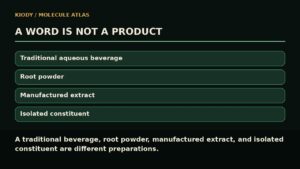
Kava root, beverage, extract and isolated methysticin are different
| Research object | What it contains | What its evidence supports | What it cannot establish |
|---|---|---|---|
| Authenticated kava root or rhizome | A cultivar-, age- and plant-part-dependent botanical mixture | Chemistry of the sampled material | Composition of every kava product |
| Traditional aqueous beverage | Water-extracted compounds from a defined preparation | Results for that beverage and context | Results for an organic-solvent extract or purified molecule |
| Standardized extract | Multiple kavalactones in a manufacturer-specific ratio | Exposure and outcomes for the tested extract | Methysticin’s independent effects |
| Purified methysticin | One chemically and stereochemically defined compound | Compound-specific assay or animal findings | Clinical effects of whole kava |
| Analytical standard | Reference material with documented identity and purity | Retention, calibration and quantitative confirmation | Safety or biological activity of a consumer product |
This separation prevents two opposite errors. A plasma methysticin measurement after a mixed extract does not prove that methysticin caused the extract’s effects. A purified-methysticin cell result does not describe the net pharmacology or safety of traditional kava.
For mixture-level context, read Kiody’s kava kavalactones and chemotypes guide. Closely related compounds are covered in the kavain guide and dihydrokavain guide.
Methysticin vs dihydromethysticin
Methysticin and dihydromethysticin share the methylenedioxyphenyl feature, but methysticin contains a 7,8 double bond that is saturated in dihydromethysticin. The two-hydrogen difference changes molecular mass, chromatographic behavior and metabolic possibilities. They need separate analytical standards and should never be treated as interchangeable names.
| Compound | Chemotype number | Structural feature | Evidence distinction |
|---|---|---|---|
| Methysticin | 6 | Unsaturated lactone side chain plus methylenedioxyphenyl group | GABA-A binding, CYP1A1 induction and CYP2C9 inactivation assays |
| Dihydromethysticin | 5 | Saturated counterpart of methysticin | Separate human exposure and enzyme profile |
| Kavain | 4 | Unsaturated; lacks methylenedioxyphenyl group | Human recombinant GABA-A functional data exist |
| Dihydrokavain | 2 | Saturated; lacks methylenedioxyphenyl group | Highest exposure in one ten-person mixed-extract study |
| Yangonin | 3 | Aromatic methoxy group | Distinct cannabinoid-receptor and MAO assay literature |
| Desmethoxyyangonin | 1 | No aromatic methoxy substituent | Distinct enzyme and absorption findings |
The 2011 CYP1A1 study illustrates why structure matters. Methysticin and dihydromethysticin were the strongest inducers among the six compounds tested, and the authors investigated the shared methylenedioxyphenyl group as a plausible contributor. That finding still belongs to the cell systems and concentrations used; it is not proof that the pair has identical effects in people.
What does chemotype number 6 mean?
Kava chemotype codes rank six principal kavalactones in decreasing order of measured abundance. Methysticin is represented by 6. A code beginning with 6 means methysticin ranked first among those six in that sample; a 6 later in the code means it ranked lower.
A chemotype is not a percentage, dose or prediction of a person’s experience. Two samples can share a six-digit code while differing in total kavalactone content, absolute methysticin amount, minor constituents, flavokavains and contaminants. A code also cannot authenticate plant part or prove that a finished extract matches its starting root.
Effect labels attached to chemotypes are usually broader than the evidence. Compound rankings are valuable for botanical and quality-control work, but controlled human outcome studies stratified by authenticated quantitative chemotype remain limited.
How much methysticin occurs in kava?
There is no single percentage. Kavalactone profiles change with cultivar, plant part, plant age, growing conditions, post-harvest handling and extraction. A University of Hawaii study compared root and rhizome from two named varieties and found all six principal kavalactones in the prepared beverages, while solvent choice changed extraction efficiency.
That experiment is useful because it held several variables in view: two cultivars, root versus rhizome, a defined aqueous preparation and five subsequent analytical solvents. It cannot provide a market-wide abundance range. Product surveys likewise show that powders, beverages, tinctures and capsules may have very different individual-kavalactone profiles.
A label claiming “30% kavalactones” reports a total, not the methysticin share. A batch-specific methysticin value requires a validated separation method, a traceable standard, clear units and a defined basis such as mass per mass or mass per volume.
Primary source: Wang et al., 2015, kavalactone content and extraction efficiency.
What the human pharmacokinetic study found
Kanumuri and colleagues enrolled ten healthy volunteers and administered capsules containing one standardized, flavokavain A/B-free kava extract. A validated UPLC–MS/MS method measured the six principal kavalactones and two flavokavains in plasma after single and divided oral schedules.
Methysticin was one of five kavalactones that were consistently quantifiable. Systemic exposure in that product ranked below dihydrokavain, dihydromethysticin and kavain but above yangonin. Five compounds reached their maximum measured concentrations within roughly one to three hours. Food reduced the extent of absorption during the multiple-administration portion.
The study demonstrates human exposure to methysticin from that mixed extract. It does not determine the pharmacokinetics of purified methysticin because the administered material contained several kavalactones, and the amount and formulation of each constituent affected the observed curve. It also did not compare a traditional aqueous beverage, diagnose a condition or isolate methysticin’s contribution to any subjective response.
The study reported NIH support through NCCIH, NIGMS and NCATS grants. Its ten-person sample and single product limit generalization, but it remains an important human disposition study. Primary source: Kanumuri et al., 2022.
Study design determines what a methysticin result means
| Study | Design | Tested material | What it supports | What remains unresolved |
|---|---|---|---|---|
| Boonen & Häberlein, 1998 | Radioreceptor binding assay | Genuine kavalactone enantiomers including (+)-methysticin | Enhancement of a GABA-A-related ligand-binding signal | Human receptor occupancy, functional subtype effects and clinical outcomes |
| Shaik et al., 2009 | Biochemical and cell-based screening | Purified kava constituents | NF-kappaB inhibition under experimental conditions | Disease prevention or treatment in humans |
| Li et al., 2011 | Cell, enzyme, reporter and docking experiments | Kava extract and six isolated kavalactones | AhR-dependent CYP1A1 induction, strongest for methysticin | Magnitude and consequences at typical human exposure |
| Zhang et al., 2022 | Human-liver microsomes and mechanistic enzyme experiments | Purified methysticin | Time- and NADPH-dependent CYP2C9 inactivation | Clinical interaction size and patient-specific risk |
| Kanumuri et al., 2022 | Oral pharmacokinetics in ten healthy adults | One standardized multi-kavalactone extract | Human plasma exposure for that formulation | Purified-methysticin PK, efficacy and long-term safety |
A receptor-binding result, cell signal, microsomal enzyme result and human plasma curve answer different questions. They become misleading when presented as a single clinical proof chain. The strongest direct human conclusion is that methysticin reached measurable plasma concentrations after one standardized mixed extract.
What does the GABA-A binding study show?
Boonen and Häberlein used radioreceptor assays to examine genuine kavalactone enantiomers. (+)-Methysticin enhanced specific binding of a radiolabeled GABA-A-site ligand, with maximal enhancement reported within the concentration range tested. Kavain, dihydromethysticin, dihydrokavain and yangonin also produced signals of varying magnitude.
This was a binding-modulation experiment, not a complete functional electrophysiology study and not a trial in people. It does not establish which human receptor subtypes are engaged at real-world unbound concentrations, whether methysticin binds the classical benzodiazepine site, or whether it produces the same downstream effects as a benzodiazepine.
The accurate conclusion is narrow: purified (+)-methysticin changed a GABA-A-related ligand-binding signal in that experimental preparation. Later functional receptor research focused on kavain, reinforcing that its findings cannot automatically be assigned to methysticin.
Primary source: Boonen and Häberlein, 1998.
Methysticin is not a benzodiazepine
Methysticin and benzodiazepines differ in structure, regulatory status, receptor evidence, pharmacokinetics and clinical data. A shared connection to a GABA-A assay does not make them equivalent in potency, impairment, dependence potential, withdrawal, overdose behavior or therapeutic effect.
Whole kava products may cause drowsiness or dizziness, and the current NCCIH guidance advises against combining kava with other substances that have sedative effects, including alcohol or benzodiazepines. That precaution applies at the product level and does not prove that isolated methysticin acts through a benzodiazepine mechanism.
Descriptions such as “natural Xanax” collapse a botanical mixture, a single constituent and a regulated prescription drug into one unsupported claim. Mechanistic comparison is useful only when the exact molecule, target, assay and evidence level remain attached.
What does CYP1A1 induction mean?
CYP1A1 is an enzyme involved in processing several endogenous and environmental chemicals. Its induction can change chemical metabolism, but the biological consequence depends on the substrate: increased enzyme activity can contribute to detoxification in one setting and bioactivation in another.
Li and colleagues compared kava extract with six isolated kavalactones. Methysticin produced the strongest CYP1A1 induction, followed by dihydromethysticin; the other four did not show comparable effects in the tested system. An aryl hydrocarbon receptor antagonist blocked the response, and cells lacking functional AhR did not show the induction. Reporter assays and docking supported an AhR-dependent mechanism.
The study used cultured cells, enzyme measurements and modeled binding—not oral human exposure. Its concentrations cannot be treated as consumer thresholds, and CYP1A1 induction is not automatically evidence of harm or benefit. The work identifies a biologically plausible interaction pathway requiring exposure-aware confirmation.
The authors were affiliated with the FDA’s National Center for Toxicological Research. Primary source: Li et al., 2011.
What does CYP2C9 inactivation mean?
CYP2C9 helps metabolize a variety of medicines. In 2022, Zhang and colleagues incubated purified methysticin with human liver microsomes and used diclofenac as a probe substrate. Inhibition increased with time and concentration and required NADPH, a pattern consistent with metabolism-dependent inactivation rather than only reversible competition.
The authors reported about 85% loss of CYP2C9 activity at 50 micromolar after a 30-minute preincubation. Mechanistic trapping experiments implicated methysticin-derived carbene and ortho-quinone intermediates, while CYP1A2, CYP2C9 and CYP3A4 contributed to bioactivation.
This is important mechanistic toxicology, but it is not a clinical interaction trial. The clinical question depends on whether unbound methysticin or its intermediates reach relevant intestinal or hepatic concentrations, how long exposure persists, which medicine is involved and the person’s enzyme activity. The laboratory concentration is not a serving limit.
Primary source: Zhang et al., 2022.
Why CYP1A1 induction and CYP2C9 inhibition are not contradictory
“Induction” and “inhibition” can sound mutually exclusive, but they concern different enzymes and mechanisms. The CYP1A1 work examined increased expression and activity through AhR signaling. The CYP2C9 study examined loss of catalytic activity after methysticin bioactivation. One compound can affect separate enzymes in different directions.
The findings also occurred in different experimental systems. Neither proves that a mixed kava beverage will reproduce the same magnitude in a living person. Whole-product human probe studies have not uniformly matched isolated-compound predictions, which is why in-vitro results are treated as hypotheses or risk signals rather than guaranteed clinical outcomes.
Kiody’s comparison of two human kava enzyme-probe studies keeps the tested products, enzymes, endpoints, and study durations separate. Neither result establishes that methysticin alone caused the observed finding.
People taking medicines—especially those with narrow therapeutic ranges—should discuss kava with a clinician or pharmacist. That precaution reflects uncertainty and product variability; it is not individualized medical advice or a claim that every combination causes an interaction.
NF-kappaB research: what it does and does not prove
NF-kappaB is a transcription factor involved in inflammation, cellular stress and cancer biology. Shaik and colleagues screened kava constituents and identified methysticin as a potent inhibitor of NF-kappaB activation in their experimental systems, with relatively low toxicity under the conditions tested.
The study generated a mechanistic hypothesis about kava’s activity in preclinical models. It did not demonstrate that methysticin prevents cancer, treats inflammation or improves a clinical outcome in people. A biochemical target can be scientifically interesting without becoming a health claim.
Concentration, cell type, exposure time, metabolism and off-target effects all influence translation. Human trials would need a defined formulation, measured exposure, appropriate endpoints and safety monitoring before a clinical conclusion could be made.
Primary source: Shaik et al., 2009.
How methysticin is metabolized
Methysticin’s methylenedioxyphenyl group can undergo oxidative transformation. The CYP2C9 inactivation study detected evidence consistent with an ortho-quinone intermediate trapped by glutathione and a carbene-related pathway. Those experiments were designed to explain enzyme inactivation, not to provide a complete human mass-balance map.
Mixture-level urine and plasma studies complicate precursor assignment because several structurally related kavalactones are present together, and multiple oxidation, reduction, demethylation and conjugation pathways may operate. Detecting a metabolite after kava does not necessarily reveal which single constituent produced it without isotope labeling or a purified-compound design.
A definitive human methysticin metabolism study would administer a chemically and stereochemically defined tracer under controlled conditions, quantify parent and metabolites over time, and report urine and fecal recovery. No such complete isolated-methysticin human study was identified for this review.
How laboratories measure methysticin
Kava contains several related lactones with overlapping ultraviolet spectra. Credible measurement therefore begins with chromatographic separation—such as HPLC, UHPLC or gas chromatography—followed by ultraviolet, flame-ionization or mass-spectrometric detection. Tandem or high-resolution mass spectrometry adds structural confidence, while isotope-labeled internal standards can improve quantitative accuracy across complex matrices.
The University of Hawaii beverage study used GC-FID with individual reference standards and reported detection limits. Other methods can separate the six principal kavalactones plus flavokavains in a single run. Human pharmacokinetic work used validated UPLC–MS/MS to distinguish low plasma concentrations from background and neighboring compounds.
A certificate of analysis should identify the batch, matrix, plant part or extract, analytical method, reference standards, units and individual-kavalactone results. “Total kavalactones” alone cannot establish methysticin content. “Not detected” means below a method-specific limit, not absolute chemical zero.
Methysticin and kava liver evidence
Published liver-injury reports generally concern kava products rather than analytically authenticated isolated methysticin. Product identity, cultivar, plant part, extraction, co-exposures and retained-sample testing are often incomplete. Those reports cannot establish that methysticin alone caused every case.
The opposite absolute is also unsupported. Compound-specific CYP findings, product variability and incomplete causation data prevent a universal no-risk claim. The current NCCIH page states that various kava products have been linked to rare but sometimes severe liver injury, including reports involving both solvent extracts and some water-prepared beverages.
The scientifically careful position is that constituent-level causation remains unresolved. Methysticin’s laboratory enzyme behavior is relevant to mechanism research, but a mechanistic signal is neither proof that it caused a reported injury nor proof that the signal is clinically irrelevant.
Current official source: NCCIH, Kava: Usefulness and Safety.
What the evidence does and does not show
| Claim | Evidence-based reading |
|---|---|
| “Methysticin is kava’s active ingredient.” | Too simple. It is one constituent in a variable botanical mixture with multiple bioactive compounds. |
| “Methysticin and dihydromethysticin are the same.” | Incorrect. They differ by saturation of the 7,8 bond and require separate standards and interpretation. |
| “Human research proves isolated methysticin works.” | Unsupported. Human plasma evidence came from a multi-kavalactone extract, not purified methysticin. |
| “Methysticin is a natural benzodiazepine.” | Unsupported. A radioligand-binding signal does not establish benzodiazepine-site action or clinical equivalence. |
| “CYP1A1 induction means methysticin is carcinogenic.” | Overstated. The cell pathway may alter chemical bioactivation or detoxification depending on context; human consequences were not measured. |
| “CYP2C9 inactivation proves a drug interaction.” | Not by itself. It is a mechanistic risk signal requiring exposure-aware clinical confirmation. |
| “Methysticin prevents cancer.” | Unsupported. NF-kappaB findings are preclinical and do not demonstrate prevention or treatment in humans. |
| “Methysticin caused kava-associated liver reports.” | Not established by generic product reports that do not isolate constituent-level causation. |
Important evidence gaps
- Controlled human pharmacokinetics of purified, stereochemically defined methysticin.
- Human receptor occupancy and functional GABA-A subtype studies at measured exposure.
- Clinical interaction trials designed around CYP2C9 substrates and quantified methysticin exposure.
- Human confirmation of CYP1A1 induction after authenticated products with known chemotypes.
- Isotope-traced human mass-balance and metabolite studies.
- Direct comparison of traditional aqueous preparations and standardized extracts with matched methysticin content.
- Controlled human outcomes stratified by quantitative methysticin exposure.
- Long-duration safety data tied to cultivar, plant part, preparation and complete composition.
These gaps do not prove inactivity or danger. They show where current evidence stops and where isolated-compound, extract and whole-botanical claims must remain separate.
Frequently asked questions
Is methysticin the same as kava?
No. Methysticin is one kavalactone within kava. Root material and beverages contain multiple kavalactones and other constituents in variable proportions.
What number is methysticin in a kava chemotype?
Methysticin is number 6. Its position in the code shows relative abundance among six principal kavalactones, not its percentage or a serving amount.
Is methysticin the same as dihydromethysticin?
No. Dihydromethysticin is the saturated counterpart of methysticin. The compounds have different molecular masses, chromatographic behavior and evidence records.
Does methysticin have human pharmacokinetic evidence?
It has human exposure evidence from ten healthy volunteers who received one standardized multi-kavalactone extract. That study did not administer isolated methysticin.
Does methysticin act at GABA-A receptors?
Purified (+)-methysticin enhanced a GABA-A-related ligand-binding signal in a radioreceptor assay. The result does not establish human receptor occupancy, clinical benefit or benzodiazepine equivalence.
Does methysticin interact with CYP enzymes?
Laboratory studies found AhR-dependent CYP1A1 induction and metabolism-dependent CYP2C9 inactivation. The clinical magnitude at actual human exposures has not been established.
Is methysticin responsible for kava liver injury?
Generic kava reports generally do not establish isolated-methysticin causation. Incomplete product identity and co-exposure data limit attribution, while the uncertainty does not prove universal safety.
What should a methysticin certificate of analysis include?
It should identify the batch and matrix, validated analytical method, methysticin result with clear units, reference standard and detection or quantification limits. Total kavalactones alone are insufficient.
Bottom line
Methysticin is a principal kavalactone with a distinctive methylenedioxyphenyl structure and several compound-specific laboratory signals. It enhanced a GABA-A-related binding measure, induced CYP1A1 through AhR in cell systems, inactivated CYP2C9 in human-liver microsomes and reached measurable plasma concentrations after one standardized kava extract.
Those findings make methysticin scientifically important, not clinically settled. Human participants received a mixture, enzyme experiments were conducted outside a living person, and no controlled purified-methysticin human outcome study was identified. Keeping root, beverage, extract and isolated-compound evidence separate is the most accurate way to understand what is known—and what remains unknown.