When you find research about kava, kratom or kanna, start with a simple question: what kind of evidence am I looking at? A document about a possible production method answers a different question from a study of a particular preparation or a record for a particular retail product.
Read the patent section, not just its title
The USPTO explains that a patent’s claims define the scope of its protection. The written description provides context about the invention and how to make and use it. Read those sections separately. A sentence describing an optional approach should not automatically be presented as an issued claim. [1]
Three grants with the same kavalactone-and-flavokavain synthesis title illustrate why this matters. These are short summaries of selected claim-1 steps:
- US10941429B2: reacting a specified precursor with malonyl-CoA using a specified enzyme, then isolating the resulting compound. [2]
- US11746364B2: alkylation, a chemical modification using specified enzymes and S-adenosylmethionine. [3]
- US11739354B2: reduction, another chemical modification using a specified enzyme. [4]
The original claims contain chemical formulas and other requirements omitted from these summaries. This is a reading guide, not a determination of legal coverage.
Keep an experiment attached to its conditions
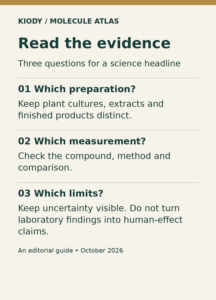
An example inside a patent should be identified as an inventor-reported example. A laboratory finding belongs with its test material, preparation, method and measured outcome. Before carrying that finding into another setting, check what evidence supports the move.
Our editorial approach applies the same questions to botanical and pharmaceutical sources. We identify the material, explain the experiment and preserve uncertainty. The source’s origin does not replace an assessment of its evidence.
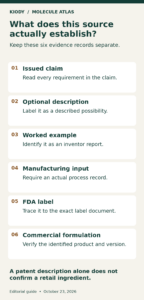
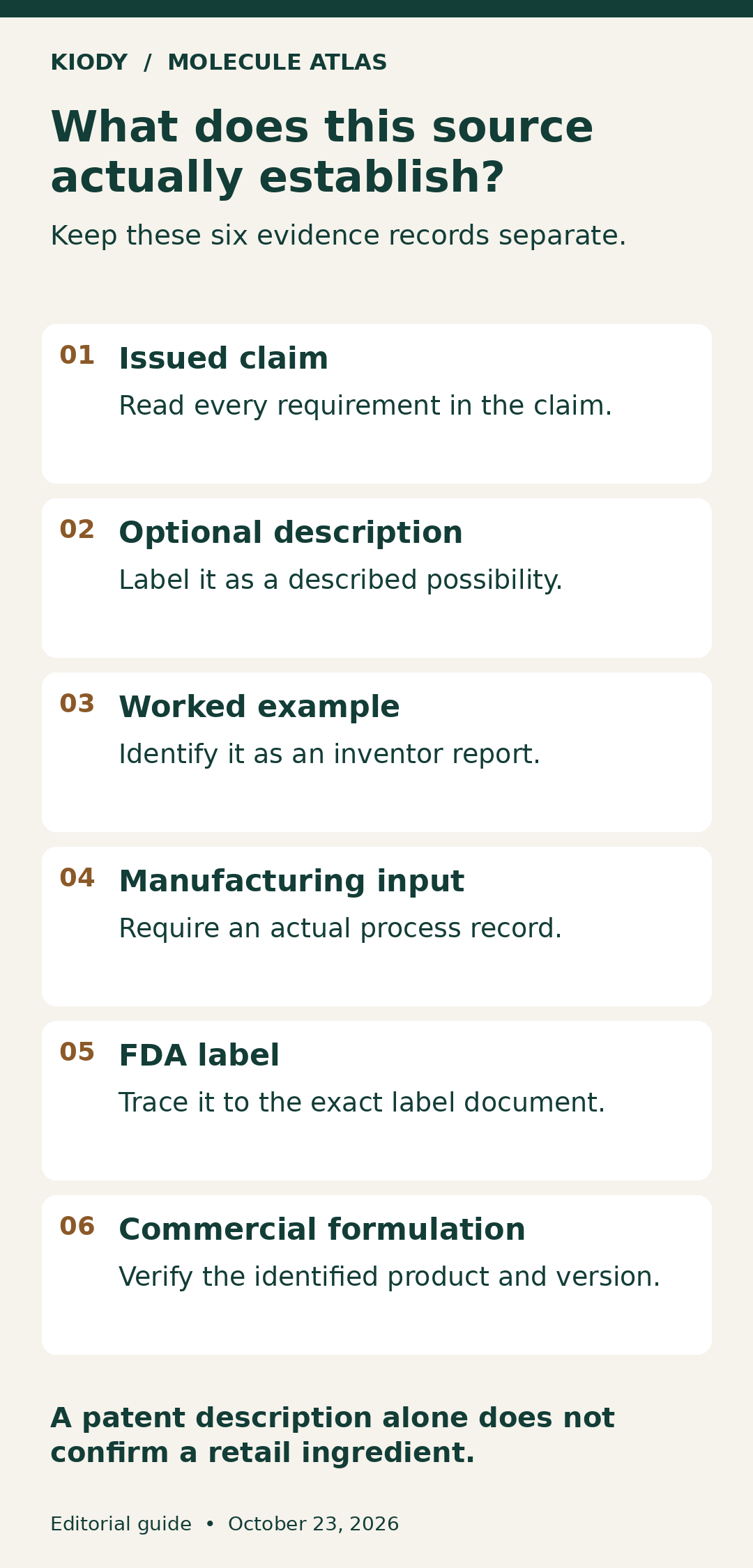
Keep six kinds of records separate
- Issued claim: the particular claimed invention, read with all its requirements.
- Optional description: an approach described in the patent text.
- Worked example: an experiment reported by the inventors.
- Manufacturing input: a material documented as used in an actual process.
- FDA-labeled ingredient: an entry traced to the exact FDA label document being discussed.
- Confirmed commercial formulation: ingredients supported by records for the identified product and relevant version or lot.
A reagent mentioned in a proposed reaction should stay in that context. To describe a retail ingredient or manufacturing method, seek product-specific documentation. These patent summaries do not establish how a Kiody product is made or what it contains.
What this guide establishes
This guide explains how the Atlas labels evidence. It does not compare human effects or establish treatment, equivalence or safety conclusions. Readers should be able to follow each scientific statement to its source and see where the evidence stops.
Sources
[1] USPTO, Applying for Patents: https://www.uspto.gov/patents/basics/apply
[2] US10941429B2, claim 1: https://patents.google.com/patent/US10941429B2/en
[3] US11746364B2, claim 1: https://patents.google.com/patent/US11746364B2/en
[4] US11739354B2, claim 1: https://patents.google.com/patent/US11739354B2/en
Reviewed October 23, 2026. Educational content for adults 21+.