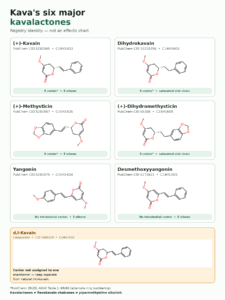
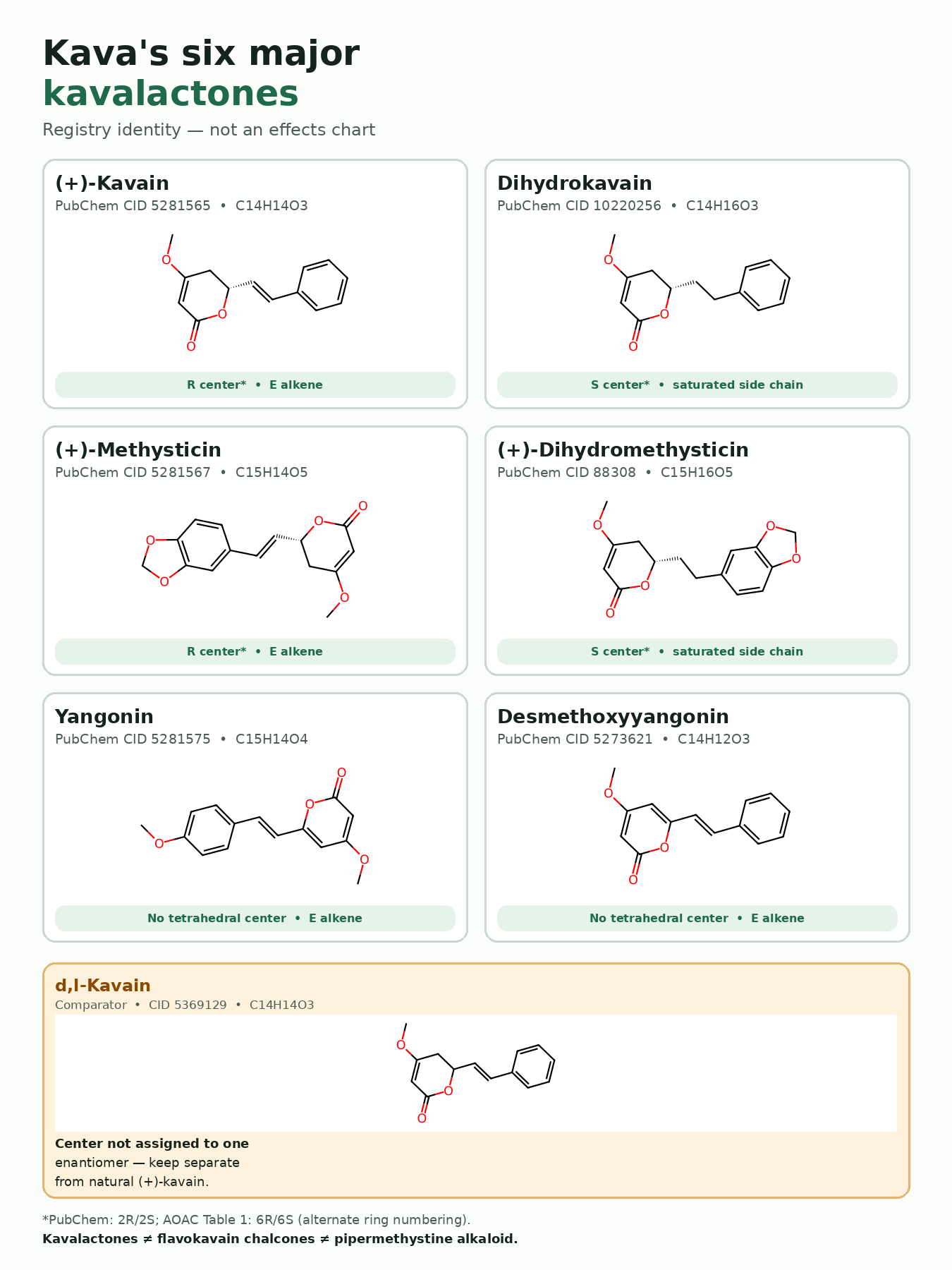
Kava chemistry is often summarized with six names: kavain, dihydrokavain, methysticin, dihydromethysticin, yangonin, and desmethoxyyangonin. Those are the six major kavalactones named in AOAC SMPR 2018.005, an analytical standard for identifying and measuring kava constituents.
But a name or molecular formula does not always provide a complete chemical identity. Some of these molecules can exist in different three-dimensional forms. Others contain a double bond whose geometry matters. A careful structure record therefore keeps several identity layers separate.
Plate note: The registry structures above keep d,l-kavain separate from natural (+)-kavain. A structure identifies a molecule; it does not establish the purity, composition, or effects of a particular kava product.
What R and S mean
The letters R and S describe the absolute configuration at a stereogenic center. In plain language, they distinguish two possible three-dimensional arrangements around a center even when the atoms and bonds are otherwise connected in the same order.
IUPAC defines absolute configuration as the spatial arrangement of a chiral molecular entity together with a stereochemical description such as R or S. The assignment follows the Cahn–Ingold–Prelog priority rules; it is not a potency grade, quality score, or direction of optical rotation.
In the verified natural-reference records used for the Molecule Atlas, (+)-kavain and (+)-methysticin have an R center, while dihydrokavain and dihydromethysticin have an S center. That R-to-S label change should not be read as proof that the natural center “flipped.” Saturating a nearby side chain can change the priority order used to assign the letter, even when the center’s spatial relationship is retained.
What the plus sign means
The (+) sign reports dextrorotatory optical rotation under specified measurement conditions. It is an experimental property, not another way of writing R.
There is no general rule that makes every R compound rotate light in the positive direction or every S compound rotate it in the negative direction. For that reason, the Atlas stores optical-rotation notation and R/S configuration in separate fields.
This distinction matters for kavain. AOAC lists natural-reference (R)-(+)-kavain separately from d,l-kavain. The older d,l notation is discouraged by IUPAC; in this context it indicates the racemic comparator, conventionally written (±)-kavain, rather than one specified enantiomer.
Natural (+)-kavain and the racemic comparator share the same molecular formula and basic atom-to-atom connectivity. They do not have the same complete stereochemical identity. The corresponding PubChem records therefore have different stereochemistry layers in their InChIKeys: natural (+)-kavain is CID 5281565, while d,l-kavain is CID 5369129.
What E means
The letter E describes geometry around a double bond. IUPAC uses E and Z for stereoisomeric alkenes after assigning priority to the groups attached to each end of the double bond. E identifies the arrangement in which the higher-priority groups are on opposite sides of the reference plane; Z identifies the same-side arrangement.
This is a different kind of stereochemical information from R/S. A molecule may have both a tetrahedral center and an E double bond, one of those features, or neither.
- (+)-Kavain and (+)-methysticin have one defined tetrahedral center and an E alkene.
- Dihydrokavain and dihydromethysticin retain a defined tetrahedral center, but their corresponding side chain is saturated rather than an E/Z alkene.
- Yangonin and desmethoxyyangonin have no tetrahedral stereocenter in the cited records, but each has defined E-alkene geometry.
Calling yangonin or desmethoxyyangonin “non-stereochemical” would therefore be too broad. The more accurate description is: no tetrahedral stereocenter; defined E-alkene geometry.
Why formulas and ordinary names can be insufficient
A molecular formula counts atoms. It does not, by itself, show how they are connected or arranged in space. A connectivity-only line notation can distinguish constitutional isomers but may still omit an enantiomer or an alkene geometry.
For a stereochemistry-sensitive Atlas record, the minimum identity anchor is therefore:
- the compound name as used by the source;
- the registry record, such as a PubChem CID;
- a stereochemistry-preserving identifier, such as the full InChIKey or isomeric SMILES; and
- the preparation actually studied—natural material, extract, isolated enantiomer, racemate, or another manufactured form.
That last step prevents a result for a laboratory racemate from being silently rewritten as a result for natural (+)-kavain. It also prevents a registry structure from being treated as proof of what is present in a beverage, root powder, extract, finished product, or analytical sample.
Keep the chemical classes separate
The six molecules shown here are kavalactones, also called kavapyrones in older literature. They should not be merged with two other kava constituent classes:
- Flavokavains A, B, and C are chalcones.
- Pipermethystine is a piperidine alkaloid.
AOAC’s standard lists kavalactones and flavokavains as separate analyte groups. A study or assay result for one class does not automatically describe another.
The practical reading rule
When a kava paper, label, patent, or database says only “kavain,” ask what identity layer is actually documented. Does the source specify natural (+)-kavain, an R/S configuration, a racemate, a structure, or only a common name? Does it preserve E/Z geometry? What preparation was tested?
Those questions do not make the chemistry unnecessarily complicated. They keep a molecular identity claim no broader than its evidence.
Sources
- AOAC INTERNATIONAL. SMPR 2018.005, Determination of Kavalactones and/or Flavokavains from Kava (Piper methysticum). AOAC PDF.
- IUPAC Gold Book: absolute configuration.
- IUPAC Gold Book: R, S.
- IUPAC Gold Book: E, Z.
- IUPAC Gold Book: optical activity.
- IUPAC Gold Book: d, l, dl.
- PubChem records: CID 5281565; CID 10220256; CID 5281567; CID 88308; CID 5281575; CID 5273621; CID 5369129.
- Boonen G, Häberlein H. Influence of Genuine Kavapyrone Enantiomers on the GABA-A Binding Site. Planta Med. 1998;64(6):504–506.
Educational chemistry reference only. This article does not evaluate treatment, efficacy, product purity, product equivalence, or guaranteed safety.