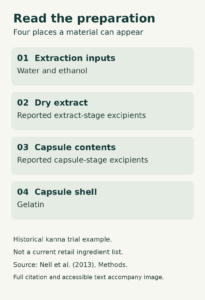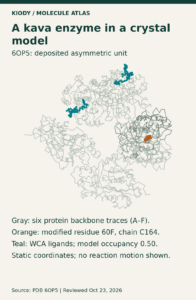
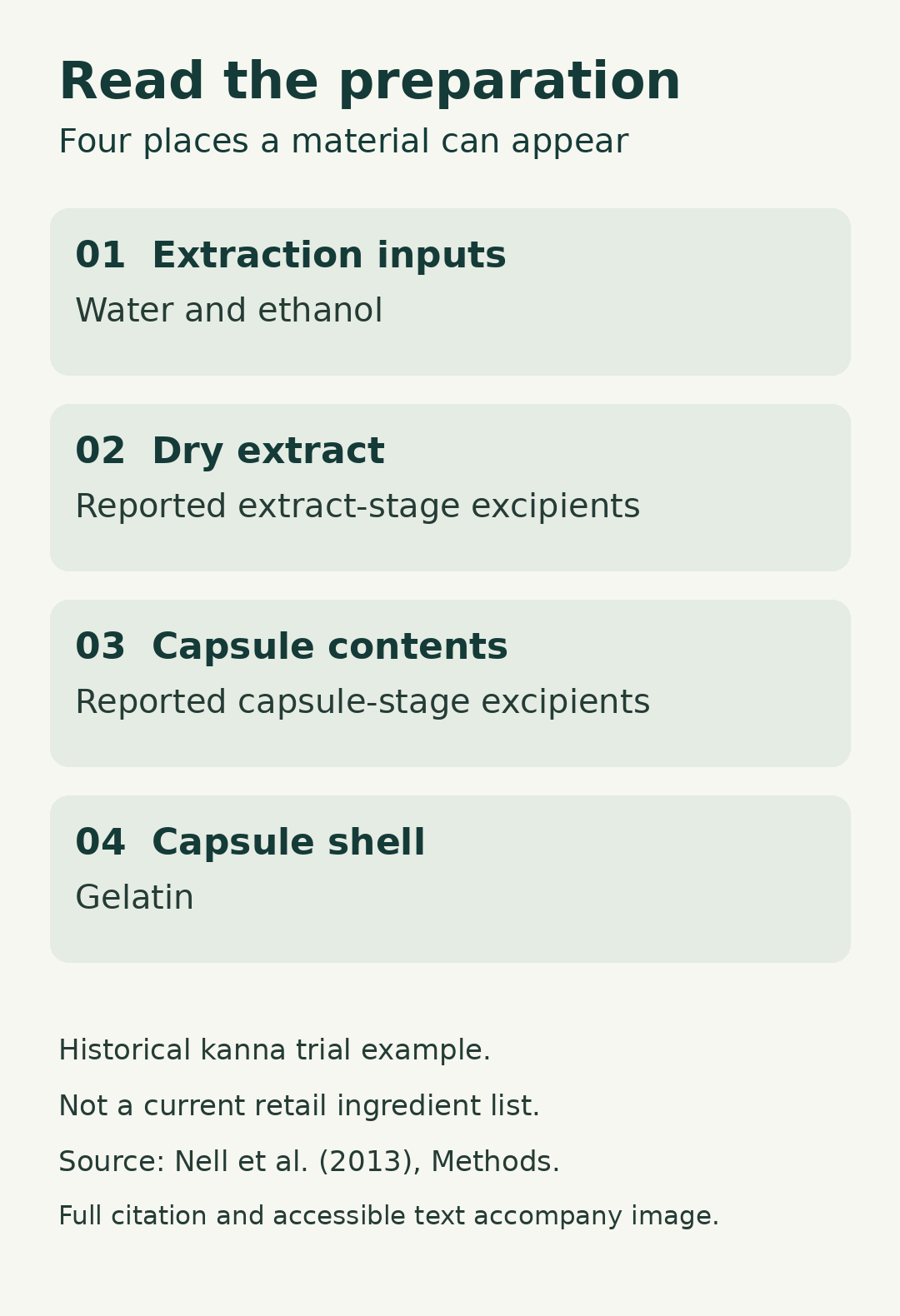
An ingredient name needs context. When reading botanical research, ask where the material appears: during extraction, in the dry extract, in the capsule contents, or in the shell. Those are different parts of the preparation.
Watch: four places a material can appear
Accessible transcript
00–06 seconds: Read the preparation. Where does each material appear? A historical kanna study example.
06–12 seconds: Extraction inputs. The paper describes water and ethanol for extraction. This does not give residual solvent in the capsule.
12–18 seconds: Dry extract. The paper separately reports extract-stage excipients. Keep each material attached to its reported stage.
18–24 seconds: Capsule contents. Capsule-stage excipients are another part of the description. Do not invent quantities that were not reported.
24–30 seconds: Capsule shell. The historical study describes a gelatin shell. A study preparation is not a current retail label.
30–36 seconds: Keep the source attached. Check the exact preparation, date and source. This example does not establish Kiody product ingredients.
Source: Nell et al. (2013), investigational-product section. Accessible primary-paper copy, early pagination pages 2–3.
A historical kanna example
The investigational-product section of a 2013 Zembrin study describes a specific manufactured kanna extract and capsule preparation. It is not a description of ordinary kanna plant material, isolated mesembrine-type alkaloids, every kanna extract, or products sold today. Read Nell and colleagues’ original study.
What the study placed at each stage
- Extraction inputs: purified water and ethanol were reported as the extraction-solvent system.
- Dry-extract stage: the paper reported lactose monohydrate and colloidal anhydrous silica as excipients used with the spray-dried extract.
- Capsule contents: lactose monohydrate, sodium starch glycolate and magnesium stearate were reported as capsule-stage excipients used to reach the final capsule weight.
- Capsule shell: the paper described a size 1 hard-shell gelatin capsule.
These are source-reported roles for the identified historical investigational product. The extraction-solvent description does not by itself measure residual solvent in the final capsule.
Four questions to keep the evidence clear
- Which stage? Keep extraction inputs separate from materials reported in the dosage form.
- Which measurement? A solvent mixture description does not tell you the measured residual solvent in a finished capsule.
- Which preparation? Record the study material and its date before comparing it with another product.
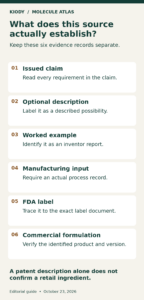
- Which source? A study methods section, a patent example and a current product label answer different questions.
This distinction does not rate an ingredient as beneficial or harmful. It helps prevent a manufacturing description from becoming an unsupported product claim. The historical kanna example also does not establish the composition of Kiody products.
Sources
Nell et al., first published online February 26, 2013; investigational-product section: publisher record.
Accessible primary-paper copy, pages 2–3 (publicly rehosted early-pagination copy).
Reviewed October 23, 2026. Educational content for adults 21+.