Last reviewed September 15, 2026. Educational content for adults 21+. This article is not medical advice and does not recommend a dose or use. Kiody does not sell concentrated 7-hydroxymitragynine (7-OH) products.
The short answer: speciociliatine is a naturally occurring monoterpene indole alkaloid in Mitragyna speciosa leaf. It has the same molecular formula and atom-to-atom connectivity as mitragynine, but one stereocenter points in a different three-dimensional direction. That makes the two molecules diastereomers rather than interchangeable names for the same chemical.
Speciociliatine is especially instructive because its research does not collapse into a simple slogan. Different receptor platforms have described it as an agonist, partial agonist or weak antagonist at the mu-opioid receptor. Human studies show that it can become a prominent circulating alkaloid after a characterized kratom preparation, yet those studies do not isolate its effects. Laboratory metabolism studies also show pronounced species differences. The accurate conclusion is that speciociliatine matters scientifically, while its compound-specific effects and risks in people remain incompletely defined.
Speciociliatine is one constituent of botanical kratom leaf
Kratom refers to the leaves of Mitragyna speciosa (Korth.) Havil., the accepted botanical name recorded by Kew’s Plants of the World Online. The leaf contains a variable mixture of indole and oxindole alkaloids. Mitragynine is commonly the most abundant quantified alkaloid; speciociliatine, paynantheine and speciogynine are among the other repeatedly measured constituents.
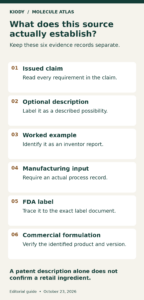
A purified-speciociliatine experiment answers a compound-level question. It does not recreate whole leaf, a tea, an extract or a person’s finished product. Likewise, a human study of multi-alkaloid leaf can measure speciociliatine exposure but cannot attribute an effect to that one molecule unless the design isolates it. Keeping those evidence categories separate is the foundation of this guide.
| Test material or system | Question it can address | What it cannot establish alone |
|---|---|---|
| Authenticated leaf | Whether speciociliatine occurs in a defined plant sample and at what measured concentration | A universal percentage for every tree, season or harvest |
| Commercial whole-leaf powder | The alkaloid fingerprint of the submitted lot | Consistency across all vendors, bags or dates |
| Tea or other preparation | Which constituents transferred under the study’s preparation conditions | Equivalence to the starting powder or another preparation |
| Broad-spectrum extract | Composition after a specified extraction process | Equivalent exposure from the same mass of ordinary leaf |
| Purified speciociliatine | Compound-specific receptor, enzyme, metabolism or animal findings | The combined behavior of botanical leaf |
| Human plasma or urine | Absorption, disposition, accumulation or metabolite detection under defined conditions | Which alkaloid caused a subjective or clinical outcome |
| Concentrated 7-OH or another derivative | The properties of a different molecule and product category | Speciociliatine’s effects, concentration or legal status |
Chemistry: the same formula does not mean the same molecule
NIH’s PubChem record lists speciociliatine as C23H30N2O4, the same molecular formula as mitragynine. The difference lies in three-dimensional configuration. Speciociliatine is the C-3 epimer of mitragynine: the spatial orientation at one stereocenter is inverted while the rest of the molecular connectivity remains the same. View the NIH PubChem record.
That apparently small change can alter how a molecule fits into a receptor, partitions between blood and tissues, binds proteins and is recognized by metabolic enzymes. The six-person human pharmacokinetic study grouped speciociliatine with the 3R alkaloids, alongside mitraciliatine and isopaynantheine. Their plasma profiles differed as a group from the 3S alkaloids mitragynine, speciogynine and paynantheine.
Stereochemistry also creates an analytical problem. Diastereomers can share molecular mass and many tandem-mass-spectrometry transitions. A method that sees the right ion but does not adequately separate retention times can combine or misidentify related alkaloids. Confident identification therefore requires a suitable reference standard, adequate chromatography and defined confirmation criteria.
How much speciociliatine is in leaf?
There is no defensible percentage that applies to every natural leaf. Genetics, location, season, leaf age, plant part, withering, drying, storage, extraction and the analytical method can all influence the result. The unit and denominator matter as much as the number: percent of dry leaf, percent of total alkaloids, milligrams per gram and percent of an alkaloid-rich extract are not interchangeable.
A validated 2019 UPLC–MS/MS method measured ten alkaloids across a deliberately mixed set of alkaloid-rich fractions, ethanolic extracts, lyophilized teas and commercial products. The published speciociliatine values spanned a broad range, but the set included concentrated materials. Its highest result therefore cannot be advertised as a normal-leaf concentration. The durable lesson is methodological: every reported percentage needs a clearly identified matrix and denominator. Read Sharma et al., 2019.
A 2022 study of authenticated plants and retail materials also found multiple chemotypes rather than one fixed alkaloid recipe. It supports the reality of compositional variation but was not a random worldwide crop census. Read Manwill et al., 2022. A label color or variety name is not a substitute for a lot-specific result from an adequately resolved method.
What the 341-product U.S. analysis adds
Sharma and colleagues analyzed 341 participant-supplied samples from 330 people enrolled in a 357-person ecological momentary assessment. The samples were primarily whole-leaf products rather than extracts. Ten alkaloids were quantified, and speciociliatine was among the more abundant compounds across the sampled materials. The chromatographic–mass-spectrometry profiles were broadly similar to the expected fingerprint of Mitragyna speciosa leaf, and the analytical screen did not detect the illicit or prescription drugs included in its panel. Read Sharma et al., 2025.
This is supportive evidence that many participant-used U.S. whole-leaf products shared recognizable botanical chemistry. It does not certify every retail lot, prove complete contaminant absence or establish that all leaf products are interchangeable. Participants submitted products they were already using; investigators did not randomly purchase a representative sample of the entire market.
The work was supported by the NIH National Institute on Drug Abuse. Kirsten Smith disclosed paid scientific-advisory work for two botanical organizations; Smith and Christopher McCurdy disclosed expert-witness work in kratom cases; and Erin Berthold disclosed a natural-products consulting company. Those disclosures should be read with the sampling design, analytical controls and reproducibility rather than used as a substitute for evaluating the study.
How laboratories separate speciociliatine from related alkaloids
Targeted liquid chromatography coupled to tandem mass spectrometry is a common quantitative approach. Chromatography separates compounds in time; the mass spectrometer then measures selected precursor and product ions. Because speciociliatine and mitragynine have identical nominal mass and related fragmentation, retention-time resolution and authentic reference standards are essential.
Flores-Bocanegra and colleagues used nuclear magnetic resonance, high-resolution mass spectrometry and related techniques to update structural assignments for numerous kratom alkaloids. Their work illustrates why reference-quality structural characterization must precede routine targeted quantification. Read Flores-Bocanegra et al., 2020.
A 2025 LC–MS/MS paper validated measurement of 11 kratom alkaloids and important metabolites in human plasma. Applied to plasma from a controlled multiple-administration study of a kratom extract, the method found quantifiable speciociliatine and documented accumulation across the 15-day study period. That is a bioanalytical and pharmacokinetic observation involving a defined extract—not a statement about ordinary leaf use or compound-specific effects. Read Sempio et al., 2025.
A 2026 University of Florida-led method expanded the plasma panel to 12 parent alkaloids and five metabolites and applied it to samples from four regular kratom users in a clinical protocol. The method is valuable for future mixture-aware studies, but four application samples cannot define population pharmacokinetics. Read Kanumuri et al., 2026. Kiody’s full-panel COA checklist explains lot matching, units and reporting limits.
The receptor literature really did disagree
Speciociliatine has not received one stable receptor label across the literature. Early and later experiments used different receptor species, cell backgrounds, receptor densities, reference ligands and signaling endpoints. Some described weak antagonist behavior; a 2020 study described partial mu-opioid-receptor agonism; a 2021 study reported full agonism in its human-receptor cAMP platform; and a broader 2026 comparison classified it as a partial agonist at the human mu receptor with weaker activity at the human kappa receptor.
These labels are not interchangeable. Binding affinity asks how strongly a ligand competes for a site. Potency asks what concentration produces a specified response in that assay. Efficacy asks how large the response becomes relative to the reference agonist. Antagonism asks whether the compound blocks another ligand’s response. Changing the receptor reserve or readout can change the apparent classification without changing the molecule.
| Study | Tested material and platform | Reported interpretation | Evidence boundary |
|---|---|---|---|
| Kruegel et al., 2016 | Purified alkaloids in receptor-binding and signaling systems | Weak antagonist behavior in the reported mu-receptor context | Assay-specific; not human administration |
| Obeng et al., 2020 | Purified alkaloids, human mu-receptor cells and mice | Partial mu agonism and antinociceptive effects in mice | Injected-animal effects do not establish oral human effects |
| Chear et al., 2021 | Purified leaf alkaloids in human opioid-receptor cAMP assays | Full agonist classification at human mu receptors in that platform | Cell efficacy depends on system and reference normalization |
| Hemby et al., 2026 | Purified alkaloids across multiple human-receptor assays | Partial agonism at human mu receptors; weaker human kappa activity | Mechanistic evidence, not a clinical outcome |
What the 2020 pharmacology study found
Obeng and colleagues compared selected purified kratom alkaloids in opioid- and adrenergic-receptor experiments. Speciociliatine bound the human mu-opioid receptor more strongly than mitragynine in that study and behaved as a partial agonist in the reported functional assay. It did not show agonist or antagonist activity at the kappa receptor under that platform’s conditions. Read Obeng et al., 2020.
The researchers also injected speciociliatine into mice and observed antinociceptive activity in a hot-plate test; 7-OH was more potent in the same experiment. Naloxone blocked the response, supporting opioid-receptor mediation in that animal model. This is not evidence that purified speciociliatine treats pain in people. The route bypassed oral absorption and first-pass metabolism, and a reflexive animal test does not reproduce a human clinical outcome.
The study was supported by NIH agencies and reported no conflicts of interest. Its comparison is scientifically useful because the compounds were tested in parallel, but the values should not be converted into a human dose or a whole-leaf potency ranking.
What the 2021 Malaysian-leaf study changed
Chear and colleagues isolated ten indole and oxindole alkaloids from freshly collected Malaysian Mitragyna speciosa leaves, established structures with one- and two-dimensional NMR plus high-resolution mass spectrometry, and examined selected compounds at human opioid receptors. They reported speciociliatine as a full agonist at the human mu receptor in their cAMP assay, with binding affinity and functional potency greater than mitragynine in that system. Read Chear et al., 2021.
“Full agonist” here means that speciociliatine reached a response comparable to the assay’s reference agonist under the experiment’s receptor expression and normalization conditions. It does not mean that the molecule is clinically equivalent to morphine, fentanyl or another drug. It also does not establish respiratory effects, dependence liability, oral bioavailability or the effect of the much smaller amount embedded within leaf.
The paper’s importance is twofold: it connected structurally authenticated Malaysian-leaf alkaloids to human-receptor assays, and it exposed a contradiction with other platforms. That contradiction called for a broader standardized comparison rather than selective citation of whichever number supports a preferred narrative.
What the 2026 human-receptor study clarified—and did not settle
Hemby and colleagues tested a larger panel of purified kratom alkaloids across human mu-, kappa- and delta-opioid receptors using radioligand binding, cAMP inhibition, beta-arrestin-2 recruitment and GTP-gamma-S signaling. In that unified comparison, speciociliatine functioned as a moderate-potency partial agonist at the human mu receptor and a weak-potency partial agonist at the human kappa receptor. Its maximum mu response was about 73% of the reference response in the reported assay. Read Hemby et al., March 17, 2026.
The authors interpreted the partial-agonist result as a reconciliation of earlier full-agonist and antagonist findings, emphasizing assay system, receptor expression and normalization. They also reported minimal beta-arrestin-2 recruitment for many tested alkaloids. Crucially, the paper warned that apparent G-protein bias should not automatically be treated as beneficial: beta-arrestin signaling does not by itself explain opioid adverse effects, and G-protein signaling can contribute to both desired and adverse outcomes.
This is the most internally standardized receptor comparison available for this guide, but it remains cell-level pharmacology. It did not administer speciociliatine to people, measure breathing, establish therapeutic benefit or determine the contribution of speciociliatine within botanical leaf. University and NIH centers supported the work; authors reported no commercial financial relationships, and one disclosed an editorial-board role.
Why beta-arrestin results cannot prove respiratory safety
Beta-arrestin-2 is one pathway measured in opioid-receptor research. Low or absent recruitment in a particular cell system does not mean that a compound cannot depress breathing, cause impairment, contribute to dependence or interact with another substance. Receptor reserve, tissue context, exposure, metabolites and G-protein efficacy all matter.
No controlled human respiratory study of purified speciociliatine was identified for this guide. Findings for isolated mitragynine, 7-OH, mitragynine pseudoindoxyl or a synthetic derivative cannot be assigned to speciociliatine. Likewise, a whole-leaf observation cannot reveal speciociliatine’s independent respiratory contribution.
Preclinical pharmacokinetics show why route and species matter
Berthold and colleagues developed a UPLC–MS/MS method and studied purified speciociliatine in male Sprague–Dawley rats after intravenous and oral administration. The compound showed measurable oral bioavailability, greater dose-normalized systemic exposure and lower clearance than mitragynine and corynantheidine in the rat comparisons. Read Berthold et al., 2021.
Those data help design later experiments; they do not supply a human half-life or safe amount. Intravenous administration bypasses the intestine and first-pass metabolism. Oral rat pharmacokinetics still differ from human exposure because enzymes, plasma binding, tissue distribution and metabolic rates vary between species. Converting these rat doses into kilograms of leaf for a person would create false precision and potentially actionable misinformation.
Human and animal cells metabolize speciociliatine at different rates
Kamble and colleagues compared speciociliatine metabolism in liver microsomes and hepatocytes from humans, dogs, monkeys, rats and mice. In intact hepatocytes, metabolism was much slower in humans and dogs than in monkeys, rats or mice. The reported in-vitro half-life was about 92 minutes in human hepatocytes, more than eight times the rat value. Read Kamble et al., 2022.
Across species, the major pathways were monooxidation and O-demethylation. Reaction-phenotyping experiments indicated that CYP3A4 was the predominant enzyme, with a smaller CYP2D6 contribution. Investigators did not find a human-specific or disproportionately formed metabolite in the human microsomal system. NIH supported the research, and the authors declared no conflicts of interest.
The slow human-cell metabolism is a reason for caution when translating short-lived rodent exposure. It is not proof of a particular human duration, benefit or harm. Cell systems omit absorption, blood flow, kidney handling, active transport, tissue sequestration and the competing constituents present in leaf.
Older urine research mapped a broader metabolite family
Philipp and colleagues first administered purified speciociliatine to rats and used liquid chromatography with ion-trap mass spectrometry to identify phase-I and phase-II metabolites. They then searched for matching retention times and spectra in urine from people who had used kratom preparations. Speciociliatine-related metabolites accounted for previously unidentified isomeric signals in those human samples. Read Philipp et al., 2011.
This was not a controlled human trial of purified speciociliatine. The human urine came after multi-alkaloid kratom use, while the isolate experiment occurred in rats. The paper supports metabolite identification and forensic-marker development; it cannot assign symptoms, outcomes or a universal detection window to speciociliatine.
What the six-person human leaf-tea study showed
Tanna and colleagues administered one characterized dried-leaf kratom product prepared as tea to six healthy adults. Researchers measured six parent alkaloids in plasma across multiple days and obtained complete urine collections from five participants. Speciociliatine reached a higher dose-normalized systemic exposure than mitragynine and remained measurable in the later sampling period. Read Tanna et al., 2022.
The 3R alkaloids—speciociliatine, mitraciliatine and isopaynantheine—showed later observed peak times, higher overall exposure, shorter terminal phases and smaller apparent terminal distribution volumes as a group than the 3S alkaloids mitragynine, speciogynine and paynantheine. Follow-up work examined metabolic stability, protein binding, blood-to-plasma partitioning and physicochemical properties as possible explanations.
This direct human evidence establishes absorption and preliminary disposition from one characterized botanical preparation. It does not show that speciociliatine caused any particular effect. The study included only six healthy adults, one leaf lot, one preparation and one administration. It was not powered for rare events, long-term outcomes, dependence or clinical efficacy. NIH/NCCIH funded the work, and the authors declared no conflicts of interest.
| Observation | Supported conclusion | Unsupported leap |
|---|---|---|
| Speciociliatine appeared in plasma after leaf tea | It was absorbed from that characterized preparation | It caused a particular sensation or health outcome |
| Dose-normalized exposure was comparatively high | Leaf abundance alone does not predict circulating exposure | Speciociliatine is the “strongest” leaf alkaloid |
| 3R and 3S groups showed different profiles | Stereochemistry is relevant to disposition | Every alkaloid within a group behaves identically |
| Repeated extract administration produced accumulation in a later study | Some elimination intervals exceeded the dosing interval in that protocol | A universal buildup rate for ordinary leaf |
| Small controlled cohorts supplied measurable data | Human measurement is feasible | Population-wide safety or rare-risk incidence |
Repeated-administration evidence uses a different product category
The 2025 plasma-method paper analyzed samples from a clinical trial in which participants received capsules containing a controlled kratom leaf extract repeatedly for 15 days. Mitragynine, speciogynine and speciociliatine accumulated in plasma across the protocol. The study improves understanding of repeated exposure, but its extract formulation and scheduled administration must remain visible in any interpretation.
Accumulation is a pharmacokinetic term: concentrations do not completely return to the prior baseline before the next administration. It does not automatically mean toxicity, dependence or clinical benefit. The amount, formulation, interval, enzyme activity, medications and duration determine its significance. The result also cannot be transferred to every whole-leaf pattern or to concentrated/manufactured 7-OH.
Metabolism and interaction questions are related but not identical
CYP3A4 and CYP2D6 help metabolize speciociliatine in laboratory systems. That means inhibitors or inducers of those enzymes could theoretically alter its exposure. It does not prove the size or clinical importance of an interaction in a person. Botanical leaf contains other alkaloids that can themselves inhibit or compete for drug-metabolizing enzymes, so a purified-compound pathway is only one part of mixture-level interaction assessment.
People who use prescription or over-the-counter medicines should disclose kratom use to a qualified clinician or pharmacist, especially when a medicine has a narrow therapeutic range. Kiody’s kratom interactions guide separates controlled human data from microsomal predictions.
Speciociliatine is not 7-OH or mitragynine pseudoindoxyl
Speciociliatine, 7-hydroxymitragynine, mitragynine pseudoindoxyl, MGM-15 and MGM-16 are different molecules. Speciociliatine is a natural stereoisomer present in botanical leaf. 7-OH is an oxidized mitragynine-related compound that can occur at trace levels or form after harvest and through metabolism; concentrated or manufactured 7-OH products alter that relationship. Mitragynine pseudoindoxyl and the MGM compounds have separate structures.
Receptor findings for one molecule cannot establish the potency, respiratory effects, dependence liability or legal status of another. Kiody’s botanical leaf versus concentrated 7-OH guide explains the format boundary.
Current federal documents do not name speciociliatine as 7-OH
The August 26, 2026 HHS notice extended an information-request deadline concerning 7-OH above proposed concentration thresholds. The deadline closed September 10, 2026. The information request did not itself create a final scheduling order, and it did not name speciociliatine. Read the HHS Federal Register notice.
A separate DEA temporary order effective August 26, 2026 placed mitragynine pseudoindoxyl, MGM-15 and MGM-16 in Schedule I. Speciociliatine is not listed as one of those compounds or an alias in the order. This is a dated federal-document summary, not legal advice or a review of every state, county or city. Read the DEA temporary order.
Claim check: what the evidence supports
| Claim | Best available evidence | What remains unproven |
|---|---|---|
| “Speciociliatine is just another name for mitragynine.” | They share a formula but differ at a stereocenter and have different analytical, metabolic and receptor behavior. | Interchangeability in products or research. |
| “It has one fixed percentage in natural leaf.” | Authenticated-plant and product studies show variable multi-alkaloid profiles. | A universal concentration or prediction from a color name. |
| “It is definitely a full opioid agonist.” | One human-receptor assay reported full agonism; other platforms found partial agonism or antagonist behavior. | An assay-independent classification or a defined human opioid effect. |
| “Threefold stronger binding means threefold stronger effects.” | One comparison found higher binding affinity than mitragynine. | A threefold potency, effect or risk difference in people or leaf. |
| “No beta-arrestin signal proves it cannot depress breathing.” | Several platforms reported low or absent beta-arrestin recruitment. | Human respiratory safety or absence of impairment. |
| “Rat half-life tells us how long it lasts in people.” | Rat PK and cross-species cell studies show major species differences. | A universal human duration or detection window. |
| “Human studies prove speciociliatine is safe.” | Small studies measured it after characterized tea or extract protocols. | Long-term safety, rare-event incidence or isolate safety. |
| “Speciociliatine is concentrated 7-OH.” | The compounds are structurally and analytically distinct. | Transfer of 7-OH findings or regulatory treatment. |
Why this guide gives no human lethal-dose calculation
No validated human lethal dose has been established for purified speciociliatine or for speciociliatine within ordinary botanical leaf. Turning an injected mouse or rat exposure into kilograms of human leaf would ignore species, route, bioavailability, enzyme activity, formulation, product variability and co-exposures. It would create false precision and potentially actionable harm from evidence that cannot support the conversion.
Case reports and surveillance records also rarely provide a complete speciociliatine profile or verify whether the material was ordinary leaf, an extract, an enhanced product or concentrated/manufactured 7-OH. Other substances—including fentanyl, other opioids, benzodiazepines, alcohol, stimulants and prescription medicines—may be present. Detection does not by itself prove that speciociliatine, kratom or any single substance caused an outcome. Incomplete data likewise cannot prove zero risk for unaltered leaf.
Research priorities
- Independent mapping of speciociliatine across authenticated genotypes, geography, seasons, leaf ages and plant parts.
- Matched studies following the same leaves through withering, drying, storage and common preparation methods.
- Interlaboratory validation using reference materials and chromatography that resolves speciociliatine from mitragynine and other stereoisomers.
- Larger human pharmacokinetic studies using multiple fully characterized ordinary-leaf lots.
- Direct comparison of leaf tea, leaf powder and defined extracts without treating the formats as equivalent.
- Standardized receptor studies using common receptor expression, reference agonists and multiple signaling endpoints.
- Controlled human research capable of separating compound-specific pharmacodynamics from mixture effects.
- Longitudinal studies pairing verified product chemistry with frequency, medications, co-use and measured outcomes.
Frequently asked questions
Is speciociliatine naturally present in kratom leaf?
Yes. It has been isolated from authenticated Mitragyna speciosa leaves and quantified in leaf products, teas and extracts. Its concentration varies, so a lot-specific measurement is more informative than a claimed universal average.
Is speciociliatine the same as mitragynine?
No. They share the same molecular formula and connectivity but differ in three-dimensional configuration at one stereocenter. That makes them diastereomers with measurably different disposition and receptor behavior.
Is speciociliatine an opioid agonist or antagonist?
The classification has varied across assay systems. A 2026 multi-assay human-receptor study classified it as a partial agonist at the mu receptor and a weaker partial agonist at the kappa receptor. Older platforms reported full agonism or weak antagonist behavior. None of these cell studies alone establishes a human clinical effect.
Does higher binding affinity mean it is more potent than mitragynine?
No. Binding, functional potency, intrinsic efficacy, oral exposure and whole-person effects are different measurements. One study’s higher affinity cannot be converted into a simple multiplier for human effects or leaf potency.
Has speciociliatine been measured in humans?
Yes. It was measured in plasma and urine after a characterized leaf tea in six healthy adults. It was also quantified during a controlled 15-day extract protocol. Those studies measured exposure; they did not isolate speciociliatine’s subjective or clinical effects.
Why can rat findings be misleading?
Human hepatocytes metabolized speciociliatine much more slowly than rat, mouse and monkey hepatocytes in a cross-species laboratory comparison. Species, route and enzyme differences prevent a rat half-life or administered amount from serving as a human instruction.
Can speciociliatine interact with medications?
CYP3A4 and CYP2D6 contribute to its metabolism in laboratory systems, creating a plausible interaction question. The size and clinical importance of any interaction are not established, and whole leaf contains other enzyme-active constituents. A clinician or pharmacist can evaluate a person’s actual medication list.
Is speciociliatine the dangerous or fatal alkaloid in natural leaf?
Available evidence does not support assigning leaf risk to speciociliatine alone. Total composition, metabolites, product format, individual susceptibility, medications, other substances, adulterants and contaminants may matter. There is no validated human lethal amount for speciociliatine, and animal-to-human lethal-dose conversions are not reliable.
Primary evidence trail
- Philipp AA, et al. Metabolism Studies of the Kratom Alkaloid Speciociliatine in Rat and Human Urine. Analytical and Bioanalytical Chemistry. 2011. Purified-compound rat metabolism plus comparison with urine after human kratom use; not a controlled human isolate trial.
- Sharma A, et al. Simultaneous Quantification of Ten Key Kratom Alkaloids. Drug Testing and Analysis. 2019. Validated UPLC–MS/MS across mixed matrices; concentrated fractions do not define ordinary-leaf ranges.
- Obeng S, et al. Investigation of Adrenergic and Opioid Binding Affinities of Selected Kratom Alkaloids. Journal of Medicinal Chemistry. 2020. Purified-compound receptor and mouse evidence; NIH-funded with no conflicts declared.
- Flores-Bocanegra L, et al. The Chemistry of Kratom: Updated Characterization Data and Methods. Journal of Natural Products. 2020. Reference structural chemistry using NMR and mass spectrometry.
- Berthold EC, et al. Preclinical Pharmacokinetic Study of Speciociliatine. Journal of Pharmaceutical and Biomedical Analysis. 2021. Intravenous and oral male-rat pharmacokinetics; not a human dose or duration study.
- Chear NJY, et al. Exploring the Chemistry of Alkaloids from Malaysian Kratom and Human Opioid Receptors. Journal of Natural Products. 2021. Fresh-leaf isolation, structural characterization and human-receptor cell assays.
- Tanna RS, et al. Clinical Pharmacokinetic Assessment of Kratom. Pharmaceutics. March 2022. Six healthy adults and one characterized dried-leaf tea; NIH/NCCIH-funded; no conflicts declared.
- Manwill PK, et al. Kratom Validation: Quantitative Analysis Reveals Chemotypes. Planta Medica. 2022. Authenticated plants and products; not a universal specification.
- Kamble SH, et al. Metabolism of Speciociliatine. AAPS Journal. July 2022. Human and four preclinical species in liver microsomes and hepatocytes; NIH-funded; no conflicts declared.
- Sempio C, et al. Quantification of 11 Kratom Alkaloids and Metabolites in Human Plasma. Analytical and Bioanalytical Chemistry. 2025. Validated human-plasma method applied to repeated controlled extract administration.
- Sharma A, et al. Chemical Analysis and Alkaloid Intake for U.S. Kratom Products. Drug Testing and Analysis. 2025. Ten-alkaloid analysis of 341 primarily whole-leaf samples; NIH-supported with advisory, expert-witness and consulting disclosures.
- Hemby SE, et al. Multifaceted Modulation of Human Opioid Receptors by Kratom Alkaloids. Frontiers in Pharmacology. March 17, 2026. Purified alkaloids across multiple human-receptor assays; university and NIH support.
- Kanumuri SRR, et al. Simultaneous Quantification of Seventeen Kratom Alkaloids and Metabolites in Human Plasma. Pharmaceutical Biology. 2026. Validated plasma method applied to four regular users; analytical evidence, not an effects trial.
- National Institute on Drug Abuse. Kratom research overview. Official background and evidence-gap summary reviewed September 15, 2026.
Editorial boundary: this guide explains evidence; it does not claim that kratom or speciociliatine treats, cures or prevents a condition. It provides no dosing, lethal-dose or overdose instructions. If you take medication, have a health condition, are pregnant or breastfeeding, or experience concerning symptoms, consult a qualified health professional. Do not drive or operate heavy machinery while impaired.