Educational information for adults 21+. This article is not medical advice. Kiody does not sell concentrated 7-OH.
Important safety note
This guide is educational. It cannot diagnose withdrawal, substance
use disorder or any other condition, and it is not a personalized
stopping or tapering plan. Symptoms that appear after reducing a product
can also come from illness, medication changes, another substance or an
unknown ingredient. A qualified healthcare professional can evaluate the
full situation.
Call 911 immediately if someone is difficult to
wake, is not breathing normally, has blue or gray lips, collapses, has a
seizure, develops severe confusion or appears to be in immediate danger.
If opioid exposure is possible and naloxone is available, administer it
according to its directions while emergency help is on the way.
For a suspected poisoning or unexpected reaction in the United
States, call Poison Help at 1-800-222-1222. The service
connects callers to a local poison center. For suicidal thoughts, a
mental-health crisis or overwhelming emotional distress, call or text
988. These resources are not substitutes for emergency
services when a person is unresponsive or having trouble breathing.
Kiody serves adults 21 and older. Kiody does not sell concentrated
7-hydroxymitragynine (7-OH) products. The presence of this guide does
not mean that kratom is FDA-approved to diagnose, treat, cure or prevent
any disease.
The short answer
Tolerance, physical dependence, withdrawal and substance use disorder
are related concepts, but they are not interchangeable.
- Tolerance generally means that a person notices
less effect from the same amount over time or feels tempted to use more
to pursue the prior effect. - Physical dependence means the body has adapted to
repeated exposure and may react when exposure is reduced or
stopped. - Withdrawal describes the signs and symptoms that
can occur after a dependent person reduces or stops a substance. - Substance use disorder is a clinical pattern
involving impaired control, continued use despite harm or other
significant problems. It is not diagnosed merely because a person
reports tolerance or withdrawal.
U.S. government sources recognize that some people who regularly use
kratom report withdrawal symptoms and other features associated with
substance use disorder. At the same time, the evidence does not support
a universal timeline, severity scale or self-directed taper that would
be safe for every person and every product. Risk can be affected by
frequency, duration, amount, product composition, other substances,
medications and individual health factors.
One of the most important distinctions is the product itself.
Ordinary botanical leaf, a concentrated extract, enhanced leaf and a
concentrated 7-OH tablet are not chemically equivalent simply because
all may be marketed with the word “kratom.” Unknown or inaccurate
labeling can make both symptom interpretation and clinical care
harder.
Why the terminology matters
Casual discussions often use “addiction,” “dependence,” “withdrawal”
and “tolerance” as if they mean the same thing. That can create
unnecessary stigma, minimize serious problems or encourage unsafe
advice.
Tolerance
Tolerance is a change in response after repeated exposure. A person
may perceive that the same amount no longer produces the same effect.
Tolerance does not prove that a substance is safe, and increasing an
amount to overcome tolerance can increase exposure to alkaloids,
contaminants or undeclared ingredients.
Tolerance is also not a product-quality test. If one package seems
“weaker” than another, possible explanations include natural botanical
variation, different moisture content, different serving measurement,
storage conditions, a formulation change or laboratory variation.
Escalating use before checking the label and lot information can turn a
quality question into a safety problem.
Physical dependence
Physical dependence reflects adaptation to repeated exposure. It can
occur with many substances and medications, including some that are
appropriately prescribed. Dependence alone is not the same as compulsive
use or a substance use disorder.
That distinction should not be used to dismiss symptoms. A person who
experiences physical dependence may still need clinical guidance,
particularly if they use concentrated products, combine substances, are
pregnant, have a significant medical condition or have previously
experienced severe withdrawal.
Withdrawal
Withdrawal is the cluster of symptoms that may follow a reduction or
discontinuation after repeated use. The National Institute on Drug Abuse
says research suggests that people who use kratom regularly may
experience mild to moderate withdrawal symptoms when they stop, while
also emphasizing the need for more research.
“Mild to moderate” is a population-level summary, not a prediction
for an individual. It does not guarantee that every episode will be
mild, and it does not account for a mislabeled product, concentrated
7-OH, polysubstance exposure, pregnancy, dehydration, a co-occurring
mental-health crisis or withdrawal from another substance.
Substance use disorder
A substance use disorder is not defined by a single symptom. FDA’s
kratom information identifies reported features that can include using
more or longer than intended, craving, continuing despite harm,
tolerance and withdrawal. A clinician assesses the broader pattern, its
duration and its effect on health and daily life.
Someone can have tolerance or physical dependence without meeting
criteria for a substance use disorder. Conversely, someone can have a
serious pattern of harmful use even when they do not recognize or report
withdrawal. Respectful, precise language makes it easier to seek
help.
Intoxication, poisoning and
overdose
These are not synonyms for withdrawal. Sedation, slowed or abnormal
breathing, inability to wake, seizure, collapse or severe confusion may
indicate an acute emergency rather than withdrawal. Do not wait for an
online discussion to identify the exact cause. Call 911.
Start by identifying
the actual product
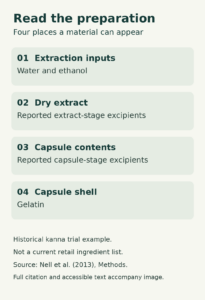
The package format alone does not establish what is inside. A capsule
can contain plain powdered leaf, an extract, enhanced leaf or a
concentrated ingredient. A liquid can be a botanical tea, an extract or
a formulation containing added alkaloids. Product identity should be
established from the ingredient statement, Supplement Facts or other
label panel, serving information, lot code and a matching certificate of
analysis when available.
Ordinary botanical leaf
This category includes dried leaf, powder, traditionally brewed leaf
tea and capsules filled only with powdered botanical leaf. Natural
alkaloid concentrations vary. A pure-leaf capsule is a delivery format,
not an extract.
Kiody’s capsules are approximately 500 milligrams of pure botanical
leaf per capsule. That statement describes fill material and approximate
mass; it is not a claim that every botanical lot has identical alkaloid
composition.
Extracts
An extract is produced by separating and concentrating selected
constituents from botanical material. Labels may describe extract
ratios, percentages, milligrams of alkaloids or standardized content.
These measurements are not interchangeable. “10x,” for example, does not
by itself disclose how much mitragynine or 7-OH is in a serving.
Enhanced leaf
Enhanced leaf is botanical material to which an extract or isolated
constituent has been added. It may look like ordinary powder while
delivering a different alkaloid amount. A color name or
botanical-sounding label does not rule out enhancement.
Concentrated or enhanced
7-OH products
These include tablets, shots, gummies, powders or other products
formulated to deliver elevated or intentionally added 7-OH. FDA
specifically distinguishes such products from the incidental trace 7-OH
that can occur in natural leaf and recommends that consumers avoid 7-OH
products.
Concentrated 7-OH should not be treated as interchangeable with
botanical leaf in discussions of effects, dependence, withdrawal or
legal status. Kiody does not sell concentrated 7-OH.
Manufactured derivatives
Mitragynine pseudoindoxyl (MGPI), MGM-15 and MGM-16 are separate
compounds, not names for ordinary botanical leaf. As of this guide’s
review date, they are temporarily placed in federal Schedule I. A
Department of Justice enforcement-discretion statement concerning only
incidental trace MGPI in an otherwise botanical product is not a legal
exemption, supplies no numerical safe harbor and does not apply to
MGM-15, MGM-16 or intentionally added, manufactured, concentrated or
fortified MGPI.
What withdrawal may feel
like
FDA’s consumer information about 7-OH lists reported withdrawal
effects including restlessness, body aches, fatigue, irritability and
cold sweats. FDA also identifies insomnia, gastrointestinal distress,
anxiety and depression among harms reported with 7-OH products. NIDA’s
broader kratom review says regular users may experience withdrawal when
stopping.
Possible reports discussed in government and clinical literature
include:
- Restlessness or feeling unable to settle
- Irritability, agitation or a pronounced change in mood
- Difficulty sleeping
- Fatigue or low energy
- Muscle or body aches
- Sweating, chills or feeling unusually cold
- Nausea, vomiting, diarrhea or abdominal discomfort
- Runny nose, watery eyes or yawning
- Craving or a strong urge to resume use
- Anxiety, low mood or trouble concentrating
This list is descriptive, not diagnostic. The same symptoms can occur
with flu, foodborne illness, dehydration, anxiety, medication changes,
opioid withdrawal, alcohol withdrawal, sedative withdrawal or exposure
to an undeclared ingredient. Severe symptoms, rapidly worsening symptoms
or an unclear product warrant professional evaluation.
No responsible guide can promise that symptoms will begin at a
particular hour, peak on a particular day or resolve on a fixed
schedule. Products and patterns of use vary too widely. Online timelines
frequently omit the product category, laboratory composition, other
substances, medical history and the difference between a single personal
story and clinical evidence.
Factors that can change risk
No checklist can calculate an individual’s risk, but several factors
can make the situation more complex.
Frequency and duration
Repeated use gives the body more opportunity to adapt. A history
should include how often the product was used, how long the pattern
continued and whether there were breaks—not just the amount used on the
most recent day.
Amount and escalation
An increasing pattern may reflect tolerance, a changing product,
imprecise measurement or an attempt to manage discomfort. “One scoop” is
not a reproducible mass, and “one tablet” says nothing about alkaloid
content unless the label is accurate.
Concentration and
formulation
Extracts, enhanced products and concentrated 7-OH can deliver
different exposures from plain leaf. A clinician needs the exact label
or package, not merely the statement “I used kratom.”
Multiple substances
Alcohol, opioids, benzodiazepines, sedating medicines, stimulants,
cannabis and other products can change the clinical picture. They can
contribute to acute toxicity, create their own withdrawal risks or mask
symptoms.
CDC’s analysis of U.S. poison-center reports from 2015 through 2025
found that reports involving multiple substances had higher proportions
of hospitalization and serious outcomes than single-substance reports.
Among 233 deaths associated with the reports, 79% involved multiple
substances. These data do not prove that kratom caused every outcome,
and poison-center calls are not a population incidence estimate. They do
reinforce why complete disclosure of all substances matters.
Unknown or unreliable
composition
A product may contain more or less of a labeled constituent than
expected, an undeclared ingredient, a contaminant or a manufactured
derivative. A generic brand name, color or flavor does not answer this
question. Retain the package and lot code if an adverse event
occurs.
Health and life
circumstances
Pregnancy, breastfeeding, adolescence, older age, a history of
substance use disorder, significant liver or kidney disease, respiratory
disease, heart problems, mental-health conditions and prescribed
medications can make self-management riskier. People in these situations
should seek individualized clinical guidance.
Signs that use
may be becoming harder to control
The presence of one sign does not establish a diagnosis. A pattern of
several signs, worsening over time, is a reason to talk with a qualified
professional.
- Using more often or for longer than intended.
- Repeatedly increasing the amount to pursue the same perceived
effect. - Spending substantial time obtaining, using or recovering from a
product. - Strong cravings or persistent preoccupation with the next use.
- Unsuccessful efforts to reduce or stop.
- Continuing despite problems at work, school or home.
- Giving up important activities.
- Using before driving, operating equipment or doing other
safety-sensitive work. - Continuing despite a suspected physical or mental-health
problem. - Feeling unable to function normally without the product.
- Using concentrated 7-OH or another high-potency product to manage
discomfort from reducing botanical leaf. - Hiding use, package quantities or spending from trusted people or
clinicians. - Combining products to intensify effects or prevent symptoms.
- Experiencing withdrawal symptoms and repeatedly resuming use solely
to make them stop.
A nonjudgmental conversation is more useful than attaching a label. A
primary-care clinician, addiction-medicine clinician or other qualified
professional can assess the pattern and discuss appropriate options.
Why a universal
online taper is not appropriate
It may be tempting to ask for a schedule based on teaspoons, capsules
or a percentage reduction. That can create false precision.
- A teaspoon is volume, not a reliable mass.
- Capsules may contain leaf, extract or enhanced material.
- Two products with the same weight may have different alkaloid
concentrations. - A stated extract ratio does not establish final potency.
- Labels may be incomplete or inaccurate.
- Other substances may carry separate withdrawal risks.
- Pregnancy, medical conditions and prescribed medicines can change
the appropriate response.
For these reasons, this guide does not prescribe a dose-reduction
schedule. Do not abruptly change prescribed medications to compensate
for kratom symptoms. Do not substitute alcohol, benzodiazepines,
opioids, concentrated 7-OH or an unknown “detox” product. A clinician
can help determine whether outpatient support is reasonable or whether
closer monitoring is needed.
If opioids, alcohol or benzodiazepines are also involved, say so
explicitly. Withdrawal from different substances is not managed the same
way, and some forms of withdrawal can be medically dangerous.
A 12-step response
when you are concerned
1. Check for an emergency
Look for abnormal breathing, inability to wake, blue or gray lips,
seizure, collapse, severe confusion, chest pain, signs of severe
dehydration, suicidal thoughts or immediate danger. Call 911 for
emergencies. Do not leave an unresponsive person alone.
2. Identify every product
Gather the package, ingredient list, serving panel, lot number and
purchase information. Photograph both sides of the label. Note whether
it is plain leaf, a pure-leaf capsule, extract, enhanced product,
concentrated 7-OH or an uncertain formulation.
3. Record the recent
pattern honestly
Write down frequency, approximate amounts, measurement method,
duration, recent increases and the time of the last use. Do not alter
the account to fit an online timeline.
4. List all other exposures
Include prescriptions, over-the-counter medicines, alcohol, nicotine,
cannabis, opioids, sedatives, stimulants, supplements and energy
products. Record when each was last used.
5. Contact an appropriate
professional
For nonemergency concerns, contact a clinician or licensed treatment
professional. For an unexpected reaction or uncertain product, Poison
Help can provide case-specific guidance. A pharmacist can help identify
medication-interaction concerns, but may still direct the person to a
clinician or emergency service.
6. Avoid driving and
hazardous work
Withdrawal, sleep loss, intoxication, anxiety and medication
interactions can impair judgment and coordination. Arrange
transportation and postpone safety-sensitive tasks.
7. Do
not improvise with other depressants or stimulants
Alcohol, sedatives, opioids and stimulants can add risk or create a
second problem. A product promoted online as a withdrawal aid may have
undisclosed ingredients or unsupported claims.
8. Preserve evidence
Keep the container, remaining product, receipt and any certificate of
analysis. Do not mail a potentially hazardous sample without
professional instructions. If the product may be involved in an adverse
event, avoid discarding the lot information.
9. Ask what level of
care is appropriate
A clinician may consider symptoms, vital signs, hydration, mental
health, pregnancy status, other substances, medications and available
support. The answer may differ from one person to another.
10. Create a support plan
Tell a trusted adult what is happening when appropriate. Arrange help
with transportation, childcare or other responsibilities if symptoms
interfere with daily function. Keep emergency contacts accessible.
11. Plan follow-up
The immediate discomfort is not the only issue. Follow-up can address
sleep, mood, cravings, recurrence, co-occurring substance use and the
original reason the product was used.
12. Report a suspected
product problem
Unexpected effects, inaccurate labeling or a quality defect may
warrant a report to FDA MedWatch and the seller or manufacturer.
Reporting does not establish causation, but complete product and lot
information can support investigation.
What to bring to a
healthcare visit
A clear record can be more useful than trying to remember details
while feeling unwell.
- Product name and manufacturer or distributor
- Photographs of the complete label
- Lot or batch number and best-by date
- Product category as labeled
- Package size and serving size
- Claimed mitragynine or 7-OH content
- Certificate of analysis, if available
- Date purchased and source
- Approximate amount and frequency used
- Measurement method, such as weighed grams, capsules or labeled
units - Date the pattern began
- Recent increases, decreases or product switches
- Date and time of last use
- Symptom onset and progression
- Temperature, fluid intake and vomiting or diarrhea history, if
relevant - All prescription and nonprescription medicines
- Alcohol and other substance use
- Relevant medical and mental-health conditions
- Prior withdrawal experiences
- Pregnancy or breastfeeding status
- Allergies and adverse drug reactions
- A trusted contact, when appropriate
Do not delay emergency care to assemble a perfect record.
Levels of concern
| Situation | Examples | Appropriate action |
|---|---|---|
| Emergency | Difficult to wake, abnormal breathing, blue or gray lips, seizure, collapse, severe confusion, immediate self-harm risk |
Call 911 now; administer naloxone per directions if opioid exposure is possible and it is available |
| Urgent evaluation | Persistent vomiting, inability to keep fluids down, rapidly worsening symptoms, severe agitation, uncertain multi-substance exposure, pregnancy with symptoms |
Contact urgent medical care or Poison Help promptly; follow their direction |
| Prompt clinical discussion | Repeated withdrawal, escalating use, inability to reduce, cravings, continued use despite harm, concentrated-product use |
Arrange an appointment with a qualified healthcare or addiction professional |
| Routine product-quality question | Label and COA mismatch without current symptoms, unclear category, missing lot code |
Stop and verify before further use; contact the seller or manufacturer and retain records |
This table is a guide to escalation, not a diagnostic tool. When in
doubt about a potentially life-threatening symptom, use emergency
services.
Five fictional examples
The examples below are educational composites. They do not predict an
individual outcome or recommend treatment.
Example
1: Pure-leaf capsules and an imprecise history
An adult says they take “six capsules,” but the clinician does not
yet know the capsule fill weight, frequency or whether the capsules
contain leaf or extract. The package identifies approximately 500
milligrams of pure leaf per capsule. The useful next step is to document
the daily pattern, other substances and symptoms—not to assume that six
capsules from every brand are equivalent.
Example
2: A switch from leaf to a concentrated tablet
An adult used botanical powder and later bought tablets marketed with
a large 7-OH number. They report stronger effects and feel unwell when a
tablet is delayed. Treating this as unchanged “kratom use” hides an
important formulation change. The product label, lot and concentration
claim should be shared with a clinician. Kiody does not sell
concentrated 7-OH products.
Example
3: Symptoms after several simultaneous changes
An adult stops a kratom product, reduces a prescribed medicine and
sharply increases caffeine during the same week. They develop insomnia,
sweating and anxiety. An online kratom timeline cannot identify the
cause. The safer response is a complete medication and substance review
with a qualified professional, without independently reversing or
changing prescriptions.
Example 4:
Vomiting and an unknown liquid shot
An adult develops persistent vomiting after using a liquid with
incomplete ingredients. Because the composition is uncertain and
dehydration is possible, they contact Poison Help and seek prompt
medical evaluation. They retain the bottle and lot code. Guessing
whether the problem is withdrawal, intoxication or contamination would
delay useful care.
Example 5: A
recurring pattern affecting daily life
An adult repeatedly intends to reduce use, resumes because of
discomfort, misses responsibilities and hides purchases. No single
detail proves a diagnosis, but the overall pattern deserves a
confidential assessment. The goal is not punishment or shame; it is
accurate evaluation and support.
Twenty warning signs in
online advice
Be cautious when a page, post, video or seller:
- Promises a guaranteed withdrawal timeline.
- Provides a universal taper without identifying the product.
- Treats teaspoons as precise doses.
- Assumes every capsule contains plain leaf.
- Treats concentrated 7-OH as ordinary botanical kratom.
- Recommends alcohol, sedatives or opioids to manage symptoms.
- Tells people to stop prescribed medication without a clinician.
- Claims a supplement “cures” withdrawal.
- Uses testimonials as proof of safety or effectiveness.
- Omits emergency warning signs.
- Discourages contact with clinicians or poison centers.
- Claims physical dependence always equals addiction.
- Claims dependence can never become serious.
- Ignores pregnancy, breastfeeding or major medical conditions.
- Ignores other substances and medication interactions.
- Presents poison-center reports as proof that one ingredient caused
every outcome. - Presents “natural” as a guarantee of predictable composition.
- Uses “lab tested” without a matching lot, method or result.
- Sells the recommended withdrawal product through an undisclosed
affiliate link. - Makes legal claims without a date and direct government source.
A responsible-use record
template
This record is meant to support an informed conversation, not to
authorize continued use or replace medical advice.
Product identity
- Product name
- Brand or distributor
- Product format
- Ingredient statement
- Labeled product category
- Net contents
- Serving size
- Servings per container
- Lot or batch number
- Best-by or expiration date
- Purchase date
- Purchase source
- Claimed mitragynine content
- Claimed 7-OH content
- Extract ratio or standardization claim
- COA URL or file
- COA lot match confirmed: yes/no/uncertain
- Evidence of enhancement: yes/no/uncertain
Use pattern
- Date first used
- Current frequency
- Approximate amount per occasion
- Measurement method
- Typical times of day
- Recent amount increase
- Recent frequency increase
- Recent product switch
- Date and time of last use
- Prior attempts to reduce or stop
- Prior symptoms after reduction
Symptoms and safety
- Symptoms reported
- Symptom start date and time
- Symptom severity and changes
- Sleep during the prior 72 hours
- Vomiting or diarrhea
- Ability to keep fluids down
- Confusion, fainting or seizure
- Breathing concerns
- Mood changes
- Suicidal thoughts or immediate safety concern
- Driving or hazardous-work exposure
Other relevant information
- Prescription medicines
- Over-the-counter medicines
- Alcohol use
- Opioid use
- Benzodiazepine or sedative use
- Stimulant use
- Cannabis use
- Other supplements or substances
- Relevant medical conditions
- Mental-health history
- Pregnancy or breastfeeding status
- Prior substance use disorder or withdrawal history
- Clinician or poison-center contact
- Advice received
- Follow-up plan
- Adverse-event report number, if applicable
Frequently asked questions
Can kratom cause physical
dependence?
Some people who use kratom regularly report withdrawal after reducing
or stopping, which is consistent with physical dependence. Risk and
severity are not identical for every person or product.
Is dependence the same as
addiction?
No. Physical dependence is adaptation that may produce withdrawal.
Substance use disorder involves a broader pattern of impaired control,
harm and functional impact. Only a qualified professional can evaluate
an individual pattern.
Does
tolerance mean a product is no longer working?
Not necessarily. Perceived changes can involve tolerance, botanical
variation, different moisture, inaccurate measurement, storage or a
formulation change. Increasing the amount without resolving the reason
can increase risk.
What are reported
kratom withdrawal symptoms?
Government sources discuss restlessness, aches, fatigue,
irritability, sweating or chills, sleep problems, gastrointestinal
symptoms, mood changes and craving. These symptoms are not unique to
kratom and require context.
How long does kratom
withdrawal last?
There is no reliable universal timeline for every person and
formulation. Frequency, duration, concentration, other substances and
health factors matter. Be skeptical of a schedule presented as
guaranteed.
Should someone stop suddenly?
This guide cannot determine that for an individual. Abrupt changes
may be inappropriate in some circumstances, especially when other
substances, pregnancy, medical conditions or prescribed medications are
involved. Seek individualized clinical advice.
Can I use
concentrated 7-OH to stop botanical kratom?
That is not a responsible self-treatment strategy. Concentrated 7-OH
is distinct from incidental trace 7-OH in leaf, carries specific FDA
warnings and may complicate dependence and withdrawal. Kiody does not
sell concentrated 7-OH.
Can alcohol or a
sedative help with withdrawal?
Do not improvise with alcohol, benzodiazepines, opioids or other
sedatives. Combining substances or replacing one with another can add
acute toxicity, interaction and withdrawal risks.
Is a pure-leaf capsule an
extract?
No. A capsule filled only with powdered leaf is a measured delivery
format for botanical material. The label and ingredient list should
establish whether extract or enhanced material is present.
Does “10x” tell me the dose?
No. An extract ratio or “x” claim does not by itself disclose final
alkaloid concentration, serving exposure or equivalence to leaf.
Is every kratom
tablet a concentrated product?
Not automatically, but tablets warrant careful label review. Format
alone does not prove composition. Look for explicit ingredient and
alkaloid amounts, serving size, lot identification and a matching
COA.
Can a COA predict withdrawal?
No. A suitable COA can help identify and quantify tested constituents
in a specific sample, but it cannot predict an individual’s dependence,
symptoms or treatment needs.
What if the label
and effects do not match?
Stop and verify the product before further use. Retain the package
and lot information. Unexpected or severe effects warrant Poison Help or
medical evaluation, and a suspected quality problem may be reported to
FDA MedWatch.
When should I call Poison
Help?
Call 1-800-222-1222 for a suspected poisoning, unexpected reaction,
uncertain exposure or product-composition concern. Call 911 instead for
trouble breathing, inability to wake, seizure, collapse or other
immediate danger.
What
if someone feels depressed or unsafe while stopping?
Take mood changes seriously. Call or text 988 for crisis support in
the United States. Call 911 for immediate danger or an active
life-threatening emergency.
Should a clinician
be told about kratom use?
Yes. Accurate product, frequency, amount and co-use information helps
a clinician evaluate symptoms and interactions. Bring the container or
label photographs when possible.
Is
there an FDA-approved medication specifically for kratom
withdrawal?
FDA has not approved a medication specifically for kratom withdrawal.
That does not mean a person should self-treat. A clinician can assess
symptoms, co-occurring conditions and whether other substance-use
treatment is relevant.
Is
detoxification alone the same as treatment for substance use
disorder?
No. NIDA explains generally that managing withdrawal is not by itself
complete treatment for addiction. Ongoing support may address cravings,
recurrence, mental health and the reasons for use.
Do
poison-center statistics prove kratom caused every reported event?
No. Poison-center data describe reports and their recorded
circumstances. They do not establish causation in every case or measure
the incidence of harm among all users.
Are
ordinary leaf and concentrated 7-OH legally the same?
Not necessarily. Federal proposals and state or local laws may
distinguish product categories, concentrations and manufacturing
methods. Other jurisdictions categorically restrict both. Check a
current law tracker and direct government sources for the
destination.
What
is the federal status of 7-OH as of September 3, 2026?
The federal proceeding to temporarily place 7-OH above a specified
threshold in Schedule I remains proposed, with comments extended through
September 10, 2026. A proposal is not a final scheduling order. State
and local restrictions may already apply independently.
What is
the federal status of MGPI, MGM-15 and MGM-16?
DEA’s temporary Schedule I order for mitragynine pseudoindoxyl,
MGM-15 and MGM-16 took effect August 26, 2026, and is scheduled to
remain in effect through August 26, 2028 unless extended or made
permanent through the applicable process. DOJ’s incidental-trace MGPI
enforcement statement is not a legal exemption and does not extend to
MGM-15 or MGM-16.
Does Kiody sell concentrated
7-OH?
No. Kiody serves adults 21 and older and does not sell concentrated
7-OH products.
Current federal regulatory
context
The legal status of a product and its health risks are different
questions. A product is not proven safe because it is not scheduled, and
scheduling does not supply a clinical diagnosis for an individual.
As of September 3, 2026:
- The federal proposal concerning 7-OH above a specified threshold
remains pending. The comment period runs through September 10,
2026. - MGPI, MGM-15 and MGM-16 are temporarily in federal Schedule I under
an order effective August 26, 2026. - DOJ has announced enforcement discretion when only incidental trace
MGPI is confirmed in a product otherwise consistent with botanical
kratom. The statement does not deschedule MGPI, establish a numerical
threshold or protect manufactured, concentrated, fortified or
intentionally added MGPI. - State and local rules can be more restrictive and may cover
botanical leaf, delivery or possession independently of federal
action.
Always date legal content and link to the official text. Do not infer
that a product is lawful from silence, a seller’s shipping menu or an
old article.
Sources and further reading
- National Institute on Drug Abuse, Kratom (updated
March 11, 2026): https://nida.nih.gov/research-topics/kratom - U.S. Food and Drug Administration, FDA and Kratom:
https://www.fda.gov/news-events/public-health-focus/fda-and-kratom - U.S. Food and Drug Administration, Products Containing 7-OH
Can Cause Serious Harm: https://www.fda.gov/consumers/consumer-updates/products-containing-7-oh-can-cause-serious-harm - Centers for Disease Control and Prevention, Increases in
Kratom-Related Reports to Poison Centers — National Poison Data System,
United States, 2015–2025, MMWR, March 26, 2026: https://www.cdc.gov/mmwr/volumes/75/wr/mm7511a1.htm - Poison Help, America’s Poison Centers: https://www.poisonhelp.org/
- Substance Abuse and Mental Health Services Administration,
National Helpline: https://www.samhsa.gov/find-help/helplines/national-helpline - 988 Suicide & Crisis Lifeline: https://988lifeline.org/
- National Institute on Drug Abuse, Treatment and
Recovery: https://nida.nih.gov/publications/drugs-brains-behavior-science-addiction/treatment-recovery - FDA, MedWatch: The FDA Safety Information and Adverse Event
Reporting Program: https://www.accessdata.fda.gov/scripts/medwatch/index.cfm?action=reporting.home - Federal Register, 7-Hydroxymitragynine Above a Specified
Threshold in Schedule I; Extension of Comment Period, August
26, 2026: https://www.federalregister.gov/documents/2026/08/26/2026-17409/hydroxymitragynine-above-a-specified-threshold-in-schedule-i-extension-of-comment-period - Federal Register, Temporary Placement of Mitragynine
Pseudoindoxyl, MGM-15, and MGM-16 in Schedule I, effective
August 26, 2026: https://www.federalregister.gov/documents/2026/08/26/2026-17429/schedules-of-controlled-substances-temporary-placement-of-mitragynine-pseudoindoxyl-mgm-15-and - U.S. Department of Justice, Justice Department Announces
Emergency Scheduling of Three Potent Opioid Compounds, updated
September 1, 2026: https://www.justice.gov/opa/pr/justice-department-announces-emergency-scheduling-three-potent-opioid-compounds