Last reviewed: August 30, 2026. Educational content for adults 21+. This is not medical or legal advice. Kiody does not sell concentrated 7-OH products.
A responsible product company should not treat every complaint as a refund request—and it should not treat every complaint as proof that a product caused an injury. The right response is a documented process: listen carefully, identify the product and lot, protect the customer, preserve evidence, assess urgency, review all relevant records, investigate possible specification failures, look for related reports, and take proportionate follow-up action.
That process matters for ordinary botanical kratom leaf as much as it does for any packaged botanical product. A torn seal, unreadable lot number, unusual odor, missing capsule, suspected contamination, incorrect label, unexpected alkaloid result or report of illness may point to very different causes. They require different questions and different follow-up.
This guide explains how a strong complaint system works without diagnosing anyone, assigning causation from a single report or making medical promises. It is written for adults 21 and older. Kiody sells botanical leaf powder and pure-leaf capsules and does not sell concentrated 7-hydroxymitragynine products.
If someone may be in immediate danger
Call 911 for a collapse, seizure, inability to awaken, serious breathing difficulty or another apparent life-threatening emergency. In the United States, Poison Help can be reached at 1-800-222-1222 for suspected poisoning or concerning exposure.
A customer-service representative should not try to diagnose symptoms, recommend treatment or delay emergency help while collecting a lot number. Essential safety instructions come first. Product details can be collected after urgent care is underway.
For a non-emergency concern, the customer should stop using the questioned package while the matter is evaluated, keep the packaging and remaining contents, and contact the seller using verified contact information. A company should not tell a person to keep consuming a product merely to “see whether it happens again.”
Why a complaint is more than a customer-service ticket
A support ticket asks, “How can we help this customer?” A quality complaint adds several other questions:
- Could the product have failed an identity, composition, purity, strength, packaging, labeling or contaminant specification?
- Does the issue involve one package, one finished lot, several related lots or a broader process?
- Is the report consistent with shipping damage, storage conditions, misuse, counterfeiting, substitution or a manufacturing problem?
- Has anyone else reported a similar issue?
- Does the report suggest a risk of illness or injury?
- Is a hold, test, supplier notification, field action or regulatory report required?
FDA’s dietary-supplement current good manufacturing practice regulation provides a useful quality-system benchmark. 21 CFR Part 111, Subpart O requires written complaint procedures, review of all complaints by a qualified person, investigation when a possible specification or Part 111 failure is involved, quality-control review, and extension of the review to all relevant batches and records.
Using Part 111 as a quality benchmark does not mean FDA has approved kratom or any Kiody product. FDA states that there are no FDA-approved kratom drug products or over-the-counter drugs legally marketed in the United States. A quality procedure and FDA product approval are different concepts. See FDA and Kratom.
Three workflows that should not be confused
1. Ordinary service issue
Examples include a delayed parcel, a customer ordering the wrong package size, a discount-code problem or an unopened return requested under the store policy. A service issue should still be documented, but it may not involve product quality.
2. Product-quality complaint
A quality complaint alleges or suggests that a product, package, label or production process may not meet an expected specification or requirement. Examples include:
- broken, loose or missing tamper evidence;
- an open, punctured, wet or leaking package;
- a missing or unreadable lot number;
- the wrong label, ingredient statement, net quantity or capsule count;
- foreign material;
- unexpected clumping, moisture, odor, color or texture;
- suspected microbial contamination;
- a COA that does not match the package lot;
- a result outside an alkaloid or contaminant specification;
- a package that appears counterfeit or altered; or
- multiple similar reports associated with one lot.
3. Adverse-event report
An adverse-event report describes an unwanted health-related event associated with use of a product. “Associated with” is not the same as “proven to have been caused by.” A company records the report and evaluates its reporting and investigation duties without declaring causation based on timing alone.
A single contact can involve all three workflows. A customer might report nausea, a leaking pouch and a request for a refund. The service team can handle the refund, but the quality and safety information must still reach trained personnel.
What FDA’s complaint rule expects
Under 21 CFR § 111.560, a qualified person must review all product complaints to determine whether a possible specification or other Part 111 failure is involved. A complaint that does involve a possible failure must be investigated. Quality-control personnel must review and approve the decision about whether to investigate, the investigation findings and the follow-up action.
The review cannot stop at the package named by the customer. It must extend to all relevant batches and records. If two lots used the same incoming botanical lot, packaging roll, milling run or capsule-filling setup, that relationship may be relevant even if only one finished lot has generated a report.
21 CFR § 111.570 specifies core complaint-record fields:
- product name and description;
- batch, lot or control number, if available;
- date received;
- complainant name and contact information, if available;
- nature of the complaint and, if known, how the product was used;
- reply to the complainant, if any; and
- investigation findings and follow-up action when an investigation occurs.
Those are minimum regulatory fields for covered CGMP complaints—not the maximum information a useful investigation may need.
A practical complaint-intake record
Kiody should consider a structured record that captures the following without asking a customer to make medical judgments:
- Unique complaint number.
- Date and exact time received.
- Channel: phone, email, web form, review, retailer, regulator or social media.
- Name and contact information of the reporter, if offered.
- Whether the reporter is the affected person, a caregiver, retailer or another party.
- Exact product name and form.
- Net weight, capsule count or package size.
- Lot or batch number exactly as printed.
- Best-by or expiration date, if present.
- UPC, order number and purchase location.
- Date purchased and date opened.
- Photos of the front, back, lot code, seal and reported condition.
- Plain-language description in the reporter’s own words.
- Whether any product remains.
- How the package was stored, if relevant.
- Whether the package appeared sealed on receipt.
- Whether the person reports an illness, injury or medical evaluation.
- Whether emergency assistance is needed now.
- Other products or substances the reporter voluntarily identifies as relevant.
- Initial routing, urgency and person assigned.
- Whether a return kit or preservation instructions were provided.
- Whether similar complaints already exist.
- Decision to investigate, with approver and rationale.
- Investigation results and corrective or preventive action.
- Closure date, final response and retained records.
The representative should distinguish facts from interpretations. “Customer reports the powder smelled different from the prior order” preserves the report. “Product was contaminated” states a conclusion that has not yet been established.
Intake language should be neutral and respectful
Good complaint handling does not require cold, legalistic language. It requires accuracy.
Helpful statements include:
- “I’m sorry this happened. I’m recording the details so our quality team can review the correct product and lot.”
- “If this may be an emergency, please call 911 now.”
- “Please keep the package, label and remaining contents unless a safety official tells you otherwise.”
- “A report does not by itself establish what caused the issue, but we take it seriously and will review it.”
- “May we contact you if the quality team needs clarification?”
Statements to avoid include:
- “That could not have come from our product.”
- “No one else complained, so it must be safe.”
- “This product caused your symptoms.”
- “This product treats that symptom.”
- “Try it one more time to prove it.”
- “Delete the review and we will refund you.”
The goal is neither admission nor denial. It is accurate intake, appropriate care, evidence preservation and timely escalation.
Triage: deciding how quickly to act
A company can use internal urgency levels, but the labels should not replace judgment.
Immediate safety escalation
Use for a reported death, life-threatening event, inpatient hospitalization, persistent or significant disability or incapacity, congenital anomaly or birth defect, or an event that may require medical or surgical intervention to prevent one of those outcomes. These are the statutory categories FDA uses for a serious adverse event in the dietary-supplement reporting framework.
Immediate escalation is also appropriate for reports suggesting an active market hazard, such as multiple illnesses, visible foreign material capable of injury, suspected pathogen contamination, undeclared controlled substances or widespread label substitution.
Urgent quality escalation
Examples include a broken seal, leaking liquid, wrong label, foreign material, COA mismatch, unexpected laboratory result, suspected counterfeiting or a repeated complaint pattern. The issue may not include a reported injury, but it could affect other packages or lots.
Standard quality review
Examples include a capsule-count discrepancy, cosmetic packaging defect, clumping without evidence of package breach, or a difference in botanical color or aroma. “Standard” does not mean “ignore.” The report still needs a documented decision, trend review and appropriate response.
Service-only handling
Use only when trained review determines that no quality or safety concern is implicated. A missed delivery may be service-only; a parcel that arrived soaked, open or visibly contaminated is not.
Do not let the first label end the review
Complaint classifications can change. A report that begins as “package damaged” may become a safety investigation if the package was compromised before shipment and several other customers report the same defect. A reported illness may later prove to involve a different product, an incorrect lot or no usable product identifier.
The record should show what was known at each decision point and who approved changes. Backdating a clean story after the facts become clear destroys the value of the record.
Lot matching is the center of the investigation
The variety name is not enough. “Green Maeng Da” can exist across many suppliers, incoming botanical lots, milling dates, packaging runs and finished lots. The investigation should map the customer package to the exact production history.
Relevant records may include:
- supplier and incoming material lot;
- receiving date and receiving inspection;
- identity and contaminant test results;
- milling or blending record;
- capsule-filling or powder-packaging record;
- packaging and label lots;
- line-clearance and equipment-cleaning records;
- in-process checks;
- finished-product COA and release approval;
- reserve-sample location;
- distribution records and customers receiving the lot;
- returns, deviations and other complaints; and
- linked lots that used the same material, equipment or packaging.
A customer-facing QR code or COA page should match the printed lot, not merely the variety. A beautiful laboratory report from a different batch does not resolve a complaint.
The reserve sample is a comparison tool, not a magic answer
21 CFR § 111.465 requires covered reserve samples to be protected against contamination and deterioration, held under labeled or ordinary storage conditions, and kept in the same or essentially equivalent container-closure system. The regulation also specifies retention for one year past shelf life when shelf-life dating is used, or two years from distribution of the last associated batch when it is not.
A reserve sample can help answer questions such as:
- Does an unopened retained package show the same odor, color or clumping?
- Does it still meet identity, alkaloid, microbiological or contaminant specifications?
- Is the customer-returned package consistent with the retained package?
- Does the defect appear related to production, packaging, shipment or post-opening storage?
But a passing reserve sample does not automatically invalidate the complaint. The customer package may have suffered a localized seal failure, shipping excursion, tampering or contamination not represented by the reserve. Conversely, a failed returned package does not automatically prove the entire lot failed. The two samples must be evaluated in context.
Returned products must be controlled
A returned package is evidence and a potential contamination source. It should not be placed back into saleable inventory.
A disciplined return process should:
- assign the complaint and return identifiers before shipment;
- provide packaging instructions appropriate to the alleged defect;
- document the condition of the shipping container on receipt;
- photograph the package before opening;
- record seal condition, lot code and net contents;
- quarantine the return from released stock;
- preserve chain of custody;
- identify who opened, sampled or tested it;
- retain enough material for confirmatory work when possible; and
- document final disposition.
If the reason for a return implicates other batches, 21 CFR § 111.530 requires an investigation of the manufacturing processes and each implicated batch under the dietary-supplement CGMP framework.
Choosing tests that answer the complaint
“Send it to the lab” is not a complete investigation plan. Testing should be selected to answer a defined question.
Suspected identity problem
Review supplier identity evidence, incoming testing, microscopy or chemical fingerprinting as appropriate, and whether the returned sample is consistent with Mitragyna speciosa. DNA methods may contribute in some contexts but do not replace every chemical or contaminant test.
Unexpected alkaloid result
Confirm the exact matrix, units, sample preparation, method scope, calibration, uncertainty and reporting basis. Compare customer or third-party results with the retained sample and original release result. Determine whether 7-OH is reported as percent, ppm, mg/g, mg/mL or amount per article.
Suspected microbial issue
Choose methods and sample quantities appropriate to the organism or indicator. A total aerobic count does not answer whether Salmonella is present. Yeast and mold results do not prove or exclude every mycotoxin.
Foreign material
Preserve the object before destructive testing. Document size, appearance and location. Microscopy, spectroscopy or other material-identification techniques may be useful depending on the object.
Heavy-metal concern
Review the correct lot, sample basis, digestion method, instrument, units and elements. A concentration result alone does not establish exposure, but an out-of-specification result still requires quality action.
Seal or packaging failure
Laboratory chemistry may be less useful than package examination, seal-integrity evaluation, component-lot review, torque or closure checks, shipping simulation or review of line settings.
An investigation should not run a broad panel merely to create pages of data. It should use scientifically valid methods and connect every result to the complaint hypothesis.
One retest should not erase an unfavorable result
Retesting needs a written rationale. If an initial result is outside specification, repeatedly testing new portions until one passes creates a biased record. The investigation should examine sampling, preparation, method performance, calculations, controls, instrument status and the possibility of real batch variability.
21 CFR § 111.75 requires appropriate tests or examinations, scientifically valid methods and corrective-action plans when an established specification is not met under the dietary-supplement CGMP framework.
A defensible retest plan states:
- why retesting is scientifically justified;
- which original and retained samples will be used;
- how many preparations or replicates are planned;
- whether a second qualified laboratory is involved;
- how conflicting results will be evaluated; and
- who approves the conclusion.
Trend review can reveal what one complaint cannot
One report may be ambiguous. Ten similar reports associated with the same packaging roll or supplier lot are not.
Trend analysis should normalize the data. A lot with five complaints from 100 packages distributed is different from a lot with five complaints from 100,000 packages. Useful dimensions include:
- complaint type;
- seriousness and urgency;
- product form;
- variety and package size;
- finished lot and incoming material lot;
- supplier;
- packaging component lot;
- production line or operator;
- distribution channel;
- geography;
- time from manufacture or opening;
- complaints per units distributed; and
- confirmed, unconfirmed and inconclusive outcomes.
“No trend” should mean the data were reviewed against defined dimensions and thresholds. It should not mean someone remembers no similar email.
From finding to corrective action
An investigation is incomplete if it identifies a cause but leaves the same condition in place.
Correction
A correction addresses the immediate instance: replacing a damaged package, fixing an incorrect web COA link, relabeling quarantined stock or removing an affected lot from sale.
Corrective action
Corrective action addresses the identified cause: adjusting a sealing process, revising a cleaning procedure, retraining personnel, correcting a label-control system, changing a sampling plan or requiring supplier remediation.
Preventive action
Preventive action reduces the chance that a related problem will occur elsewhere: adding barcode verification, changing incoming packaging inspection, improving trend alerts or extending the correction to related product lines.
Effectiveness check
An effectiveness check asks whether the action worked. Examples include reviewing the next three packaging runs, confirming that complaint rates fell, auditing revised records or testing follow-up lots.
The action should match the evidence. A vague instruction to “be more careful” is difficult to verify and rarely fixes a system problem.
Supplier and contract-manufacturer responsibility
Outsourcing production or testing does not remove the need for clear complaint ownership. Agreements should define:
- who receives complaints;
- who performs initial triage;
- who controls the 15-business-day safety-reporting clock when applicable;
- who holds production and distribution records;
- who has access to reserve samples;
- how quickly complaints must be forwarded;
- who can place inventory on hold;
- who approves testing and investigations;
- who communicates with regulators and customers; and
- who decides on a recall or other field action.
FDA’s adverse-event guidance explains that the manufacturer, packer or distributor whose name appears on a dietary-supplement label is generally the “responsible person” for serious adverse-event reporting. A retailer whose name appears on the label may transfer reporting responsibility to a manufacturer or packer by agreement, but it must forward the reports it receives as the agreement requires. See FDA’s adverse-event reporting Q&A.
Kiody should have counsel and qualified regulatory personnel determine the responsible person and reporting pathway for each label configuration. A website article cannot substitute for that product-specific determination.
When is an adverse event “serious”?
FDA’s dietary-supplement reporting framework defines a serious adverse event by outcome. It includes an event resulting in:
- death;
- a life-threatening experience;
- inpatient hospitalization;
- persistent or significant disability or incapacity;
- congenital anomaly or birth defect; or
- a medical or surgical intervention required, based on reasonable medical judgment, to prevent one of those outcomes.
An emergency-room visit is not automatically the same as inpatient hospitalization. FDA’s guidance considers admission on an inpatient basis to be hospitalization even if the patient is released the same day, and it includes prolongation of an existing hospitalization.
Company personnel should not downgrade an event merely because causation is uncertain. The reporting framework concerns serious events associated with product use; filing the report does not admit that the product caused or contributed to the event.
The 15-business-day clock
FDA guidance states that serious adverse-event reports received through the address or phone number on a dietary-supplement label must be submitted no later than 15 business days after receipt by the responsible person. New medical information received within one year after the initial report must also be submitted within 15 business days. FDA recommends the same 15-business-day timeframe for serious reports received through other channels such as email or fax.
The clock begins when the minimum data elements are known:
- an identifiable patient;
- an identifiable initial reporter;
- identity and contact information for the responsible person;
- a suspect product; and
- a serious adverse event or fatal outcome.
The company should actively and respectfully seek missing elements and document those efforts. It should not wait for the quality investigation, laboratory testing or a final causation assessment before calculating the reporting deadline.
Industry submits mandatory dietary-supplement serious adverse-event reports using the FDA Safety Reporting Portal or Form FDA 3500A as described in FDA guidance. Consumers and health professionals can submit voluntary reports using FDA’s reporting channels. See How to Report a Problem with Dietary Supplements.
Reporting is not a causation decision
An adverse-event report can be incomplete, duplicated or confounded by other products, underlying conditions, inaccurate product identification or missing medical records. It can still be important.
FDA explicitly states that submitting a serious adverse-event report is not an admission that the product caused or contributed to the event. This protects the central purpose of surveillance: getting signals into a system where they can be evaluated.
The quality investigation can separately assess:
- whether the reported package is authentic;
- whether the lot meets specifications;
- whether an undeclared ingredient or controlled derivative is present;
- whether similar reports exist;
- whether storage or package damage is relevant;
- whether the chronology is documented; and
- whether a field action is warranted.
Neither a passing COA nor an absence of prior complaints proves that the product played no role. Neither timing alone nor a single unverified allegation proves that it did.
Adverse-event record retention
Under 21 U.S.C. § 379aa-1 and FDA’s guidance, the responsible person must retain records related to each adverse-event report for six years. FDA’s guidance applies that retention discussion to both serious and non-serious adverse-event reports and related records.
Records may include:
- the original contact;
- follow-up questions and responses;
- seriousness assessment;
- the report submitted to FDA and attachments;
- subsequent medical information;
- communications with the reporter, manufacturer, packer or distributor;
- label image;
- quality investigation cross-reference; and
- documentation of attempts to obtain missing information.
Privacy matters. Access should be limited to personnel with a legitimate role, and public summaries should not expose personal medical or contact information.
Complaint investigation versus recall decision
A complaint does not automatically require a recall, but a recall decision should not be delayed when evidence indicates a distributed product may present a hazard or violate applicable law.
Possible actions include:
- no field action, with documented rationale;
- customer-specific replacement or refund;
- internal inventory hold;
- supplier or contract-manufacturer hold;
- additional sampling or testing;
- stop-sale instruction;
- market withdrawal;
- voluntary recall;
- public safety communication; or
- regulatory notification.
The existing Kiody guide on recalls explains the distinctions among recall, market withdrawal, stock recovery and safety alert. The complaint investigation supplies evidence for the decision; it is not a substitute for a documented recall assessment.
Botanical leaf, extracts and concentrated 7-OH need different questions
Ordinary botanical leaf powder
Investigate identity, supplier lot, natural batch variation, moisture, microbiology, foreign material, heavy metals, pesticides where applicable, alkaloid profile, packaging and lot traceability. A color or aroma difference alone is not proof of contamination, but it should be documented and compared with the matching retained lot.
Pure-leaf capsules
Review all leaf-powder questions plus capsule-shell identity, fill-weight controls, capsule count, cross-contamination controls and whether the COA corresponds to the powder lot used for encapsulation. Kiody describes its pure-leaf capsules as approximately 500 mg each; that is an approximate fill statement, not a medical dose recommendation.
Extracts and enhanced products
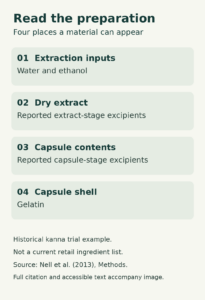
Confirm extraction or enhancement inputs, solvents, concentration factors, serving and container composition, homogeneity, and whether the test method fits the matrix. A powder method may not be appropriate for a syrup, resin or gummy.
Concentrated 7-OH
Do not classify concentrated or enhanced 7-OH as ordinary botanical leaf. A complaint involving a high-7-OH product requires precise units, total product mass or volume, per-article amount, source, label claims and screening for other named derivatives. Kiody does not sell concentrated 7-OH.
Mitragynine pseudoindoxyl, MGM-15 and MGM-16
These compounds require immediate legal and quality escalation if detected or declared in a product. A federal temporary Schedule I order became effective August 26, 2026, covering mitragynine pseudoindoxyl, MGM-15 and MGM-16 through August 26, 2028 unless modified earlier. See the effective federal order.
Current federal 7-OH proposal: do not confuse it with an effective complaint rule
DEA’s separate proposed action would temporarily place 7-OH above specified thresholds into Schedule I. The proposal describes criteria of more than 0.050% 7-OH by dry weight or more than 1 milligram 7-OH per article, and HHS extended the public-comment deadline to September 10, 2026.
As of this review date, those federal 7-OH threshold criteria remain proposed rather than effective. They should not be presented as an existing nationwide threshold. The procedural status does not reduce the need to investigate a complaint, comply with effective state rules or distinguish an enhanced product from botanical leaf.
Official records: DEA’s proposed rule and HHS’s comment-period extension.
Six example complaint paths
Example 1: Unreadable lot code
A customer reports that the lot code rubbed off a powder pouch. There is no reported illness and the seal is intact.
The company documents the package, order and photos; determines whether the order record can identify the lot; checks whether the print defect appears on retained or warehouse packages; reviews the printer settings and packaging run; and decides whether related inventory requires relabeling or hold. A refund alone does not correct the traceability problem.
Example 2: Unusual clumping
A customer reports that powder contains firm clumps after the pouch was stored open in a humid kitchen.
The company records the storage history without blaming the customer, examines package integrity and photos, compares an unopened reserve, reviews water-activity and microbial data where relevant, and considers whether the complaint reflects post-opening moisture exposure or an original package problem. The conclusion should identify evidence and limitations.
Example 3: Missing capsules
A bottle labeled 100 capsules contains 94.
The review checks the package lot, counting or checkweigher records, reconciliation, retained packages and similar complaints. Corrective action may involve fill-line settings or count verification. This is a quality and net-quantity issue even without an adverse event.
Example 4: Third-party 7-OH result
A customer provides a laboratory report that appears inconsistent with the posted COA.
The company confirms sample identity, chain of custody, matrix, units, method, laboratory scope, dry-weight basis and lot match. It compares the release and reserve-sample results and evaluates measurement uncertainty. It should not dismiss the result because the laboratory is unfamiliar, nor accept it without verifying the sample and method.
Example 5: Hospitalization reported
A reporter states that a person was admitted to a hospital after using a product.
Customer service immediately routes the report to trained safety personnel. The responsible person seeks the minimum reporting elements, starts the 15-business-day assessment clock when those elements are known, preserves the label and lot information, and opens a parallel quality investigation. Reporting does not wait for the laboratory conclusion and does not admit causation.
Example 6: Undeclared scheduled derivative
Testing detects mitragynine pseudoindoxyl in a product represented as ordinary botanical leaf.
The company places affected and related inventory on hold, preserves evidence, verifies the result through a qualified method, traces suppliers and related lots, stops shipment, escalates to counsel and regulatory personnel, assesses distributed product and complaints, and evaluates recall and notification obligations. This is not handled as routine botanical variation.
A proposed 18-point Kiody complaint standard
For review and approval, Kiody could adopt the following public-facing standard:
- Provide one visible complaint and safety contact route.
- Train every customer-facing employee to recognize quality and adverse-event language.
- Put immediate safety ahead of order-detail collection.
- Record the reporter’s words without diagnosing or rewriting causation.
- Assign every quality or safety complaint a unique identifier.
- Capture the exact lot, package and order whenever available.
- Preserve photos, labels, remaining product and shipping evidence.
- Route serious-event reports immediately to a named qualified reviewer.
- Document the decision to investigate or not investigate.
- Extend investigations to related batches, materials and records.
- Use retained samples and scientifically appropriate tests.
- Require written justification for retesting.
- Trend complaints by lot, supplier, product form and units distributed.
- Separate immediate correction from root-cause corrective action.
- Verify whether corrective action worked.
- Maintain a documented pathway for adverse-event reporting, follow-up and retention.
- Keep ordinary leaf separate from extracts, concentrated 7-OH and scheduled derivatives.
- Communicate confirmed findings and field actions accurately without medical promises or concealment.
This proposed standard is not a claim that every listed system is already implemented. Before publication, Kiody should compare each point with its actual SOPs, contracts, labels, staff training and records.
What a customer should expect
A responsible company may not be able to provide an immediate final answer. Laboratory testing, record retrieval and supplier review take time. It should still provide:
- acknowledgment that the report was received;
- immediate safety guidance when appropriate;
- a complaint or case reference;
- reasonable preservation or return instructions;
- a request for relevant identifiers rather than unrelated personal information;
- an explanation of what will happen next;
- follow-up when material findings or actions are available; and
- recall or stop-use instructions if the product is affected.
A company should not condition a legitimate safety investigation on removal of a negative review. It also should not promise a medical conclusion it is not qualified to make.
Frequently asked questions
Does one complaint prove a kratom product is defective?
No. It creates information that must be reviewed. The outcome may be confirmed, unconfirmed or inconclusive. A responsible system neither assumes every allegation is proven nor dismisses a single report without triage.
Does a passing COA close the complaint?
Not automatically. The COA must match the lot and address the reported issue. A release microbiology panel does not answer a capsule-count complaint, and a heavy-metal result does not evaluate a seal failure.
Should I throw the product away before contacting the company?
Unless an official recall or safety instruction requires immediate disposal, preserve the package, label and remaining contents while seeking guidance. Do not keep it where children or others could access it. In an emergency, prioritize medical help.
Why does the company need the lot number?
The lot connects the package to incoming material, production, testing, release and distribution records. Without it, the company may still investigate, but the scope and certainty can be limited.
What if the lot number is missing?
Provide the order number, purchase date, package size, photos, UPC and retailer. The missing code may itself be a quality complaint.
Is a refund the same as resolving a complaint?
No. A refund can resolve the financial part of the customer interaction. It does not determine whether other packages or customers are affected.
Does filing an FDA adverse-event report prove causation?
No. FDA states that submission is not an admission that the product caused or contributed to the event.
Are all adverse events legally “serious”?
No. Seriousness is defined by outcomes such as death, life-threatening experience, inpatient hospitalization, significant disability or incapacity, congenital anomaly or birth defect, or an intervention needed to prevent one of those outcomes. Non-serious reports still matter and may require retention and quality review.
When does the 15-business-day period begin?
FDA guidance says it begins when the five minimum elements are known: identifiable patient, identifiable reporter, responsible-person information, suspect product and serious event or fatal outcome.
Should a company wait for test results before filing a serious-event report?
The reporting clock and quality investigation are separate. A company should not delay a required report while waiting for final causation or laboratory conclusions.
Can a botanical color difference be normal?
Yes. Agricultural materials vary, and commercial color names do not guarantee identical appearance. But a material difference can still be documented and compared with the matching lot, particularly if moisture, odor, foreign material or package damage is also reported.
Are approximately 500 mg capsules a dosage recommendation?
No. It is an approximate capsule-fill description. It is not individualized medical or dosing advice.
Is concentrated 7-OH the same as kratom leaf?
No. Concentrated, enhanced, synthesized or semi-synthesized 7-OH products should not be grouped with ordinary botanical leaf. Kiody does not sell concentrated 7-OH.
Who decides whether a recall is needed?
The responsible firm evaluates the evidence, applicable law and regulatory guidance, often with qualified quality, legal and regulatory personnel. FDA can evaluate, request or in certain circumstances order recalls. A customer-service representative should not make or conceal that decision alone.
Can complaints be useful even when no defect is confirmed?
Yes. They can identify confusing labels, weak instructions, recurring shipping damage, inaccessible lot codes, documentation gaps or emerging patterns that deserve preventive action.
Primary and authoritative sources
- 21 CFR Part 111, Subpart O — Product Complaints
- 21 CFR § 111.560 — Complaint review and investigation
- 21 CFR § 111.570 — Complaint records
- 21 CFR § 111.465 — Reserve samples
- 21 CFR § 111.530 — Returned-product investigation across processes and batches
- 21 CFR § 111.75 — Specifications, scientifically valid testing and corrective-action plans
- 21 U.S.C. § 379aa-1 — Serious adverse-event reporting for dietary supplements
- FDA — Questions and Answers Regarding Adverse Event Reporting and Recordkeeping for Dietary Supplements
- FDA — How to Report a Problem with Dietary Supplements
- FDA — FDA and Kratom
- FDA Science Forum — Kratom-Related Adverse Event Reports from CAERS
- Federal Register — Proposed federal 7-OH threshold action
- Federal Register — 7-OH comment-period extension
- Federal Register — Effective temporary order for mitragynine pseudoindoxyl, MGM-15 and MGM-16
- Poison Help — U.S. poison-center assistance