Last reviewed: August 30, 2026. Educational content for adults 21+. This is not medical or legal advice. Kiody does not sell concentrated 7-OH products.
Suggested page: Learning Center → Lab Testing & Product Quality
Short answer
A laboratory instrument does not normally measure a scoop of kratom powder directly. The laboratory first has to turn the submitted material into a representative, measurable analytical solution or test portion. That workflow may involve mixing or grinding, weighing, adding solvent, shaking or sonicating, centrifuging, filtering, diluting, and transferring a small volume to an instrument vial. For microbiological testing, the preparation may instead involve adding a defined mass to a sterile diluent and following a culture or molecular method.
Every preparation step can influence the final result. Poor homogenization can cause two portions from the same bag to disagree. Incomplete extraction can leave an analyte behind. A missed dilution factor can move a result by tenfold or one hundredfold. Dirty equipment can add metals or carry alkaloids from a concentrated sample into botanical leaf. A method validated for a simple powder may not perform the same way with a flavored gummy, viscous liquid, or highly concentrated extract.
That is why a polished certificate of analysis, or COA, is only the final summary. To understand the quality of the result, a reviewer should ask whether the sample was representative, whether the preparation matched the product matrix, whether recovery and blanks were acceptable, and whether all calculations and dilutions were traceable.
Kiody is an educational, 21+ company. Kiody does not sell concentrated 7-hydroxymitragynine, or concentrated 7-OH. This guide does not make medical claims, tell anyone to use kratom, or determine whether a product is lawful in a particular jurisdiction.
Important regulatory context
Federal dietary-supplement current good manufacturing practice regulations state that required laboratory methods must be appropriate for their intended use and scientifically valid. Those requirements appear in 21 CFR §111.320. FDA’s current public position, however, is that kratom is not lawfully marketed as a dietary supplement or conventional food ingredient. Discussing Part 111 quality principles does not mean FDA has approved kratom, accepted it as a lawful dietary ingredient, or approved a particular laboratory method for kratom.
This guide uses three types of sources carefully:
- Binding dietary-supplement regulations, such as 21 CFR Part 111, to explain generally applicable laboratory and quality concepts where relevant.
- FDA food-laboratory manuals and validation guidelines as authoritative technical frameworks for homogenization, blanks, recovery, matrix effects, and method performance. These documents are not kratom-specific safe harbors.
- Current FDA and DEA materials to state the federal kratom and selected-alkaloid status as of the draft date.
The distinction matters. A method can be technically strong without making the product lawful. A product can also satisfy one laboratory specification while failing another specification or legal requirement.
The result begins before the instrument
When people compare COAs, they often focus on the instrument: LC-MS/MS, HPLC-UV, ICP-MS, GC-MS/MS, PCR, or another technology. The instrument matters, but it only sees what reaches it. A highly capable instrument cannot repair a nonrepresentative scoop, incomplete extraction, contaminated blank, transcription error, or incorrect dilution factor.
A useful way to picture the process is:
lot → field or production sample → laboratory sample → analytical sample → analytical portion → prepared extract or dilution → instrument measurement → calculation → reported result
These terms are sometimes used differently by different laboratories, so the method or standard operating procedure should define them. The important idea is that each arrow represents a reduction or transformation. A 25-kilogram production lot may ultimately be represented by a fraction of a gram and a few microliters injected into an instrument. The workflow has to preserve representativeness through every reduction.
Lot
The lot is the defined quantity of material linked by production history and a lot, batch, or control number. A COA should identify the lot it represents. If the tested sample came from a different lot, an otherwise excellent analysis cannot establish the tested attributes of the lot being sold.
Laboratory sample
This is the material the laboratory receives. It may be a sealed retail unit, a composite taken from several locations in a drum, several capsules, a bottle of liquid, or another defined sample. The laboratory should document receipt condition, identifiers, quantity, seals when used, and any damage or unusual appearance.
Analytical sample
This is the material prepared so smaller portions can be taken with reasonable confidence. For a dry powder, preparation might include thorough mixing or controlled grinding. For capsules, the laboratory may need to define whether it tests capsule contents, the complete dosage unit including the shell, or a composite of multiple capsules. For a liquid, the method might require shaking, inversion, warming within a defined range, or another mixing instruction before a portion is taken.
Analytical portion
This is the measured mass or volume that actually enters the test preparation. An analyst might weigh 0.2500 gram for an alkaloid method, 0.500 gram for metals digestion, or 25 grams for a pathogen method. Those are examples, not universal kratom requirements. The validated method should specify the portion size and acceptable tolerance.
Prepared solution or test suspension
The analytical portion may be extracted into a solvent, digested with acid, diluted in sterile broth, or otherwise transformed. The final report depends on accounting for every added solvent volume, intermediate dilution, concentration step, and correction factor.
1. Homogenization: making a small portion meaningful
Homogenization is the attempt to distribute the relevant components evenly enough that a small analytical portion represents the prepared sample. FDA’s Elemental Analysis Manual explains that its methods assume the analytical sample is homogeneous relative to the size of the analytical portion. It also suggests evaluating homogenization through replicate portions; unexpectedly poor precision can signal that the preparation was not sufficiently uniform.
Kratom products can challenge that assumption in different ways.
Leaf powder
Particle-size differences can promote segregation. Finer particles may settle differently from coarse fibers during shipping and handling. If a bag is sampled only from the surface, the portion may not match the center or bottom. Moisture differences and static can make mixing harder.
A laboratory method should define whether the received powder is mixed, tumbled, milled, sieved, or otherwise prepared before portions are taken. More processing is not automatically better: aggressive milling can heat the material, add equipment wear particles, or create dust loss. The procedure should be appropriate to the analyte and product.
Pure-leaf capsules
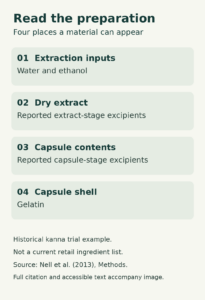
Kiody describes its capsules as approximately 500 milligrams of pure leaf powder per capsule. Testing one capsule may answer a different question from testing a composite of many capsules. One-capsule testing can examine unit variation, while a multi-capsule composite can estimate the average composition of the sampled units. A report should not imply unit-level uniformity when only a pooled composite was tested.
The laboratory should also define whether the shell is removed. If the result is reported per gram of capsule contents, including the shell in the mass would change the denominator. If the result is reported per complete capsule, the shell may be part of the relevant unit. The preparation and reporting basis must match.
Extract powders
An extract powder may contain botanical solids, carrier material, anti-caking ingredients, or regions of different concentration if blending was inadequate. A visually uniform powder is not necessarily chemically uniform. Replicate portions and a validated homogenization procedure are especially useful when a decision depends on a low-level analyte near a legal or internal threshold.
Liquids and suspensions
Liquids can separate, settle, form layers, or hold material on the container wall. “Shake well” is not a laboratory procedure unless the duration, intensity, temperature, and delay before sampling are controlled enough for the method. A viscous product may not become uniform after a casual inversion. A suspension may begin settling again while portions are being pipetted.
Gummies and other heterogeneous units
Gummies, tablets, or mixed matrices may require cutting, cryogenic grinding, dissolution, or another validated preparation. Surface coatings and internal material may differ. Testing only a surface shaving or a single unit cannot be generalized to all units without an appropriate sampling design.
2. Equipment can change the sample
Homogenizers, grinders, mills, spatulas, tubes, filters, pipettes, and storage vessels are not neutral by default. Their composition, cleanliness, capacity, and condition matter.
FDA’s Elemental Analysis Manual tells analysts to clean homogenization equipment before and between uses and to consider whether equipment materials could introduce elements of interest. That lesson is directly relevant to kratom testing. Stainless-steel wear may be important when measuring certain metals. Glass, plastic, or filter materials may adsorb an analyte. A previous high-concentration extract can contaminate the next botanical-leaf preparation if the equipment is not adequately cleaned.
A strong procedure considers:
- compatibility of blades, vessels, caps, tubing, and filters with the analyte and solvent;
- equipment cleanliness and verified changeover between products;
- whether disposable tools are truly single-use;
- whether the mill loses fine particles or overheats the sample;
- whether the equipment can handle the sample mass without dead zones;
- whether plasticizers, metals, fibers, lubricants, or cleaning residues could be introduced;
- whether the laboratory runs equipment blanks or cleaning checks when cross-contamination risk is high.
Carryover risk is not symmetrical. Preparing ordinary leaf after a concentrated alkaloid product creates a different risk from preparing leaf after leaf. A laboratory that accepts botanical powder and high-concentration materials should have separation, sequencing, or cleaning controls appropriate to that contrast.
3. Weighing and volume measurements
A method calculation is only as reliable as its input measurements. Sample mass, final volume, aliquot volume, and dilution factors must be recorded with suitable equipment and sufficient resolution.
Balance suitability
If a method calls for 0.1000 gram, a balance that only resolves to 0.01 gram is not suitable. A 0.01-gram rounding step represents ten percent of a 0.10-gram portion before any other uncertainty is considered. Balance calibration, daily checks, environmental stability, and minimum-weight practices all affect confidence.
Tare and transfer loss
Powder can cling to weigh paper, funnels, spatulas, and tube walls. An analyst should know whether the method uses direct weighing into the extraction vessel or quantitative transfer. If material is lost after the recorded mass is entered, the calculation may assume more sample reached the extraction solvent than actually did.
Volumetric equipment
Graduated cylinders, volumetric flasks, pipettes, syringes, and dispensers have different tolerances and intended uses. “Add about 50 mL” is different from bringing a solution to a defined final volume of 50.00 mL. Evaporation can also change solvent volume, especially during long sonication, heated extraction, or open-vessel work.
Density and mass-versus-volume reporting
One milliliter is not always one gram. A liquid result reported per gram cannot be converted to per milliliter without an appropriate density value. A label that defines a serving by volume should not be compared with a mass-based laboratory result through an assumed density unless that assumption is justified and disclosed.
4. Extraction: moving the analyte into a measurable phase
Chemical testing often requires the target analyte to be removed from the product matrix and placed into a solution compatible with the instrument. That is extraction. The method may specify solvent composition, solvent-to-sample ratio, pH, mixing technique, time, temperature, centrifugation, filtration, and storage conditions.
An extraction is not automatically complete because the powder disappeared or the solution became colored. The target compound may remain bound to solids, degrade under the extraction conditions, adhere to labware, or precipitate later.
Solvent selection
The solvent must be capable of extracting the target compounds from the specific matrix while remaining compatible with the analytical method. A solvent system that works for leaf powder may perform differently for a gummy, oily liquid, resin, or product with carrier ingredients.
Time and agitation
Shaking, vortexing, stirring, or sonication can improve contact between the matrix and solvent. More time or energy does not guarantee better recovery. Excessive heat or prolonged treatment may change an unstable analyte or solvent volume. The validated procedure should define the acceptable range.
pH
Alkaloid extraction can be pH-sensitive. Changing pH may affect solubility, chemical form, retention, or degradation. A laboratory should not casually change an acid, base, buffer, or pH target without evaluating method performance.
Centrifugation and filtration
Removing solids protects instruments and improves reproducibility, but filters can retain analytes or release interferences. Filter material, pore size, pre-rinsing, discard volume, and compatibility should be established. A clear filtrate is not proof that analyte recovery is complete.
Extract stability
The prepared extract may have a shorter useful life than the original sample. Light, temperature, oxygen, pH, container material, and time before analysis can affect results. The method should specify holding time and storage conditions for extracts when these factors matter.
5. Recovery: did the process find what was present?
Recovery is an estimate of how much known analyte the method can measure after it has been added to, or is already present in, a matrix. Recovery studies help reveal losses or enhancement caused by preparation and the matrix.
FDA’s laboratory terminology distinguishes useful quality-control tools:
- A fortified analytical portion is spiked before digestion or extraction and can show whether sample preparation or the matrix contributes bias.
- A fortified analytical solution is spiked after preparation, before instrumental measurement, and can help evaluate matrix effects at the measurement stage.
- A method blank is carried through the full preparation process to check whether reagents, equipment, labware, or the environment added the analyte.
The position of the spike matters. A spike added after extraction cannot reveal poor extraction recovery. It may only test the instrument response in the final solution. A spike added to solvent does not establish performance in kratom powder. A strong validation challenges the complete workflow in representative matrices and across relevant concentration levels.
Recovery is not a universal correction button
Suppose a validation experiment recovers 85 percent of a fortified analyte. It may be tempting to divide every future result by 0.85. That is not automatically appropriate. Whether recovery correction is used should be defined and validated in the method. Recovery may vary by concentration, matrix, lot, analyst, and day. Applying an improvised correction can add bias rather than remove it.
The useful COA-review questions are:
- Was recovery evaluated in the same or a representative product matrix?
- Was the spike added before the critical preparation steps?
- Were low, middle, and high concentrations studied?
- Were acceptance criteria predetermined?
- Were the batch quality-control recoveries acceptable?
- Does the reported result include a recovery correction, and if so, is that disclosed?
6. Matrix effects: when the product changes the signal
The “matrix” is everything in the sample other than the target analyte. Kratom leaf contains many plant components. Finished products may add capsule shell material, flavors, sweeteners, acids, colors, carriers, preservatives, or other botanical ingredients. These components can suppress or enhance an instrument signal, alter extraction, create interferences, or affect microbial detection.
Matrix effects are a major reason why a method validated for one product form should not automatically be assumed valid for another.
Consider four examples:
- A clean leaf-powder extract may be suitable for a method, while a dark resin overloads the same preparation.
- A flavored liquid may contain compounds that coelute near an alkaloid peak.
- A mineral-rich botanical matrix may create spectral interference in elemental analysis.
- An antimicrobial ingredient may reduce recovery of a microorganism unless the microbiology method neutralizes it.
Dilution can reduce some matrix effects, but dilution also moves low-level analytes closer to the reporting limit. Cleanup steps can help, but they may also lose analyte. The method must balance selectivity, sensitivity, and recovery.
7. Dilution math: where tenfold mistakes happen
After extraction, the solution may be too concentrated or too dirty for direct measurement. Laboratories make one or more dilutions. Every step must be included in the final calculation.
For a simple chemical result, a useful conceptual equation is:
Result (mg/g) = instrument concentration (µg/mL) × final extraction volume (mL) × total dilution factor ÷ sample mass (g) ÷ 1,000 (µg/mg)
The actual validated method may use a different equation, internal-standard ratio, moisture correction, recovery factor, or unit convention.
Worked example 1: one extraction and one secondary dilution
An analyst weighs 0.2500 gram of powder, extracts it to 50.00 mL, then dilutes 1.00 mL of extract to 10.00 mL. The instrument reports 1.25 µg/mL in the diluted vial.
- Extraction volume: 50.00 mL
- Secondary dilution factor: 10
- Sample mass: 0.2500 g
- Instrument concentration: 1.25 µg/mL
Calculation:
1.25 × 50.00 × 10 ÷ 0.2500 ÷ 1,000 = 2.50 mg/g
Because 1 mg/g equals 0.1 percent by weight, 2.50 mg/g equals 0.250 percent by weight.
If the secondary dilution factor were accidentally omitted, the report would show 0.250 mg/g—ten times too low.
Worked example 2: serial dilutions
An extract is first diluted 1:20, and that diluted solution is then diluted 1:5. The total dilution factor is not 25; it is:
20 × 5 = 100
Adding dilution factors instead of multiplying them produces a fourfold error in this example.
Worked example 3: percent and mg/g
For weight-based results:
- 1 percent = 10 mg/g
- 0.1 percent = 1 mg/g
- 0.05 percent = 0.5 mg/g
- 0.01 percent = 0.1 mg/g
These conversions do not resolve the denominator. A percentage of total alkaloids is not the same as percentage of product dry weight. A per-serving limit is a third measurement basis. The COA and legal rule must use the same denominator before they are compared.
Worked example 4: moisture or dry-basis correction
Suppose a powder result is 12.0 mg/g as received, and the measured moisture fraction is 8 percent. A conceptual dry-basis calculation is:
12.0 ÷ (1 − 0.08) = 13.04 mg/g dry basis
The as-received and dry-basis results are both legitimate expressions, but they are not interchangeable. A laboratory should state the basis. A dry-weight legal threshold should not be evaluated using an uncorrected wet-basis result unless the governing rule or validated procedure supports that comparison.
Worked example 5: per-capsule calculation
A composite of capsule contents tests at 14 mg/g for an analyte, and the verified average fill mass is 0.500 gram per capsule.
14 mg/g × 0.500 g/capsule = 7 mg/capsule
That value estimates the average based on the tested composite and average fill mass. It does not prove that every capsule contains exactly 7 mg. Unit-level variability requires a design that examines individual units or appropriately evaluates uniformity.
8. Moisture changes the denominator
Dry plant powders can gain or lose water during storage, shipping, laboratory conditioning, grinding, and weighing. When concentration is reported per gram, added water increases the denominator and can make the measured concentration per gram appear lower. Drying removes water and can make it appear higher.
A complete result should make clear whether it is:
- as received;
- on a dry-weight basis;
- corrected using loss on drying;
- corrected using a specific moisture method; or
- calculated from another defined basis.
Moisture testing is not merely a side panel when a regulatory threshold is expressed on a dry-weight basis. The moisture result, method, sample timing, and correction formula become part of the compliance decision. A moisture measurement from a different lot or a different portion may not support the correction.
9. Blanks and contamination controls
A result can be falsely elevated if the analyte enters during preparation. Laboratories use different blanks to locate contamination.
Reagent blank
This checks reagents and, depending on the procedure, some preparation steps. It does not necessarily challenge every sample-contact surface.
Method blank
FDA’s Elemental Analysis Manual defines a method blank as material such as water processed through the full preparation steps, reagents, labware, apparatus, and analytical procedure in the same manner as a sample. It helps reveal contamination introduced by the process or laboratory environment.
Matrix blank
This is a sample matrix known not to contain the target analyte, when such a matrix is available. For botanical alkaloids that naturally occur in leaf, a truly blank kratom matrix may be difficult or impossible to obtain. The laboratory should explain its surrogate or alternative approach.
Carryover blank
This is run after a high-concentration standard or sample to check whether the next result is affected by residue in the instrument pathway.
Blank terminology varies. A reviewer should ask what each blank actually passed through rather than relying on the name alone.
10. Replicates reveal different problems
Not all duplicates test the same thing.
- Duplicate injections of the same vial mainly examine short-term instrument repeatability.
- Duplicate dilutions from the same extract examine dilution and measurement repeatability.
- Duplicate extractions from the same homogenized material include extraction variability.
- Replicate analytical portions include small-scale sample heterogeneity as well as preparation variability.
- Replicate field or production samples include broader sampling variability.
If two injections agree, that does not prove the original powder was homogeneous. If two separate portions disagree but repeat injections agree, the issue may lie in sampling, homogenization, weighing, or extraction rather than the instrument.
FDA’s homogenization guidance notes that replicate analytical portions can help evaluate whether a prepared sample is homogeneous enough for the portion size. The lesson is simple: replicate design must match the question.
11. Different product forms need different preparation evidence
Botanical powder
Key questions include particle-size distribution, mixing procedure, portion mass, moisture basis, extraction recovery, and whether the method was validated in a comparable leaf matrix.
Approximately 500 mg pure-leaf capsules
Key questions include number of capsules sampled, shell inclusion or removal, composite versus individual-unit testing, actual fill-mass determination, and how per-capsule values were calculated.
Extract powder
Key questions include carrier composition, concentration range, need for larger dilutions, carryover controls, extraction completeness, and whether high analyte levels exceed the validated calibration range.
Liquid extract
Key questions include mixing instructions, density, settled solids, pipetting suitability, container-wall residue, extract stability, and mass-versus-volume reporting.
Gummies or flavored products
Key questions include unit compositing, grinding or dissolution, surface coating, matrix cleanup, recovery in the flavored matrix, and possible chromatographic or microbial interferences.
Enhanced or concentrated 7-OH products
These present high carryover and dilution risks and require distinct legal review. Kiody does not sell concentrated 7-OH. A laboratory’s ability to quantify a compound does not establish that the product is lawful to possess, manufacture, distribute, or ship.
12. Near-threshold 7-OH decisions require the whole workflow
As of August 30, 2026, DEA’s federal action concerning 7-OH above a specified threshold remained a proposal, with the comment period extended through September 10, 2026. The proposal uses a 0.050-percent dry-weight threshold and an alternative trigger for certain articles. It must not be confused with the separate federal order that took effect August 26, 2026, temporarily placing mitragynine pseudoindoxyl, MGM-15, and MGM-16 in Schedule I.
For a result near any legal threshold, the reviewer should verify:
- Was the correct compound measured?
- Was the product form within the method’s validated scope?
- Was the sample representative of the lot?
- Was the product homogenized adequately?
- Was extraction recovery acceptable at the decision level?
- Was the result within the calibration range?
- Were all dilution factors included?
- Was the moisture measurement from the same relevant sample and time?
- Is the result expressed on the same basis as the rule—dry weight, product weight, total alkaloids, unit, or serving?
- Were rounding and measurement uncertainty handled under a documented decision rule?
A result printed as exactly 0.050 percent is not self-interpreting. The unrounded value, reporting convention, uncertainty, method quantitation limit, and governing legal language may all matter. Kiody should not label a near-limit product compliant from a rounded COA alone.
13. What a COA should disclose—and what may require a supporting report
A concise COA cannot contain the entire method. It should still provide enough information to identify the sample, result, units, method, and laboratory. For higher-risk or near-threshold decisions, the underlying method summary, validation, raw-data review, and quality-control results may be needed.
Useful COA or supporting-report fields include:
- laboratory name and location;
- unique report number and version;
- client and product name;
- lot, batch, or control number;
- sample receipt and condition;
- dates received, prepared, analyzed, and reported;
- product matrix and form;
- sampling source or statement that the client supplied the sample;
- method identifier and revision;
- analytical portion mass or volume;
- preparation and extraction summary;
- result and exact units;
- wet-, as-received-, or dry-basis statement;
- detection and quantitation limits;
- measurement uncertainty when relevant;
- quality-control acceptance statement;
- deviations or modifications;
- authorized approval and report status.
Do not assume “USP,” “FDA method,” “in-house,” or “validated” is sufficient by itself. Ask which method, which revision, which analytes, which matrices, which range, and what verification was performed for the actual product form.
14. Twenty sample-preparation warning signs
- The COA identifies no lot or batch number.
- The laboratory tested a powder but the product is a gummy, liquid, or resin.
- A single capsule result is presented as proof of batch-wide uniformity.
- The report does not say whether capsule shells were included.
- A per-serving calculation uses label fill weight rather than measured or controlled fill weight.
- The result basis—wet, as received, or dry—is missing.
- A dry-weight threshold is compared with an as-received result without a documented moisture correction.
- The method’s sample portion is tiny relative to a visibly heterogeneous product, with no homogenization evidence.
- High-concentration and botanical samples are prepared on the same equipment without documented carryover controls.
- The method was changed from powder to liquid without verification or validation evidence.
- Recovery was tested only in solvent, not in matrix.
- A post-extraction spike is used to claim extraction efficiency.
- Blanks are described only as “pass,” with no indication of what process they covered.
- Replicate injections are presented as proof of sample homogeneity.
- An out-of-range sample is reported after extrapolating beyond the calibration curve.
- Serial dilution factors are added instead of multiplied.
- A liquid’s mass and volume are treated as equal without a density basis.
- The result has more decimal places than the method supports.
- A near-limit decision is made from a rounded number without a documented decision rule.
- The client or seller cannot provide the method identifier, report version, or explanation of a corrected COA.
15. A practical 34-field Kiody review record
For each lot and report, a review file can capture:
- Product name
- Product form
- Kiody or supplier SKU
- Lot, batch, or control number
- Supplier lot number
- Laboratory name
- Laboratory accreditation and relevant scope
- Report number
- Report version
- Sample source
- Sample collection date
- Receipt date
- Receipt condition
- Analysis date
- Method identifier and revision
- Matrix covered by validation
- Analytes covered
- Homogenization procedure summary
- Number of units or increments combined
- Analytical portion mass or volume
- Extraction or digestion summary
- Total dilution factor
- Calibration range
- Result and units
- Reporting basis or denominator
- Moisture method and result when applicable
- LOD and LOQ or reporting limit
- Recovery-control result
- Blank-control result
- Replicate design and result
- Measurement uncertainty or decision rule when relevant
- Deviations, modifications, or reanalysis
- Reviewer and review date
- Final disposition and approval
The record should link to the original, unedited report rather than replacing it with screenshots or retyped values. If a laboratory corrects a report, preserve the superseded version and document why the new version replaced it.
16. Questions to ask a laboratory
The goal is not to demand proprietary details. It is to determine whether the method is fit for the decision.
- What exact matrix was used during method validation?
- Does the scope include leaf powder, capsules, extracts, liquids, and gummies, or only some forms?
- How is the received sample homogenized before a portion is taken?
- How many units or increments are combined?
- What is the analytical portion size?
- Was recovery assessed before extraction in a representative matrix?
- What are the typical and acceptable recovery ranges at the relevant concentration?
- How are matrix effects evaluated?
- What blanks are included, and which preparation steps do they cover?
- How is carryover controlled after concentrated samples?
- How are out-of-range results diluted and recalculated?
- Is the result as received or dry basis?
- How is moisture measured and paired with the alkaloid result?
- What is the unrounded result for a near-threshold decision?
- What decision rule is used when uncertainty overlaps a specification?
- What changes would require method re-verification or revalidation?
17. Frequently asked questions
1. Does the laboratory test the whole bag?
Usually no. The laboratory tests one or more analytical portions taken from the submitted sample. The sampling and homogenization plan determine how well those portions represent the bag or lot.
2. Is grinding always required?
No. Grinding may improve uniformity for some matrices, but it can also add heat, contamination, or particle loss. The validated method should specify the appropriate preparation.
3. Why can two laboratories get different results from the same lot?
Differences can arise from lot sampling, sample segregation, homogenization, portion size, extraction, calibration, matrix effects, moisture basis, reporting rules, or actual laboratory error. Instrument brand alone rarely explains the entire difference.
4. What is extraction recovery?
It is evidence of how effectively the method measures known analyte through the relevant sample preparation and matrix. The spike must be introduced at the correct point to test the step of interest.
5. Does 100 percent recovery prove the result is perfect?
No. Recovery is one performance characteristic. Sampling error, selectivity, precision, calibration, uncertainty, contamination, and calculation errors can still affect the result.
6. Is a post-extraction spike enough?
It can help assess matrix effects in the final solution, but it does not demonstrate that extraction removed the analyte from the original product efficiently.
7. Why are method blanks important?
They can reveal contamination added by reagents, labware, equipment, or the laboratory environment. They are especially important for low-level analytes and after high-concentration materials.
8. Why does the capsule shell matter?
Including the shell changes total mass and can change a result expressed per gram. The method should define the tested material and the reporting basis.
9. Can one capsule represent a bottle?
It represents that capsule. A broader conclusion requires an appropriate plan examining multiple units or a justified composite.
10. Why must liquids be mixed before sampling?
Ingredients or suspended particles may settle or separate. A small pipetted portion taken from an unmixed layer may not represent the container.
11. What is a matrix effect?
It is an influence from other sample components that suppresses, enhances, or interferes with the target measurement or preparation.
12. What does “1:10 dilution” mean?
It should be defined by the procedure. Often it means one part sample or solution brought to ten total parts, but informal usage varies. The laboratory record should state actual aliquot and final volume.
13. Are dilution factors added or multiplied?
Serial dilution factors are multiplied. A 1:20 step followed by a 1:5 step produces a total factor of 100.
14. Is 0.05 percent the same as 0.5 mg/g?
Yes, if both are weight-based on the same basis. It is not the same as 0.05 percent of total alkaloids or 0.5 mg per serving.
15. Why can dry-basis and as-received results differ?
Water contributes to the as-received mass. Removing that water from the denominator increases the concentration expressed per gram of dry material.
16. Does a passing COA prove every unit passes?
No. It supports the tested sample and attributes under the sampling design, methods, and acceptance rules used. It does not establish perfect uniformity across every unit.
17. Does laboratory testing make a kratom product federally lawful?
No. FDA currently states that kratom is not lawfully marketed as a drug, dietary supplement, or conventional-food additive. Testing and legal status are separate questions.
18. Does Kiody sell concentrated 7-OH?
No. Kiody is 21+ and does not sell concentrated 7-OH.
18. The most useful takeaway
The number on a COA is the end of a chain. Trustworthy review follows the chain backward:
- Was the correct lot sampled?
- Was the sample representative?
- Was it made homogeneous enough for the portion size?
- Was the portion weighed or measured accurately?
- Did the method extract or detect the analyte reliably in that matrix?
- Were blanks, recovery controls, and replicates acceptable?
- Were every dilution and correction factor recorded?
- Is the final result expressed on the correct basis?
- Does the decision account for rounding, uncertainty, specifications, and current law?
A good laboratory does more than operate an instrument. It controls the path from sample receipt through the final calculation. A good retailer or quality reviewer does more than download a PDF. It asks whether that path was suitable for the product and the decision.
Primary and authoritative sources
- Electronic Code of Federal Regulations, 21 CFR §111.320 — Laboratory methods for testing and examination.
- FDA, Elemental Analysis Manual for Food and Related Products, updated March 6, 2026.
- FDA, Elemental Analysis Manual §2.2 — Food Homogenization.
- FDA, Elemental Analysis Manual §3.2 — Terminology, including method blanks, fortified analytical portions, and fortified analytical solutions.
- FDA, Guidelines for the Validation of Chemical Methods for the FDA Foods Program.
- FDA, Foods Program Methods Validation Processes and Guidelines.
- FDA, Q2(R2) Validation of Analytical Procedures. This drug-focused guidance is used here only as a technical validation reference, not as dietary-supplement law or evidence of kratom approval.
- FDA, Dietary Supplement Inspection Compliance Program CP 7321.008, issued August 18, 2025.
- FDA, FDA and Kratom, current federal agency position accessed August 30, 2026.
- DEA, Proposed temporary placement of 7-OH above a specified threshold in Schedule I, July 6, 2026.
- DEA, Extension of the federal 7-OH proposal comment period, August 26, 2026.
- DEA, Temporary Schedule I placement of mitragynine pseudoindoxyl, MGM-15, and MGM-16, effective August 26, 2026.