Last reviewed: August 30, 2026. Educational content for adults 21+. This is not medical or legal advice. Kiody does not sell concentrated 7-OH products.
Suggested page / content hub: Learning Center → Lab Testing & Product Quality
Suggested URL slug: /learn/kratom-identity-testing/
Review date: August 29, 2026
The short version
A strong kratom identity decision should be able to answer six questions:
- What material was supposed to arrive? The specification names Mitragyna speciosa, the intended plant part and the expected physical form.
- Which lot was examined? The sample, supplier lot, receiving record and finished package remain traceable.
- Was the test suitable for that form? Whole leaf, powder, capsules and extracts do not preserve the same identity evidence.
- What authenticated reference was used? A name on a vendor invoice is not a scientific reference by itself.
- Did more than one kind of evidence agree? Independent, complementary methods can reduce the weaknesses of relying on one marker.
- What did the result not prove? Species identity does not establish contaminant absence, legal status, consistent strength, clinical effect or FDA approval.
Customers will not always see every underlying identity record. A trustworthy company should nevertheless be able to explain which method it uses, why the method fits the product and how the result connects to the lot being sold.
Identity is not the same as purity, strength or safety
Quality terms often get collapsed into the word “tested.” They are not interchangeable.
Identity asks whether the material is what it is represented to be. For a botanical-leaf product, that usually includes species, plant part and form.
Composition asks what ingredients or constituents are present and, when appropriate, their amounts.
Strength or concentration asks how much of a specified constituent is present under the reported method and units.
Purity may address unwanted material, adulteration or conformance with a defined standard, but the word is meaningless unless the specification is stated.
Contaminant testing looks for particular hazards or unwanted analytes, such as specified microorganisms, heavy metals, pesticides or mycotoxins.
Legal status depends on the product, jurisdiction, date and applicable rule. A sample can be correctly identified chemically and still be prohibited. A lawful-looking label does not change the chemistry.
Safety cannot be established by one identity result or one COA. FDA states that no FDA-approved kratom drug products or over-the-counter drugs containing kratom are legally on the U.S. market and continues to warn about serious adverse events and unlawfully marketed products.
An identity result therefore supports one necessary conclusion: the tested sample is consistent with the specified material under the chosen method. It is not a universal seal of approval.
The regulatory-quality benchmark—and its limit
The federal dietary-supplement current good manufacturing practice framework provides a useful model for understanding identity controls. Under 21 CFR § 111.70, a manufacturer must establish an identity specification for each component used to manufacture a dietary supplement. Under 21 CFR § 111.75, at least one appropriate test or examination must generally verify the identity of each dietary ingredient before use. The rule recognizes gross organoleptic, macroscopic, microscopic, chemical and other scientifically valid methods.
The same rule says a method must be appropriate and scientifically valid. That matters more than simply checking a box labeled “identity.” A visual check that may help identify intact leaves is not automatically enough for a highly processed extract. A single chemical marker may support identity without proving that no other plant or added material is present.
This guide uses Part 111 as a quality-system benchmark. It does not represent that FDA has accepted kratom as a lawful dietary ingredient, approved a Kiody product or authorized therapeutic claims. FDA’s current kratom page says the agency acts against unlawfully marketed kratom dietary supplements, conventional foods and unapproved drug products.
Start with a written botanical specification
Testing cannot answer a vague question well. “Kratom powder” is not a complete identity specification.
A review-ready specification could identify:
- accepted scientific name: Mitragyna speciosa (Korth.) Havil.;
- family: Rubiaceae;
- intended plant part: leaf;
- physical form: intact dried leaf, cut leaf or ground dried leaf;
- whether the material is unextracted botanical biomass;
- expected organoleptic and microscopic characteristics;
- reference materials or authenticated specimens used;
- selected DNA region, chemical markers or fingerprint criteria where used;
- method acceptance criteria;
- known limitations or likely related species that require differentiation;
- sampling requirements; and
- records needed to connect the result to the received lot.
The scientific name should not be treated as decoration. Common names can be inconsistent. The specification should also avoid assuming that a commercial color or variety name—such as Green Maeng Da or Red Bali—is a formal taxonomic identity. Those labels may organize a catalog, but the core botanical identity remains Mitragyna speciosa leaf unless reliable evidence supports a more specific claim.
The evidence begins before the laboratory
Laboratory methods are strongest when they sit inside a traceable receiving system. Useful pre-laboratory evidence includes:
- approved supplier identity and address;
- supplier lot number;
- Kiody receiving or internal lot number;
- country or region information only when documentation supports it;
- purchase specification and purchase order;
- form and quantity received;
- intact seals and container condition;
- collection record for the submitted sample;
- chain of custody or laboratory submission number; and
- quarantine, approval or rejection status.
These records do not replace scientific authentication. They preserve the connection between the test result and the physical material. A sophisticated method applied to a mislabeled jar still produces a result for the wrong jar.
FDA’s manufacturing guide provides a useful traceability benchmark: each unique component lot should have an identifier linking it to the supplier, receipt date, component name, status and products made from it. That is the kind of connection a customer should expect behind a lot-matched COA.
Method 1: organoleptic examination
Organoleptic examination uses sensory characteristics such as appearance, color, odor and texture. It is fast and inexpensive. Experienced personnel can use it to detect obvious mix-ups, moisture damage, foreign material, unexpected odor or a major difference from an approved reference.
For kratom powder, a receiving examiner might document:
- general color range;
- powder fineness and texture;
- characteristic versus unexpected odor;
- visible fibers or foreign material;
- clumping or signs of moisture exposure; and
- consistency across sampled containers.
Organoleptic examination has important limits. Color can change with drying, milling, storage, particle size, lighting and normal botanical variation. A green powder is not automatically kratom. A “red” commercial label does not require the powder to be visually red. Odor judgment varies between people and may be affected by packaging or storage.
Organoleptic characteristics work best as a screening layer against an approved reference and written description. They should not be presented as a complete authentication method for a fine powder, capsule or extract unless a scientifically justified procedure shows that the examination is sufficiently specific for the question being asked.
Method 2: macroscopic examination
Macroscopic examination evaluates structures visible without a microscope or with simple magnification. Intact leaves can preserve characteristics such as shape, margin, venation, base, apex and arrangement.
This can be useful when receiving whole or cut leaf because recognizable anatomy remains. The examiner can compare the submitted material with an authenticated reference specimen and a documented botanical description.
Grinding removes much of that information. Once a leaf becomes a uniform powder, overall leaf shape and vein arrangement can no longer be reconstructed reliably. A few visible fragments may provide clues, but powder should not be authenticated solely by imagining what the original leaf looked like.
Macroscopy also depends on competent comparison. Closely related Mitragyna species can share broad features. A 2021 study of Mitragyna speciosa and related Thai species noted identification difficulty across fresh leaves, dried powder and finished products and evaluated DNA barcoding with high-resolution melting to improve differentiation.
Method 3: microscopic examination
Microscopy examines smaller diagnostic structures that can remain after drying and grinding. Depending on the validated reference and preparation, an analyst may evaluate epidermal cells, stomata, trichomes, vascular fragments, crystals, fibers and other anatomical features.
Microscopy can be especially helpful for single-ingredient botanical powders because it works directly with plant structure. It can also reveal obvious foreign plant tissues or nonbotanical debris that a chemistry-only assay focused on one alkaloid might miss.
Its performance depends on several factors:
- the existence of well-characterized authenticated reference material;
- analyst training and demonstrated competency;
- the quality and particle size of the powder;
- preparation and staining procedures;
- the specificity of the selected features;
- the amount and distribution of diagnostic tissue; and
- whether processing has destroyed or removed those structures.
Extracts are a major limitation. Filtration and extraction may remove most recognizable tissue. An analyst cannot call microscopy “failed” merely because an authentic extract has no intact leaf structures; the method may simply be inappropriate for the form. Conversely, detecting some leaf tissue does not prove the absence of added extract, other powder or isolated compounds.
Method 4: DNA barcoding
DNA barcoding compares one or more selected genetic regions in an unknown sample with authenticated reference sequences. For plants, commonly investigated regions include nuclear internal transcribed spacer regions and chloroplast regions such as rbcL, matK and trnH-psbA.
Kratom-specific research supports the value of this approach. A 2021 Scientific Reports study used DNA barcoding with high-resolution melting analysis to distinguish Mitragyna speciosa from allied Mitragyna species. Among the regions evaluated, ITS2 produced clearly distinct melting profiles in that study.
A 2024 commercial-product study evaluated ITS, matK, rbcL and trnH-psbA regions and reported that ITS showed the greatest variation among the samples studied. A 2026 study integrated nine DNA regions with UHPLC, GC-MS and LC-MS/QTOF chemical profiling; ITS and ITS2 showed the strongest interspecific variation for distinguishing the tested kratom material from allied species.
Those findings do not mean “ITS always solves everything.” DNA results depend on:
- DNA survival through drying, heat, extraction or other processing;
- primer design and amplification success;
- the quality and coverage of reference sequences;
- whether the sample contains one plant or a mixture;
- laboratory contamination controls;
- the discriminatory power of the selected region; and
- interpretation rules for sequence similarity or melting profiles.
A failed amplification is not automatically proof that a product contains no kratom. Highly processed material may yield degraded or insufficient DNA. A positive Mitragyna speciosa sequence can confirm detected DNA while failing to measure alkaloid concentration or rule out undeclared additions. Mixed samples may produce complex results or preferentially amplify one ingredient.
DNA is evidence of biological source, not a measurement of mitragynine, 7-OH, heavy metals or microorganisms.
Method 5: targeted chemical markers
Chemical analysis looks for constituents expected in the botanical material. For kratom, mitragynine is commonly used as a major marker, while broader methods may examine multiple indole and oxindole alkaloids.
Methods can include thin-layer chromatography, high-performance or ultra-high-performance liquid chromatography, mass spectrometry and other validated analytical techniques. A targeted assay may answer whether selected compounds are present and, when quantitative, at what reported concentration.
This approach can remain useful when visible structure or amplifiable DNA has been reduced by processing. It can also help distinguish ordinary botanical leaf from a chemically unusual product that contains isolated, enriched or transformed alkaloids.
But one marker is not the whole plant.
Detecting mitragynine supports consistency with kratom but does not by itself prove:
- that the entire sample is Mitragyna speciosa leaf;
- that no other botanical is mixed in;
- that the material is unextracted;
- that the product contains no added alkaloids;
- that the 7-OH level is ordinary for botanical leaf;
- that the lot meets contaminant limits; or
- that the product is legal in the destination jurisdiction.
An identity method should define why its selected marker or marker pattern is sufficiently specific for the material and decision.
Method 6: chemical fingerprinting
A chemical fingerprint considers a pattern of multiple peaks or constituents rather than one marker alone. The pattern may be compared with authenticated Mitragyna speciosa references using retention times, mass spectra, relative abundance ranges and multivariate statistical tools.
This can provide more information than a mitragynine-only test because botanical identity exists in a chemical context. The 2026 integrated-authentication study combined DNA regions with UHPLC, GC-MS and LC-MS/QTOF profiles and identified chemical patterns that helped distinguish the tested Mitragyna speciosa variants from allied species.
A 2025 analysis of 341 primarily whole-leaf U.S. kratom product samples reported that their measured alkaloid compositions closely matched an expected chromatographic-mass-spectrometry fingerprint for Mitragyna speciosa leaf material. That study illustrates how a multi-alkaloid pattern can characterize a collection of leaf products. It does not establish that every product on the market matches that pattern or that fingerprint matching proves safety.
Chemical fingerprints require carefully selected references and acceptance criteria. Natural variation can result from genetics, plant development, season, geography, drying, storage and processing. A specification that is too narrow may reject authentic material; one that is too broad may accept unsuitable substitutions. The model should be validated for its intended use and updated only through controlled review.
Why complementary methods are stronger
Two methods are complementary when they answer different parts of the identity question.
Microscopy can show plant anatomy but may not quantify characteristic alkaloids. DNA can support species identity but may fail in a processed extract. Chemical analysis can show expected markers but may not detect every substituted plant. Supply-chain records preserve traceability but cannot authenticate a species by themselves.
A practical evidence matrix might look like this:
| Product form | Strong starting evidence | Common limitation | Useful complement |
|---|---|---|---|
| Intact dried leaf | Macroscopy plus authenticated reference | Related species may resemble one another | DNA or chemical fingerprint |
| Ground leaf powder | Microscopy and chemical pattern | Whole-leaf shape is lost | DNA barcoding where suitable |
| Pure-leaf capsules | Identity of the bulk powder before filling plus finished-lot traceability | Capsule shell hides the contents | Finished-product spot check and composition review |
| Botanical extract | Chemical fingerprint and manufacturing records | Little tissue or DNA may remain | Raw-material identity before extraction |
| Multi-ingredient blend | Ingredient-level receiving controls and formulation records | Mixed DNA and chemistry are harder to interpret | Validated finished-product methods |
| Concentrated or enhanced product | Broad quantitative alkaloid profile and process records | A “kratom” label can conceal added or transformed compounds | Product-specific legal and derivative testing |
This table is not a universal laboratory protocol. It shows why method selection should follow the physical form and manufacturing history.
Raw-material identity and finished-product identity are different checkpoints
Testing incoming leaf powder answers whether the sampled component is consistent with the specified botanical. It does not prove that the correct powder went into every later package.
A finished-product system should also control:
- correct component-lot issuance;
- weighing and reconciliation;
- line clearance and mix-up prevention;
- encapsulation or packaging records;
- label and package verification;
- finished lot number assignment;
- reconciliation between bulk yield and packaged quantity; and
- quality-control release.
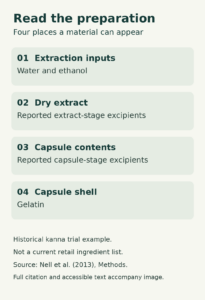
For Kiody’s approximately 500 mg pure-leaf capsules, the identity chain should begin with authenticated ground Mitragyna speciosa leaf and continue through the encapsulation record. “500 mg” describes approximate leaf fill per capsule when supported by production data; it is not a botanical identity method, alkaloid amount or usage recommendation.
If a company receives finished capsules rather than producing them from approved bulk powder, it needs sufficient documentation and testing to establish what those capsules contain. A supplier statement alone should not be treated as automatically equivalent to a verified identity program.
How identity testing helps separate leaf from concentrated 7-OH
Ordinary botanical leaf and concentrated 7-OH products should not be collapsed into one category merely because both may use the word “kratom.” Identity testing can help describe the physical and chemical form:
- plant-structure evidence can support ground botanical leaf;
- a multi-alkaloid fingerprint can be compared with authenticated leaf patterns;
- quantitative testing can show whether selected alkaloids are unusually enriched;
- records can reveal extraction, isolation, chemical conversion or addition steps; and
- derivative-specific methods can identify compounds not adequately addressed by a mitragynine-only result.
Current federal status must be described carefully. DEA’s July 6, 2026 action concerning 7-OH above proposed thresholds remains a proposal, with the comment period extended to September 10, 2026. Its proposed criteria include more than 0.050% 7-OH on a dry-weight basis for botanical material and alternative criteria for other articles. Those numbers should not be presented as an effective nationwide safe harbor or current final ban.
A separate DEA temporary order became effective August 26, 2026 for mitragynine pseudoindoxyl, MGM-15 and MGM-16. Identity and composition testing should therefore distinguish these named derivatives from ordinary botanical leaf rather than reporting only “total alkaloids.” State rules may be more restrictive.
Kiody does not sell concentrated 7-OH.
What a useful identity COA should show
Not every laboratory puts identity information on the same page as contaminants or alkaloid quantities. When identity is reported, useful fields include:
- laboratory name and report identifier;
- client and sample name;
- client lot and laboratory sample number;
- received and tested dates;
- material or matrix, such as ground botanical leaf;
- scientific name and plant part claimed;
- method or method identifier;
- reference material or reference database where appropriate;
- qualitative decision and acceptance criteria;
- analyst or authorized-review approval;
- amendments or deviations; and
- page numbering that shows whether the report is complete.
“Pass” without a method, specification or lot connection is difficult to evaluate. A numerical mitragynine result on an alkaloid panel should not automatically be relabeled as a complete botanical identity test.
The company should also confirm that the method appears on the laboratory’s applicable accreditation scope when it describes the result as accredited. ISO/IEC 17025 accreditation attaches to a laboratory’s defined scope—not every test the laboratory happens to offer.
Questions Kiody should ask an identity laboratory
- Which product matrices has the method been validated for?
- Does the method identify Mitragyna speciosa, the genus Mitragyna or only a selected marker?
- Can it distinguish the relevant allied species?
- What authenticated reference materials or sequences support the comparison?
- What are the method’s acceptance criteria?
- How does processing affect detection?
- How are mixtures or inconclusive results reported?
- Are positive, negative and contamination controls included where applicable?
- Is the method included on the laboratory’s ISO/IEC 17025 scope?
- Does the report clearly identify the tested matrix and lot?
- What quantity and sample handling does the laboratory require?
- What triggers repeat, confirmatory or orthogonal testing?
The laboratory should not be asked to convert a method beyond its validated purpose into a broader marketing claim.
A proposed Kiody botanical-identity standard
The following is a review proposal, not a claim about current operations:
- Maintain a written specification for Mitragyna speciosa leaf and each accepted form.
- Approve suppliers using documented identity, quality and traceability evidence.
- Assign a unique receiving identifier to every incoming supplier lot.
- Keep incoming material quarantined until required review and testing are complete.
- Collect a representative, documented sample under a written plan.
- Use at least one scientifically justified identity method suitable for the material’s form.
- Use complementary evidence when one method lacks adequate specificity.
- Record the authenticated references, databases and method versions used.
- Establish written pass, fail and inconclusive criteria before testing.
- Investigate mismatches, unexpected fingerprints and failed DNA amplification rather than rewriting the specification after seeing the result.
- Connect approved bulk powder to finished powder and capsule lots through production records.
- Keep identity, contaminant, alkaloid and legal reviews as separate release questions.
- Require quality-control approval before release.
- Retain enough records to reconstruct which supplier lot entered each customer-facing lot.
If adopted, Kiody should publish only standards that its actual records can support.
A five-minute customer identity checklist
Before relying on a kratom product’s identity claim, ask:
- Does the label name Mitragyna speciosa leaf rather than only “proprietary botanical”?
- Is there a visible lot number?
- Can that lot be matched to a COA or supporting record?
- Does the company distinguish identity testing from alkaloid and contaminant testing?
- Does the report identify the method and sample matrix?
- Is a mitragynine-only result being overstated as proof of everything in the package?
- If the product is an extract or enhanced form, does the testing address the processed form?
- Are concentrated 7-OH and named derivatives reported separately from ordinary leaf?
- Does the company avoid FDA-approval and medical-treatment claims?
- Can customer support explain the identity method in plain language?
A missing public detail is not automatic proof of a bad product. It is a reason to ask for clarification before treating “lab tested” as a complete answer.
Frequently asked questions
Is mitragynine testing the same as kratom identity testing?
Not necessarily. Mitragynine can be a useful chemical marker, but detecting one compound does not by itself prove species identity, plant part, absence of other plants or absence of added alkaloids. The method and specification determine what conclusion the result supports.
Can a laboratory identify kratom by color?
Color may be documented during organoleptic examination, but it is not sufficiently specific by itself. Processing and normal botanical variation can change powder color, and commercial red, green and white names are not formal species identifications.
Is DNA testing always the best method?
No. DNA can provide strong species evidence when suitable DNA survives and the selected regions and references are discriminatory. Extracts, heat-treated material and mixtures may produce limited or complicated results. Chemical or manufacturing evidence may be needed.
Does a failed DNA test prove that a product is fake?
No. “No amplification” or an inconclusive result can occur because DNA is degraded, insufficient or affected by the matrix. The result should trigger review or complementary testing, not an automatic conclusion beyond the method.
Can microscopy identify powdered kratom?
Microscopy can examine diagnostic plant structures remaining in a powder. Its value depends on reference materials, analyst competence, particle size, processing and the specificity of the observed features. It is much less useful when extraction has removed plant tissue.
What is an orthogonal identity test?
In practical quality language, it is a test based on a different scientific principle. DNA barcoding and chemical fingerprinting are complementary because one evaluates genetic evidence and the other evaluates chemical composition.
Does a botanical identity pass mean the product is contaminant-free?
No. Microorganisms, heavy metals, pesticides and mycotoxins require their own specifications and methods. Identity and contaminant testing answer different questions.
Does a COA prove every capsule contains the same material?
The COA describes the submitted sample. Production controls and representative finished-lot testing help connect that result to packaged capsules. The lot match, sampling plan and batch records matter.
Are pure-leaf capsules extracts?
Not when they contain only ground leaf and the capsule-shell ingredients. Kiody describes its capsules as pure botanical leaf with approximately 500 mg of leaf fill per capsule. That statement should be supported by component identity and production records, not confused with an alkaloid amount or use direction.
Can identity testing tell whether 7-OH was added?
A sufficiently broad quantitative chemical profile and manufacturing records may identify an unusual or enriched product, but a basic species or mitragynine test may not answer that question. Added, concentrated or transformed alkaloids require product-specific analysis.
Is the proposed federal 0.050% 7-OH threshold already effective?
No. As reviewed August 29, 2026, it remains part of a proposed federal action, and the comment period runs through September 10, 2026. Separate federal scheduling for mitragynine pseudoindoxyl, MGM-15 and MGM-16 became effective August 26, 2026.
Does identity testing make medical claims acceptable?
No. Product identity does not establish that kratom diagnoses, treats, cures or prevents any disease. Kiody content should remain educational and nonmedical.
Primary and authoritative sources
- Electronic Code of Federal Regulations, 21 CFR § 111.70—Specifications. Establishes identity, component, in-process, packaging, label and finished-product specification concepts used here as quality-system benchmarks.
- Electronic Code of Federal Regulations, 21 CFR § 111.75—Determining whether specifications are met. Lists organoleptic, macroscopic, microscopic, chemical and other scientifically valid methods and addresses supplier COAs.
- FDA, Small Entity Compliance Guide for Dietary Supplement CGMP. Provides official explanations of receiving, lot identification, quarantine, COA and quality-control records.
- FDA, FDA and Kratom. Current federal public-health and product-status context; confirms that the quality benchmarks in this guide are not FDA approval of kratom.
- Tungphatthong C. et al., Differentiation of Mitragyna speciosa from allied species using DNA barcoding–high-resolution melting analysis, Scientific Reports 11, 6738 (2021). Primary kratom-authentication study evaluating ITS2, rbcL, trnH-psbA and matK regions.
- Graham K. et al., Sequence variation of commercially available kratom products using DNA barcoding (2024). Primary study evaluating ITS and chloroplast barcode regions in commercial products.
- Anantaworasakul P. et al., DNA Barcoding and Chemical Profile Using UHPLC, GC-MS and LC-MS/QTOF, Plants 15(7), 1003 (2026). Primary integrated authentication study using genetic and chemical evidence.
- Sharma A. et al., Chemical Analysis and Alkaloid Intake for Kratom Products Available in the United States, Drug Testing and Analysis (2025). Primary analysis of 341 predominantly whole-leaf product samples and their multi-alkaloid fingerprints.
- DEA, Proposed temporary placement of 7-OH above specified thresholds (July 6, 2026). Official proposed-action text and thresholds.
- HHS, Extension of the 7-OH threshold comment period (August 26, 2026). Confirms the September 10, 2026 deadline.
- DEA, Temporary placement of mitragynine pseudoindoxyl, MGM-15 and MGM-16 in Schedule I (effective August 26, 2026). Official current federal derivative status.