Important: This guide provides product-handling information, not medical advice or a recommendation to use kratom. Storage cannot make an unsafe, adulterated, recalled, expired, prohibited, or incorrectly labeled product safe. Follow the exact package directions and applicable law. If anyone has severe or rapidly worsening symptoms, call 911. In the United States, Poison Help is available at 1-800-222-1222.
The short answer
Keep a kratom product in its original, correctly labeled container unless the manufacturer gives different instructions. Close the package securely after each opening. Protect it from moisture, excessive heat, direct light, contamination, pests, and mixups. Keep it inaccessible to children and pets. Preserve the lot number, product name, package size, seller information, and any “best by” or expiration date.
Do not use a product simply because it looks normal. Set it aside if the seal was broken before purchase, the container is damaged, the contents are unexpectedly wet, the label conflicts with the order, the lot number is missing or unreadable, the matching laboratory report cannot be found, the product is subject to a recall, or anything about the package creates a reasonable concern.
There is no honest universal answer such as “all kratom lasts exactly two years.” A shelf-life statement depends on the formulation, moisture, packaging, closure, manufacturing controls, storage conditions, and supporting stability data. FDA’s dietary-supplement manufacturing guidance says the applicable rule does not require an expiration or “best if used by” date, but a company that places such a date on a label should have data supporting it. FDA CGMP compliance guide
That FDA guidance is a useful quality-system benchmark; it does not change FDA’s separate position that kratom is not lawfully marketed as a dietary supplement, conventional-food additive, or drug. FDA and Kratom
Why storage is part of product quality
Quality is not frozen at the moment a laboratory receives a sample. A test report describes the submitted sample and the measurements reported by the laboratory. It does not control what happens to every finished pouch after packaging.
Between the manufacturing site and the customer, a product may pass through:
finished batch → packaging → warehouse → carrier → delivery location → customer storage
At every point, the product identity and container should remain intact. A strong quality program therefore addresses more than initial testing. It also addresses packaging suitability, label control, lot traceability, storage conditions, distribution records, complaints, returns, and recalls.
The federal dietary-supplement CGMP framework in 21 CFR Part 111 requires covered products and components to be held under appropriate temperature, humidity, and light conditions so identity, purity, strength, and composition are not affected. It also addresses protection from mixups, contamination, and deterioration. Again, these provisions are cited here as a concrete quality-control model, not as a claim that FDA has accepted kratom as a lawful dietary supplement. 21 CFR Part 111
Start with the original package
The original Kiody package should connect the physical product to the information needed to investigate it:
- exact product name;
- powder or capsule form;
- color family and commercial variety name;
- net weight or capsule count;
- ingredient statement;
- lot, batch, or control number;
- relevant date marking;
- storage directions;
- warnings and age restriction;
- business and contact information; and
- a usable route to the matching laboratory report.
Moving powder into an unmarked jar can break that connection. If the original package is discarded, the customer may lose the lot number, warnings, product form, package quantity, and date information needed during a complaint or recall.
If a secondary container is necessary, preserve the original packaging and copy the product name, lot number, date, and storage instructions accurately. Never combine different lots in one container. Never place kratom in a food, drink, candy, medicine, or household-product container that could cause someone to mistake its contents.
The five storage factors that matter most
1. Moisture
Unexpected moisture can change a dry botanical powder and create conditions different from those used to establish the product’s specifications or shelf-life support. Humid rooms, wet scoops, condensation, spills, and closures left open can introduce moisture.
Practical safeguards include:
- close the zipper, lid, or closure completely after use;
- use only clean, dry utensils;
- do not reach into the package with wet hands;
- do not store the package beside a sink, shower, humidifier, kettle, or other recurring moisture source;
- do not return powder that has contacted a cup, counter, utensil, or another product; and
- set the package aside if the inside becomes unexpectedly damp or the powder changes in a concerning way.
Normal powder can form small clumps from compression or static. Clumping alone does not diagnose contamination. The relevant question is whether the condition is new, unexplained, associated with moisture, or inconsistent with the product when received.
2. Temperature
Follow the labeled storage conditions. Avoid leaving products in places likely to experience uncontrolled heat, such as a parked vehicle, next to a stove, on top of heat-producing equipment, or in direct sun.
A responsible seller should not publish a universal storage-temperature range unless it has verified that the range applies to the actual formulation and packaging. It should also avoid advising refrigeration or freezing without product-specific evidence. Cold storage can introduce condensation when a container is repeatedly opened or returned to room temperature.
3. Light
Direct sunlight can heat a package and may affect light-sensitive constituents or packaging over time. Store the product in a location consistent with the label and protect it from prolonged direct light.
Opaque or light-limiting packaging can be part of a container system, but color alone does not prove protection. The closure, seams, liner, barrier properties, print durability, and the complete package configuration matter.
4. Air and closure integrity
Resealable pouches work only when the seal is free of trapped powder and pressed closed across its full width. Screw-top containers require a properly seated lid. Tamper-evident features should be intact when the customer first receives the product.
A damaged zipper does not automatically establish that the contents are contaminated, but it means the package is no longer performing as intended. Do not repair a commercially sealed package with household tape and then treat it as equivalent to the original closure. Photograph the condition and contact Kiody.
5. Contamination and mixups
Store kratom away from cleaning products, pesticides, fuels, fragrances, pet supplies, and other materials that could spill, leak, transfer odors, or be confused with it. Use a dedicated clean utensil instead of a scoop shared across foods, powders, supplements, or household chemicals.
Keep different colors, varieties, forms, and lots separated. A Red Bali capsule package should not be topped off with Red Bali capsules from a different lot. The names may match while the batch records and dates do not.
What “best by,” “use by,” and expiration dates mean
These phrases are often used casually, but A responsible seller should define exactly what its date represents.
A date is not a guess
FDA’s dietary-supplement CGMP compliance guide states that an expiration, shelf, or “best if used by” date is not required by that rule, but any date used should be supported by data. The guidance also discusses retaining reserve samples for one year past a shelf-life date when such dating is used, or for two years after distribution of the last associated batch when it is not. FDA CGMP compliance guide
The most defensible Kiody date would be tied to:
- the defined product specification;
- the finished formulation;
- the actual container-closure system;
- labeled storage conditions;
- stability observations or testing;
- documented production and packaging dates; and
- an approved method for extending, shortening, or investigating the period.
Changing from a pouch to a bottle, changing the closure, adding a desiccant, changing capsule-shell material, or changing the formulation can make prior support less relevant. A responsible seller should not simply copy a supplier’s date onto a different finished package without determining what the date covers.
“Best by” is not permission to ignore a problem
A package can require investigation before its date if the seal fails, it becomes wet, it is recalled, it was stored outside the labeled conditions, the label is wrong, or a customer reports a concern.
Conversely, reaching a printed date does not tell a customer what chemical or microbiological change occurred at midnight. It means the labeled quality period has ended or requires the action defined by the company. A responsible seller should provide a clear policy rather than encouraging customers to smell, taste, or visually judge an out-of-date product.
Do not reset the clock
Repackaging an older lot does not create a new botanical batch or justify a new unsupported shelf-life period. Internal records should preserve the relationship among the source lot, packaging date, finished lot, and date marking.
Powder and capsules need separate handling information
Pure-leaf powder
Loose powder is repeatedly exposed when the pouch is opened. The customer should keep the closure clean, avoid introducing moisture, and use a dry utensil. Package instructions should explain whether a scoop is included and how it should be stored.
Pure-leaf capsules
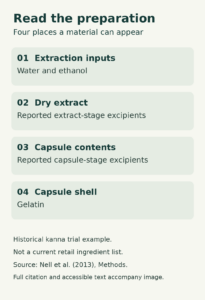
Capsules add a shell and a finished-unit form. Storage conditions can affect both the leaf fill and the capsule shell. The label should identify the shell ingredients and state the approximate nominal fill only when verified.
If Kiody describes a capsule as approximately 500 mg, that means approximately 500 mg of leaf powder per capsule—not 500 mg of mitragynine, 7-OH, or total alkaloids. It is not dosing advice.
Capsules should be set aside if they are unexpectedly cracked, leaking, stuck together from unexplained moisture, visibly contaminated, or inconsistent with the sealed product’s expected appearance. Minor cosmetic differences should be documented and reviewed rather than diagnosed from a photograph alone.
A package-integrity check before opening
Before breaking the seal, confirm:
- The shipment is yours. The recipient and order match.
- The outer shipment shows no concerning damage. Photograph crushing, punctures, wetness, or leakage.
- The product name matches the order. Verify color, variety, and form.
- The package size matches. Confirm net weight or capsule count option.
- The Kiody artwork is current and consistent. A logo mismatch may be a packaging-version issue, but it should be checked.
- The tamper-evident feature is intact. Do not assume a broken or missing seal is harmless.
- The lot number is readable. It should connect to the correct batch documentation.
- The date is readable. Follow the policy stated on the package.
- Warnings and ingredients are present. Missing information is a reason to pause and contact support.
- The laboratory-report route works. The report should match the lot, not merely the product name.
If a mismatch exists, preserve the unopened condition until Kiody responds when practical. Opening the package can make it harder to determine when damage occurred.
When to set a product aside
Set the product aside and contact Kiody if you observe:
- a broken or missing first-open seal;
- a puncture, split seam, leak, or damaged closure;
- unexplained moisture inside a dry product;
- insects, foreign material, or visible growth;
- a strong unexpected odor that was not present when the product was received;
- a powder/capsule, color, variety, or quantity mismatch;
- an unreadable or missing lot number;
- a lot that cannot be matched to the available documentation;
- a label pasted over conflicting product information;
- evidence that the product was exposed to a chemical spill or unsuitable storage condition;
- a recall or stop-use notice covering the product or lot; or
- illness or another adverse event that may be associated with the product.
Do not “test” a questionable product by tasting or consuming more. Do not discard the only evidence until you have documented it, unless an emergency instruction or official recall specifically tells you to dispose of it immediately.
What to document for Kiody support
A useful report includes:
- product name and form;
- color and commercial variety;
- lot or batch number;
- package size or capsule count;
- order number and purchase date;
- date received and date opened;
- where and how it was stored;
- clear photos of the front, back, seal, lot code, and concern;
- a short factual description of what was observed and when;
- whether anyone used the product; and
- whether anyone became ill or required medical care.
Avoid posting medical records, full payment-card details, passwords, or unrelated personal information in a public review or community thread. A responsible seller should provide a private, verified channel for sensitive details.
Recalls: why the original lot number matters
In 2018, FDA used mandatory recall authority for certain kratom products because of Salmonella risk. FDA advised consumers with affected products to discard them and gave specific precautions for products no longer in original packaging, including cleaning storage containers and preventing cross-contamination. FDA mandatory kratom recall
That historical event demonstrates why “it looks fine” is not an adequate recall check. Microbial contamination is not reliably ruled out by appearance, smell, or taste. A product name alone may also be too broad. The lot or other identifying information allows a company to determine whether a notice covers the package in hand.
Storage claims that should not appear on product pages
Avoid unsupported statements such as:
- “stays fresh forever”;
- “never expires”;
- “guaranteed sterile”;
- “mold-proof packaging”;
- “refrigeration always extends life”;
- “freezing preserves every alkaloid”;
- “safe if it smells normal”;
- “heat cannot affect it”;
- “the gold pouch proves authenticity”;
- “lab tested, so storage does not matter”; or
- a specific shelf life copied from another seller.
A responsible seller can say what it has documented: the exact container, labeled conditions, supported date, current lot, testing performed, and support process.
Frequently asked questions
How long does kratom powder last?
There is no responsible universal period for every product. Use Kiody’s supported date and storage instructions for the exact formulation and package. Contact Kiody if the date is absent, unreadable, or inconsistent.
Should kratom be refrigerated?
Not unless the label or verified product-specific instructions say so. Refrigeration can create condensation if the package is repeatedly moved between temperatures. Follow the package directions.
Can I freeze kratom?
Do not assume freezing extends shelf life. A responsible seller should recommend freezing only if it has evaluated the formulation, package, thawing, condensation, and stability implications.
Is a resealable pouch enough?
Only if the complete packaging system is suitable and the closure remains functional. Close it fully, keep the sealing track clean and dry, and report damage.
Can I move powder into a glass jar?
The original package preserves essential identity and recall information. If a secondary container is necessary, retain the original package and accurately transfer the name, lot, date, warnings, and storage directions. Do not mix lots.
Does a dark pouch guarantee protection from light and air?
No. Appearance does not prove barrier performance. Package material, seams, closure, liner, handling, and the finished system all matter.
Is clumped powder unsafe?
Clumping alone does not diagnose contamination. Set the package aside if clumping is new, associated with wetness, or otherwise concerning, and let Kiody review the lot and storage history.
Can I rely on smell or taste to check safety?
No. Appearance, smell, and taste cannot reliably rule out microbial, chemical, or heavy-metal contamination. Do not taste-test a questionable product.
What if the package arrived open?
Do not use it. Photograph the shipping container, package, closure, lot number, and contents; preserve the materials and contact Kiody through the verified support channel.
What if my product has no lot number?
Set it aside and contact Kiody. Without a readable lot identifier, matching the package to batch documentation or a recall can be difficult.
Where can I check recalls?
Check FDA’s current Recalls, Market Withdrawals and Safety Alerts. Confirm product name, form, package size, lot, and dates.
How do I report a serious product problem?
Seek appropriate medical help first. Preserve the package and lot information, notify Kiody, and use FDA’s current reporting pathway when appropriate. FDA maintains a central Report a Problem page and the Human Foods Program can be reached at 1-888-SAFEFOOD (1-888-723-3366), option 4. FDA Human Foods assistance
Primary and authoritative sources
- FDA, Small Entity Compliance Guide for Dietary Supplement CGMP: https://www.fda.gov/regulatory-information/search-fda-guidance-documents/small-entity-compliance-guide-current-good-manufacturing-practice-manufacturing-packaging-labeling
- Electronic Code of Federal Regulations, 21 CFR Part 111: https://www.ecfr.gov/current/title-21/chapter-I/subchapter-B/part-111
- Electronic Code of Federal Regulations, 21 CFR Part 111 Subpart M: https://www.ecfr.gov/current/title-21/chapter-I/subchapter-B/part-111/subpart-M
- FDA, “FDA and Kratom,” updated December 2, 2025: https://www.fda.gov/news-events/public-health-focus/fda-and-kratom
- FDA, 2018 Mandatory Kratom Recall Due to Salmonella Risk: https://www.fda.gov/safety/recalls-market-withdrawals-safety-alerts/fda-orders-mandatory-recall-kratom-products-due-risk-salmonella
- FDA, Recalls, Market Withdrawals and Safety Alerts: https://www.fda.gov/safety/recalls-market-withdrawals-safety-alerts
- FDA, Report a Problem: https://www.fda.gov/safety/report-problem-fda
- FDA Human Foods Program Assistance, updated January 16, 2026: https://www.fda.gov/food/resources-you-food/get-assistance-fda-human-foods-program-hfp
- HRSA Poison Help: https://poisonhelp.hrsa.gov/