Important: This guide is educational. It does not recommend kratom, provide dosage advice, promise safety or effectiveness, or rank individual sellers. FDA states that kratom is not lawfully marketed in the United States as a drug, dietary supplement, or conventional-food additive. A professional website, laboratory report or positive review does not make a product risk-free, FDA-approved or legal in every jurisdiction.
The short answer
A trustworthy kratom company should make important product facts easy to verify before checkout. That means more than displaying a polished logo or using the words “premium” and “lab tested.” A buyer should be able to identify:
- what the product actually is;
- whether it is ordinary botanical leaf, an extract or an enhanced product;
- its net quantity or capsule count;
- its ingredients and warnings;
- its lot or batch number;
- a laboratory report that matches that lot;
- what the laboratory did—and did not—test;
- the seller’s current shipping restrictions;
- how to contact the company about a problem; and
- clear return, complaint and recall procedures.
Trust grows when evidence is specific, current and consistent across the product page, package, cart and laboratory report. It falls when a seller substitutes dramatic claims, anonymous reviews or a generic “tested” badge for verifiable information.
This guide gives customers a practical way to compare sellers without assuming that any single badge, association, testimonial or test result settles every question.
Why kratom vendor comparisons require extra care
Online shoppers often compare ordinary consumer goods by price, star rating and appearance. Kratom requires more careful distinctions because similarly named products may be very different.
A page labeled “Green Maeng Da” could describe plain botanical leaf powder, pure-leaf capsules, an extract, a blend, or a product with added alkaloids. A “500 mg capsule” may refer to approximately 500 mg of leaf fill; it should not be confused with 500 mg of mitragynine or 7-hydroxymitragynine. A “lab tested” statement may refer to one analyte, one old batch or a report that does not match the package being sold.
FDA has warned about contamination in certain kratom products, including Salmonella and concerning heavy-metal levels. The agency has also warned consumers about products containing concentrated or enhanced 7-OH. Those concerns make product identity, lot traceability and testing scope meaningful—not decorative. FDA and Kratom
The goal is not to tell customers that a particular product is safe. It is to help them ask better questions and recognize whether a seller supplies evidence that can actually be checked.
Trust signal 1: the product form is stated plainly
The first question should be simple: What is this?
A responsible product page should identify whether the item is:
- botanical Mitragyna speciosa leaf powder;
- pure-leaf capsules;
- a botanical extract;
- an enhanced or fortified product;
- a liquid, tablet, gummy or other prepared form; or
- a product containing added or concentrated 7-OH or another derivative.
The product name, short description, full description, image and cart label should agree. A page should not market an enhanced product as though it were ordinary leaf. FDA has specifically noted that concentrated 7-OH products may be disguised or marketed as kratom even though concentrated or enhanced 7-OH is materially different from the trace amount that may occur naturally in the plant. FDA 7-OH action
For Kiody, every powder and capsule page should say botanical leaf or pure-leaf capsules when that is accurate. Kiody does not sell concentrated or enhanced 7-OH products, and its product pages should state that distinction without claiming ordinary leaf is risk-free.
Trust signal 2: the strain or variety name is not treated as a medical promise
Names such as Maeng Da, Bali, Hulu, Ketapang, Vietnam and Malay are commercial catalog names. Green, Red and White are product-family labels. Those names can help organize choices, but they do not establish a standardized medical effect, potency level or chemical specification.
A trustworthy seller describes what is verifiable: product form, ingredients, package size, lot identity and test results. It avoids guaranteed effect charts, disease-treatment language and claims that every customer will experience the same result.
Watch for wording that turns a color or variety name into a promise to treat pain, anxiety, depression, withdrawal, insomnia or another condition. The FTC explains that advertisers are responsible not only for explicit claims but also for reasonable implied claims. Health-related claims require appropriate substantiation. FTC Health Products Compliance Guidance
Trust signal 3: quantity information is exact and understandable
Powder pages should state net weight. Capsule pages should state the actual capsule count and a verified approximate fill per capsule when the seller makes that claim.
For example:
- “Net weight: 100 g” identifies the powder quantity.
- “60 pure-leaf capsules; approximately 500 mg leaf powder per capsule” identifies both count and approximate fill.
- “500 mg” should not appear alone where it could be mistaken for an alkaloid amount.
NIST Handbook 130’s model packaging rules require net quantity to exclude wrappers and other material packed with the commodity. NIST also explains that quantity declarations help purchasers compare price and quantity. These model rules are useful product-literacy benchmarks, but the exact law applicable to a package depends on the product and jurisdiction. NIST Packaging and Labeling, NIST Handbook 130—2026
A warning sign is a dropdown labeled only “small,” “medium” and “large” with no actual weight or count.
Trust signal 4: ingredients are complete and match the product form
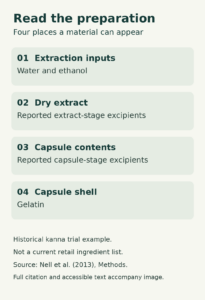
A plain-leaf powder page should not hide additional ingredients. A capsule page should identify the botanical fill and the capsule shell material. An extract should identify its form and the basis of any concentration claim.
The ingredients shown online should match the finished package. If the product contains flavors, sweeteners, colors, carriers, acids or other ingredients, those should not be buried in an image that is impossible to read on a phone.
“Proprietary” should not be used to conceal the basic identity of what the customer is buying. A company may protect legitimate manufacturing details while still giving customers an accurate ingredient statement.
Trust signal 5: every sellable package has a lot or batch identifier
A lot number connects a physical package to records about sourcing, processing, packaging, testing and distribution. Without that connection, a customer cannot know whether a displayed certificate of analysis belongs to the product in hand.
The lot should be visible on the pouch or bottle and should match the lot shown on the relevant COA. If the seller uses a QR code, it should open the correct report directly or lead to a simple lot-search page. It should not lead only to the homepage.
FDA-posted recall notices demonstrate why lot-level identification matters. A 2025 kratom recall identified affected products by brand, variety, package size, UPC and lot number. That specificity allows a company and its customers to distinguish affected packages from unrelated ones. FDA-posted 2025 kratom recall
Trust signal 6: the COA matches the lot being sold
A generic laboratory PDF is not enough. Check at least these fields:
- product or sample name;
- lot, batch or sample identifier;
- date received and date reported;
- laboratory name and report number;
- tests performed;
- results and units;
- detection or quantitation limits where relevant; and
- signs that the report is complete rather than a cropped screenshot.
The page should not display one old COA for every future batch. A current lot may have different measured values or a different contamination status.
A trustworthy seller also explains what happens during the gap between a batch change and the posting of its report. The answer should not be “trust us.”
Trust signal 7: “lab tested” identifies the actual testing scope
Laboratory testing is not one universal test. A report may include some or all of the following:
- alkaloid identity or quantitation;
- heavy metals such as lead, arsenic, cadmium and mercury;
- microbiological targets such as Salmonella or specified organisms;
- residual solvents for relevant extracted products;
- pesticides or other analytes; and
- basic identity or physical measurements.
A result for mitragynine does not prove the batch passed microbiological testing. A heavy-metal panel does not prove the absence of every contaminant. “Full panel” should be defined rather than treated as a self-explanatory badge.
FDA’s analysis of 30 kratom products found concerning lead and nickel levels in tested samples. FDA has also documented Salmonella-related recalls. Those findings support asking whether a seller’s current batch-testing program addresses relevant contaminants; they do not prove that every tested or untested product has the same condition. FDA heavy-metal analysis, FDA mandatory kratom recall
Trust signal 8: laboratory credentials can be verified
ISO/IEC 17025 is an international standard for testing and calibration laboratory competence, impartiality and consistent operation. Accreditation to the standard can strengthen confidence in a laboratory’s technical system, but it should not be presented as proof that every sample is safe or that every possible analyte was tested. ISO/IEC 17025 overview
Customers should be able to identify the laboratory and, when accreditation is claimed, verify the accrediting body, scope and current status. The scope matters: a laboratory can be accredited for some methods or fields without every method on a particular report necessarily falling within its accredited scope.
Warning signs include an unnamed laboratory, a blurred logo, a certificate number that cannot be checked, or a seller-created spreadsheet presented as an independent laboratory report.
Trust signal 9: results are shown with units and limits
Numbers without units are incomplete. A result may be expressed as percent, parts per million, micrograms per gram, milligrams per kilogram or another unit. Those values cannot be compared responsibly without understanding the unit and the basis of measurement.
Customers should also be able to distinguish:
- ND: not detected under the stated method and reporting conditions;
- LOD: limit of detection;
- LOQ: limit of quantitation; and
- a zero, which is not automatically equivalent to ND.
“Passed” should be accompanied by the result, applicable limit and enough method information to understand what was evaluated. A pass badge alone is not a data table.
Trust signal 10: the seller does not make unsupported health or safety claims
Claims such as “completely safe,” “non-addictive,” “FDA approved,” “clinically proven,” “treats withdrawal,” or “guaranteed pain relief” should trigger caution.
FTC advertising standards require advertising to be truthful and non-deceptive and require evidence to support objective claims. The FTC’s health-products guidance explains that the amount and quality of evidence depend on the claim and that disclaimers cannot reliably cure a misleading main message. FTC Advertising FAQs, FTC substantiation policy
A responsible seller can explain its manufacturing, testing, packaging and support practices without converting those practices into a promise of medical benefit or zero risk.
Trust signal 11: ordinary leaf and concentrated 7-OH are separated
A trustworthy catalog does not place pure botanical leaf, high-concentration extracts and enhanced 7-OH into one vague “kratom” category without explanation.
The product page should state:
- whether 7-OH was added or enhanced;
- whether the product is plain leaf or an extract;
- the relevant measured units when a claim is made; and
- any destination restrictions specific to that form.
As of August 28, 2026, DEA’s federal action concerning 7-OH above a specified threshold remains a notice of intent, not a final effective scheduling order. A separate DEA order temporarily placed mitragynine pseudoindoxyl, MGM-15 and MGM-16 into Schedule I effective August 26, 2026. Sellers should not merge those separate federal actions or describe a proposal as already effective law. Federal 7-OH notice, effective derivative order
Trust signal 12: shipping restrictions are specific and dated
“Ships nationwide” is not a reliable trust signal. Kratom rules vary by jurisdiction, product form and date. A seller should identify prohibited or restricted destinations and state when the information was last reviewed.
The best shipping notice distinguishes:
- ordinary botanical leaf;
- extracts;
- concentrated or enhanced 7-OH;
- synthetic or semi-synthetic derivatives;
- state restrictions;
- known local restrictions; and
- age requirements.
The seller should avoid inferring legality from a jurisdiction’s silence. It should also make clear that an online checkout control is an operational precaution, not legal advice to the customer.
Trust signal 13: policies are visible before payment
Customers should not have to begin checkout to discover basic terms. A responsible store makes the following easy to find:
- shipping timeframes and carriers;
- destination restrictions;
- return and refund rules;
- treatment of opened products;
- damaged-package procedures;
- privacy information;
- age requirements;
- contact methods; and
- complaint or recall instructions.
The FTC advises online shoppers to research sellers and products and carefully read product descriptions. Clear, accessible policies help customers make that evaluation. FTC Online Shopping guidance
For Kiody, policies should use plain language and remain consistent between the footer, product page, cart and checkout.
Trust signal 14: reviews are authentic and not manipulated
Five stars do not replace batch evidence. Reviews can still help customers judge service, packaging and whether an order arrived as described, but companies should not fabricate reviews, buy sentiment or hide material relationships.
The FTC’s Consumer Reviews and Testimonials Rule prohibits specified practices involving fake or false reviews, purchasing positive or negative reviews, certain undisclosed insider reviews, review suppression and fake indicators of social-media influence. FTC final review rule, FTC review-rule Q&A
Trustworthy review practices include:
- marking verified purchases accurately;
- disclosing incentives or material relationships;
- publishing critical reviews unless they violate a neutral policy;
- not converting customer statements into medical advertising; and
- giving the company a documented way to respond to service problems.
Trust signal 15: the company can answer a lot-specific question
The strongest trust signal is operational: can the company respond when something does not match?
A customer should be able to ask:
- “Is this the current COA for lot KIO-XXXX?”
- “Why does the package weight differ from the product page?”
- “What should I do if the seal is damaged?”
- “Was this lot included in a recall?”
- “Why did the product image change after I selected another size?”
A useful response should identify the relevant product and lot, explain the evidence available, preserve complaint details and give a clear next step. A generic chatbot statement that “all products are safe and tested” is not an acceptable substitute.
Ten warning signs that deserve a closer look
No single warning sign automatically proves fraud or contamination, but multiple unresolved signs should slow a purchase decision:
- The product form is unclear or changes between the title and description.
- “500 mg” appears without saying whether it means leaf fill or an alkaloid amount.
- The page promises treatment, withdrawal relief or guaranteed effects.
- The COA has no matching lot number.
- The report is cropped, altered, unreadable or missing pages.
- “Full panel” appears without a list of analytes and results.
- The seller claims “FDA approved” or uses an official-looking government seal.
- Every review is perfect, generic or posted in an unnatural pattern.
- Shipping is advertised as unrestricted everywhere.
- There is no working contact, return, complaint or recall process.
The appropriate response is not necessarily to accuse the company. Ask for clarification and evidence. If the answer stays vague, treat the uncertainty as part of the decision.
A five-minute vendor comparison checklist
Before ordering, open the product page, COA and policy pages side by side.
Product identity
- Is the product ordinary leaf, pure-leaf capsules, an extract or an enhanced product?
- Do the title, description, photograph and cart label match?
- Are all ingredients shown?
Quantity
- Is powder listed by net weight?
- Are capsules listed by count and verified approximate fill?
- Are ounces and grams converted accurately?
Batch evidence
- Is the lot shown on the package?
- Does the COA match the lot?
- Are dates, units, methods and reporting limits visible?
- Does the testing scope include the panels the seller claims?
Business practices
- Are shipping, returns, complaints and recalls explained?
- Is there a real contact method?
- Are reviews handled transparently?
- Are age and destination restrictions visible?
Claims
- Does the seller avoid medical promises?
- Does it avoid calling the product risk-free or FDA approved?
- Does it distinguish botanical leaf from concentrated 7-OH and synthetic derivatives?
Frequently asked questions
Does a COA prove that kratom is safe?
No. A COA reports results for a sample, specified tests, methods and reporting limits. It does not prove zero risk, individual suitability, legal status everywhere or the absence of every untested substance.
Is ISO/IEC 17025 accreditation enough by itself?
No. It is a meaningful laboratory-competence signal, but customers should still confirm the laboratory, accreditation status, relevant scope, sample identity, test methods and lot match.
Does “lab tested” mean the product passed every possible test?
No. The phrase should be followed by the actual testing scope. Alkaloid, heavy-metal, microbiological, pesticide and solvent analyses are separate.
Are positive reviews proof of product quality?
No. Reviews may help evaluate service or whether an order arrived as described, but they do not replace a matching COA, accurate label or lot-level records.
Is a 500 mg capsule an extract?
Not necessarily. If a pure-leaf capsule listing states approximately 500 mg of leaf fill per capsule, the finished-product specification should support that statement. It is not a statement of 500 mg of mitragynine or 7-OH.
Does a bigger package mean stronger kratom?
No. Package size measures quantity. It does not establish alkaloid concentration, potency or expected effect.
Are Green, Red and White standardized chemical grades?
No universal national standard makes every product with the same commercial color label chemically identical. Use the label to navigate the catalog, then verify the current batch information.
Should a product page list the current lot number?
It should provide a reliable way to connect the sellable inventory to the matching lot and report. The exact display method may vary, but the connection must be real and maintained.
What if the COA and package lot do not match?
Do not assume the displayed report covers the package. Contact the seller and request the report for the exact lot before relying on the results.
Can a disclaimer fix an unsupported health claim?
Not reliably. The FTC evaluates the overall express and implied message. A small disclaimer does not automatically correct a prominent misleading claim.
Should a seller ship wherever checkout accepts an address?
No. Checkout behavior is not proof of legality. Sellers should maintain current product-specific restrictions, and customers should check applicable state and local rules.
Does Kiody sell concentrated 7-OH?
No. Kiody’s catalog should clearly state that it does not sell concentrated or enhanced 7-OH products and should keep ordinary botanical leaf pages separate from 7-OH education and law-tracker content.
The bottom line
A trustworthy kratom company makes it easier to verify facts than to absorb slogans.
Look for a clearly identified product form, accurate quantity, complete ingredients, a matching lot-level COA, defined testing scope, verifiable laboratory information, current restrictions, honest reviews and a working support process. Treat medical promises, vague lab badges, mismatched reports and unrestricted-shipping claims as reasons to ask more questions.
A responsible seller can earn trust by publishing specific evidence, acknowledging the limits of that evidence and correcting errors when product data or laws change. That approach is stronger than claiming perfection.
Primary and authoritative sources
- U.S. Food and Drug Administration, FDA and Kratom, updated December 2, 2025.
- U.S. Food and Drug Administration, Laboratory Analysis of Kratom Products for Heavy Metals.
- U.S. Food and Drug Administration, FDA Orders Mandatory Recall for Kratom Products Due to Risk of Salmonella.
- U.S. Food and Drug Administration, Vanguard Enterprises/Bedrock MFG Lot-Specific Kratom Recall, October 30, 2025.
- U.S. Food and Drug Administration, FDA Takes Steps to Restrict 7-OH Opioid Products, July 29, 2025.
- Federal Trade Commission, Health Products Compliance Guidance.
- Federal Trade Commission, Advertising FAQs: A Guide for Small Business.
- Federal Trade Commission, Consumer Reviews and Testimonials Rule Q&A.
- National Institute of Standards and Technology, NIST Handbook 130—2026.
- International Organization for Standardization, ISO/IEC 17025—Testing and Calibration Laboratories.
- Drug Enforcement Administration, Notice of Intent for 7-OH Above a Specified Threshold, July 6, 2026.
- Drug Enforcement Administration, Temporary Schedule I Order for Mitragynine Pseudoindoxyl, MGM-15 and MGM-16, effective August 26, 2026.
- Google Search Central, Merchant Listing Structured Data and Product Variant Structured Data.