Last reviewed September 15, 2026. Educational content for adults 21+. This article is not medical advice and does not recommend a dose or use. Kiody does not sell concentrated 7-hydroxymitragynine (7-OH) products.
The short answer: understanding how 7-hydroxymitragynine forms requires separating several routes. A laboratory may measure a trace amount in a leaf sample; post-harvest handling can change the alkaloid profile; enzymes can convert some mitragynine into 7-OH after botanical-leaf exposure; and manufacturers can deliberately produce or enrich high-7-OH material. Those are not interchangeable sources or exposures.
The evidence does not support either of two popular shortcuts: that every natural leaf contains a fixed amount of 7-OH, or that any product labeled “kratom” represents ordinary leaf. It also does not establish that 7-OH is the leaf’s only pharmacologically relevant constituent. The scientifically useful question is narrower: what material was tested, how was 7-OH identified, and when could it have formed? Kiody’s kratom leaf alkaloids guide maps the wider mixture.
Four sources that should never be collapsed into one
| Source | What it means | What it does not prove |
|---|---|---|
| Fresh or minimally handled leaf | A trace signal measured in a defined plant sample with a stated method | That every tree or lot has the same concentration |
| Post-harvest leaf | Material after withering, drying, light, oxygen, heat or storage may have altered chemistry | That a measured amount was present in the living leaf |
| Metabolically formed 7-OH | Enzymes oxidize a portion of absorbed mitragynine after exposure | That the person swallowed a high-7-OH product |
| Concentrated or manufactured 7-OH | A formulation has been deliberately enriched, converted or synthesized to contain far more 7-OH than ordinary leaf | That its composition or risk describes botanical leaf |
This four-part framework is the key to reading 7-OH research. “Natural” can refer to a molecule found at some point in a plant-derived pathway, but that word alone says nothing about concentration, processing, product identity or exposure. A molecule can occur in nature and still be deliberately manufactured or concentrated into a very different product.
What is 7-hydroxymitragynine?
7-hydroxymitragynine is an oxidized derivative of mitragynine, the alkaloid usually measured at the highest concentration in Mitragyna speciosa leaf. Adding a hydroxyl group at the seventh carbon changes the molecule’s receptor pharmacology and metabolism. Purified 7-OH generally shows greater activity than mitragynine at the mu-opioid receptor in laboratory assays.
That does not make 7-OH the leaf’s only relevant compound. Ordinary leaf is a complex mixture containing mitragynine, speciogynine, paynantheine, speciociliatine, corynantheidine and other alkaloids, along with non-alkaloid constituents. Mitragynine itself has receptor activity, can contribute to dependence, and can affect drug-metabolizing enzymes. Product contaminants and co-exposures can introduce additional risks. A compound-level analysis must preserve the mixture rather than reducing the plant to one molecule.
Is 7-OH naturally present in fresh kratom leaf?
The most accurate answer is: measurements vary, concentrations are usually low when detected, and the result depends on the plant, handling and analytical method. Some authentic leaf studies report no 7-OH above their method’s reporting limit; others report trace measurements under particular cultivar, season or post-harvest conditions. “Not detected” does not mean zero molecules, while a trace signal does not establish a universal natural concentration.
A 2025 University of Florida study followed two cultivated kratom varieties through two seasons and controlled combinations of withering and drying. Average 7-OH in the analyzed leaf-alkaloid extracts was reported at 0.02–0.04% when detected, and detection was limited to specific seasons and varied by cultivar. The authors described genotype, environment and post-harvest handling as interacting factors. Because the denominator was a leaf-alkaloid extract—not necessarily the dry leaf itself—the reported percentage must not be copied onto a retail leaf label. The study covered two cultivars under defined conditions, not all kratom worldwide. The authors reported no commercial financial conflict; one disclosed a journal editorial-board role. Read Zhang et al., 2025.
In a separate 2025 product-characterization study, researchers analyzed 341 product samples supplied by 330 participants from a 357-person, 15-day real-time assessment. Most samples were described as whole-leaf products, and their multi-alkaloid fingerprints were broadly similar to one another. This strengthens the case for evaluating an entire botanical fingerprint rather than a single headline compound. It remains a convenience sample of products people already used, not a random survey of every product on the market. The paper disclosed paid advisory, expert-witness and consulting relationships involving several authors. Read Sharma et al., 2025.
How post-harvest handling can change the answer
A harvested leaf is not chemically frozen in time. Enzymes, oxygen, moisture, temperature and light can continue to affect plant compounds during withering, drying and storage. Because 7-OH is an oxidation product of mitragynine, post-harvest conversion is a plausible and experimentally supported source of at least some trace measurements.
In the 2025 two-cultivar study, withering and drying conditions changed several alkaloids, and 7-OH appeared only in certain cultivar-season combinations. The study therefore argues against treating “fresh leaf,” “dried leaf” and “extract of dried leaf” as chemically identical. It does not establish a single industrial recipe for forming 7-OH, nor does it show that ordinary drying can create the concentrations found in deliberately enriched products.
The distinction also matters for historical studies. A paper may describe its samples as “leaf” even though researchers received dried commercial material of unknown age and storage history. That material may be botanically authentic while still differing from a leaf collected directly from a living tree. Reliable reporting should state harvest status, drying method, storage conditions, matrix and denominator.
Oxidation is not the same as simple extraction
Extraction and chemical conversion are different operations. An extraction transfers or concentrates compounds already present in the starting material. Oxidation changes a molecule into another molecule. A product can involve both: mitragynine may first be isolated or concentrated and then chemically converted to 7-OH.
This is why an “extract ratio” such as 10:1 cannot establish a product’s 7-OH content. Ratios usually describe starting material and finished extract mass; they do not reveal extraction yield, constituent recovery or later conversion. A percentage claim needs a validated measurement and a defined basis. Kiody’s kratom extract-ratio guide explains these denominator problems.
What high-7-OH product studies show
Brown and colleagues examined eight packages representing five brands of products marketed as “kratom extracts” but labeled for high 7-OH content. Using AOAC Official Method 2017.14, they measured 7-OH at 22–75 milligrams per gram of dry product and mitragynine at 2–6 milligrams per gram. The chromatographic profiles lacked the major-alkaloid pattern of the authentic leaf comparator and contained unidentified peaks. The authors concluded that the exceptional 7-OH levels were achievable only through synthetic means.
That study is strong evidence about the eight packages analyzed; it is not a census of every tablet, gummy, shot, extract or leaf product. The work received Canada Research Chairs funding, and study materials were supplied by a third-party nonprofit. Two authors disclosed consulting work involving botanical regulation, including kratom, while stating that no clients contributed to the work. Read Brown et al., published October 9, 2025.
A broader 2026 analysis by Avula and colleagues examined commercially available 7-OH-labeled products and reported label-to-content discrepancies, over-oxidized byproducts and chemical evidence consistent with semisynthetic origins in more than 98% of the labeled products they analyzed. The authors declared no competing financial interests. The abstract does not turn that sample into a market-wide percentage, and its conclusions should not be transferred to ordinary leaf. Read Avula et al., 2026.
For the product-level distinction, see Kiody’s botanical leaf versus concentrated 7-OH guide.
How the body forms 7-OH from mitragynine
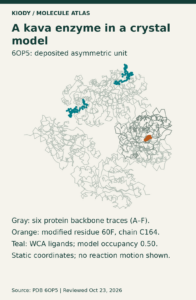
After mitragynine is absorbed, metabolic enzymes can oxidize some of it to 7-OH. Kruegel and colleagues demonstrated CYP3A-mediated conversion in human liver microsomes and in mice. In their mouse experiments, metabolically formed 7-OH contributed substantially to mitragynine’s antinociceptive effect. That established an active-metabolite pathway, but it did not prove that 7-OH explains every effect of leaf in humans. Read Kruegel et al., 2019. Kiody’s mitragynine evidence guide follows the parent compound through receptor, metabolism and human pharmacokinetic studies.
A 2022 mouse study by Berthold and colleagues reached a more limited conclusion. At exposures associated with similar behavioral effects, the amount of 7-OH measured in brain after mitragynine administration was far lower than after direct 7-OH administration. The authors concluded that metabolically formed 7-OH played a negligible role in mitragynine antinociception in their model. Both studies used purified compounds and mice, but their designs, exposure measurements and interpretations differed. Together they show that the quantitative contribution of this metabolite remains model-dependent and unsettled. Read Berthold et al., 2022.
What controlled human pharmacokinetic studies add
Human pharmacokinetic studies can measure a metabolite after people receive a characterized botanical preparation. They do not by themselves determine which molecule produced a subjective effect or establish a medical benefit.
In 2022, Tanna and colleagues administered one characterized dried-leaf product prepared as tea to six healthy adults. The study measured mitragynine, 7-OH and several co-occurring alkaloids in plasma and urine. Its small sample, single product and single preparation limit generalization, but it directly documents human exposure after a defined leaf preparation. NIH/NCCIH funded the work, and the authors declared no conflicts. Read Tanna et al., 2022.
A 2024 randomized, double-blind, placebo-controlled escalation study evaluated one standardized encapsulated dried-leaf powder. The pharmacokinetic analysis included 49 participants who received active product across four cohorts. Because the powder contained less than 0.01% 7-OH, the authors attributed most measured 7-OH exposure to metabolism from mitragynine. This supports the metabolite distinction; it does not make the study equivalent to direct administration of an isolated or concentrated high-7-OH product. Johnson Foods funded the study; all four authors were paid consultants, one was employed by Della Terra Pharmaceuticals, and two disclosed consulting for the American Kratom Association. Read Huestis et al., 2024.
| Study | Material and design | What it supports | Main boundary |
|---|---|---|---|
| Zhang et al., 2025 | Two cultivars, two seasons and controlled post-harvest treatments | Cultivar, season and handling can alter measured leaf alkaloids, including trace 7-OH | Not a universal leaf percentage or product specification |
| Kruegel et al., 2019 | Human liver microsomes, recombinant enzymes and mice; purified mitragynine | CYP3A can form active 7-OH from mitragynine | Preclinical; contribution to all human leaf effects is not established |
| Berthold et al., 2022 | Male and female mice; purified mitragynine and semisynthesized 7-OH | Metabolically formed 7-OH contributed little in that antinociception model | One animal model; does not negate formation |
| Huestis et al., 2024 | Controlled human study of one encapsulated dried-leaf powder | Most measured 7-OH was attributed to metabolism because starting 7-OH was very low | One sponsor product; industry funding and author conflicts |
| Brown et al., 2025/2026 | Eight high-7-OH packages from five brands plus authentic leaf comparator | Sampled products had exceptional 7-OH and profiles inconsistent with leaf | Small targeted sample, not the whole market |
| Sheehan et al., 2026 | Authentic leaf materials and 38 commercial products; UHPLC-HRMS | Orthogonal criteria are needed to separate 7-OH from related isomers | Composition study, not human pharmacology |
Direct 7-OH and metabolically formed 7-OH are different exposures
When the body forms 7-OH from mitragynine, the timing and amount are governed by absorption, enzyme activity, distribution and further metabolism. Direct exposure to a concentrated 7-OH formulation begins with a different parent-to-metabolite balance and may produce a different concentration-time profile. Milligram-for-milligram comparisons between the two pathways are therefore not scientifically justified without matched human data.
Individual CYP3A activity can vary with genetics, health conditions and other substances. Inhibiting or inducing the enzyme may change mitragynine and metabolite exposure, but the direction and clinical importance cannot be safely predicted from a cell experiment alone. No list of universally “safe combinations” follows from this pathway. People who take medicines should discuss kratom with a qualified clinician or pharmacist. Kiody’s kratom interactions guide explains the difference between enzyme signals and demonstrated clinical interactions.
What receptor studies show—and do not show
Purified 7-OH is a partial mu-opioid receptor agonist in multiple cell systems, generally with greater potency and efficacy than mitragynine under the same assay conditions. A March 17, 2026 study compared several isolated kratom alkaloids across radioligand binding, cAMP, beta-arrestin-2 and GTP-gamma-S assays at human opioid receptors. In that platform, 7-OH showed stronger mu-receptor activity than mitragynine. The work used receptor-expressing cells, not leaf products or human participants. University and NIH sources supported the research; the authors declared no commercial financial conflicts, and one disclosed a journal editorial-board role. Read Hemby et al., 2026.
Obeng and colleagues found opioid-like discriminative and antinociceptive effects from purified 7-OH in rats, with naltrexone antagonizing those effects. This supports an opioid-receptor mechanism in that model. It does not describe the concentration of 7-OH in ordinary leaf or establish a human dose-response curve. Read Obeng et al., 2021.
Respiratory findings require product and species labels
Hill and colleagues compared purified mitragynine and 7-OH in mice. Direct 7-OH produced dose-dependent respiratory depression, while mitragynine’s respiratory effect reached a ceiling in the tested model; blocking CYP3A changed mitragynine’s effects. This supports a meaningful pharmacological distinction between the isolated compounds. It does not supply a human lethal amount or prove that botanical leaf has no respiratory risk. Read Hill et al., 2022.
NIDA’s current overview similarly distinguishes the lower respiratory-depressant findings generally reported for leaf or isolated mitragynine from laboratory findings for 7-OH. NIDA also notes adverse effects, dependence, interactions, product variability and remaining evidence gaps. The defensible conclusion is comparative: direct high-7-OH exposure has a different and concerning preclinical respiratory profile. It is not scientifically defensible to turn a rodent experiment into a number of kilograms of leaf that a person would need to consume. Review NIDA’s kratom evidence overview.
Why identifying 7-OH is analytically difficult
Kratom contains structurally related alkaloids and isomers that can share an exact mass or a commonly monitored fragment. A 2026 analytical study developed a multicriteria UHPLC–high-resolution mass-spectrometry workflow using authentic leaf materials and 38 commercial products. Multiple peaks appeared at the same mass-to-charge value used for 7-OH-related compounds. Relying on accurate mass alone—or on a common transition such as 415 to 190—could produce a false-positive 7-OH identification.
The researchers combined chromatographic retention, accurate mass and diagnostic fragmentation to distinguish mitragynine, 7-OH, mitragynine pseudoindoxyl and related isomers. This work explains why a certificate of analysis should identify the method, reference standard and confirmation criteria rather than displaying a single unexplained number. It is an analytical study, not evidence about human effects. Read Sheehan et al., 2026.
For a practical laboratory-document checklist, see Kiody’s alkaloid-results guide and full-panel COA guide.
How to read a 7-OH result
| Question | Why it matters | Red flag |
|---|---|---|
| What was sampled? | Fresh leaf, dried leaf, extract, tablet, gummy and biological fluid answer different questions | The report says only “kratom” |
| What is the denominator? | Percent dry leaf, percent alkaloid fraction and milligrams per gram of finished product are not interchangeable | A number appears without units or basis |
| Was identity confirmed? | Chromatographic separation and diagnostic ions help distinguish related isomers | One mass transition is treated as definitive |
| What are the LOD and LOQ? | Detection and reliable quantification have different thresholds | “Zero” substitutes for “not detected” |
| Was the tested lot matched? | Product composition can vary by lot and age | A generic report is applied to every package |
| Was processing documented? | Withering, drying, storage and chemical conversion can change the profile | “Natural” is the only process description |
Claim check: what the evidence supports
| Claim | Best available evidence | What remains unproven |
|---|---|---|
| “7-OH is either completely natural or completely synthetic.” | Trace 7-OH can be measured in some post-harvest leaf, can form metabolically, and can also be deliberately manufactured or concentrated. | The word “natural” does not identify source, concentration or process. |
| “Every leaf starts with the same 7-OH level.” | Authentic-leaf results vary with cultivar, season, handling and method. | No universal starting concentration has been established. |
| “An extract naturally explains any high 7-OH result.” | Some sampled high-7-OH products lacked the broader alkaloid fingerprint expected from leaf extraction and showed evidence of conversion. | One study does not classify every commercial product. |
| “All effects of mitragynine come from 7-OH.” | CYP3A forms active 7-OH, but animal studies disagree about its quantitative contribution in different models. | The pathway does not establish that every human leaf effect is metabolite-driven. |
| “7-OH is the only leaf constituent that could matter for harm.” | Mitragynine has pharmacology and interaction potential; dependence, contaminants, product variability and co-exposures also matter. | No evidence reduces all botanical-leaf risk to one alkaloid. |
| “Animal research proves natural leaf overdose is impossible.” | Some models find lower or ceiling-limited respiratory effects for mitragynine relative to classical opioids, while direct 7-OH produces stronger respiratory effects. | Animal studies cannot establish a universal human lethal dose or physical impossibility. |
Why animal doses cannot be converted into human leaf amounts
Animal studies use defined species, routes and purified compounds under controlled conditions. Converting those experimental exposures into kilograms of leaf for a person would ignore absorption, product chemistry, metabolism and individual variability. This guide therefore reports what each experiment tested without publishing an unsupported human overdose calculation.
Current U.S. federal record: proposal is not the same as an order
On July 6, 2026, DEA published a notice of intent concerning 7-OH above proposed concentration thresholds. On August 26, HHS extended an information request through September 10. That deadline has closed, but the HHS notice was not itself a final scheduling order and did not automatically make the proposed threshold effective. A review of the Federal Register record on September 15, 2026 identified the notice of intent and the closed information-request extension, not a later signed temporary order for the proposed 7-OH threshold. Read the August 26 HHS notice.
A separate DEA temporary order published August 26 covers mitragynine pseudoindoxyl, MGM-15 and MGM-16. Those compounds are not aliases for 7-OH and should not be folded into a claim about ordinary botanical leaf. Read the separate DEA order. Legal status can change, and this dated scientific guide is not legal advice.
Research gaps that would answer the formation question better
- Matched measurements from living leaf through withering, drying, packaging and long-term storage across many genotypes and climates.
- Interlaboratory studies that use shared authenticated reference materials and report LOD, LOQ, recovery and isomer-separation criteria.
- Independent market sampling designed to estimate how often concentrated or manufactured 7-OH appears in products sold as ordinary leaf or extract.
- Larger human pharmacokinetic studies comparing multiple fully characterized botanical-leaf preparations without directly administering high-7-OH products.
- Mechanistic work that resolves why mouse studies differ on the contribution of metabolically formed 7-OH.
- Transparent studies of oxidation products, stability and storage that report complete chemical profiles rather than only two target alkaloids.
- Clear funding, conflict-of-interest and sample-acquisition disclosures for both industry-funded and advocacy-funded research.
Frequently asked questions
Is 7-hydroxymitragynine found in natural kratom leaf?
Some studies measure trace 7-OH in particular authentic leaf samples, while others report it below the method’s detection or quantification limit. Cultivar, season, post-harvest handling and analytical specificity can affect the result. There is no fixed concentration that describes every leaf.
Can drying kratom leaf create 7-OH?
Post-harvest oxidation can contribute to 7-OH formation, and controlled research shows that withering, drying, cultivar and season influence measured alkaloid profiles. Ordinary drying has not been shown to explain the exceptional concentrations reported in deliberately enriched high-7-OH products.
Does the body turn mitragynine into 7-OH?
Yes. Microsomal, animal and human pharmacokinetic evidence supports metabolic formation of 7-OH from mitragynine, with CYP3A playing an important role. Studies disagree about how much that metabolite contributes to particular effects.
Is metabolically formed 7-OH the same as taking a concentrated 7-OH product?
No. Metabolic formation is limited by absorption, enzyme activity, distribution and further metabolism. A concentrated product introduces 7-OH directly and can have a very different alkaloid balance and concentration-time profile.
Is a high-7-OH product just a strong kratom extract?
Not necessarily. Studies of sampled high-7-OH products found chemical profiles inconsistent with authentic leaf extraction, including unusually high 7-OH, low mitragynine, missing native alkaloids and unidentified or oxidized byproducts. A lot-specific analysis is required.
Can one mass-spectrometry peak prove 7-OH is present?
No. Related kratom alkaloids and isomers can share masses and fragments. Reliable identification should combine chromatographic separation, an authenticated reference standard, accurate mass and diagnostic fragmentation criteria.
Is 7-OH the only potentially harmful kratom constituent?
No. Direct high-7-OH exposure warrants special concern, but mitragynine has receptor and enzyme effects, regular use can lead to dependence for some people, and interactions, contaminants, adulterants and product variability also matter.
Does science prove a person cannot overdose on natural leaf?
No. Preclinical findings support lower respiratory-depressant liability for mitragynine than for classical full mu-opioid agonists, but they do not establish physical impossibility or a universal human safety boundary. Case records also often cannot identify the exact product or separate leaf from extracts and manufactured derivatives.
Primary evidence trail
- Kruegel AC, et al. 7-Hydroxymitragynine Is an Active Metabolite of Mitragynine. ACS Central Science. 2019. Human liver microsomes, recombinant enzymes and mouse experiments; purified compounds, not human leaf exposure.
- Obeng S, et al. Pharmacological Comparison of Mitragynine and 7-Hydroxymitragynine. Journal of Pharmacology and Experimental Therapeutics. 2021. Isolated-compound receptor and rat behavioral experiments; no human administration.
- Berthold EC, et al. The Lack of Contribution of 7-Hydroxymitragynine to the Antinociceptive Effects of Mitragynine in Mice. Frontiers in Pharmacology. 2022. Purified and semisynthesized compounds in male and female mice.
- Tanna RS, et al. Clinical Pharmacokinetic Assessment of Kratom. Pharmaceutics. March 2022. Six healthy adults and one characterized dried-leaf product prepared as tea; NIH/NCCIH-funded; no conflicts declared.
- Hill R, et al. Respiratory Effects of Mitragynine Are Limited by Conversion to 7-OH. British Journal of Pharmacology. 2022. Isolated compounds in mice; respiratory findings cannot define a human leaf dose.
- Huestis MA, et al. Human Mitragynine and 7-OH Pharmacokinetics. Molecules. February 23, 2024. Controlled single and repeated exposure to one encapsulated dried-leaf powder; industry-funded with disclosed consulting and employment conflicts.
- Sharma A, et al. Product Characterization From a Naturalistic Kratom Study. Drug Testing and Analysis. 2025. Ten-alkaloid analysis of 341 participant-supplied products; mostly self-identified whole leaf; disclosed advisory, expert-witness and consulting relationships.
- Zhang M, et al. Alkaloid Biosynthesis in Medicinal Crop Kratom Varies With Postharvest, Genetic and Seasonal Factors. Frontiers in Plant Science. 2025. Two cultivars, two seasons and controlled withering/drying; no commercial conflict declared, with one editorial-board disclosure.
- Brown PN, et al. Elevated 7-Hydroxymitragynine Levels Found in Products Misbranded as Kratom. Journal of AOAC International. Published October 9, 2025; issue dated 2026. Eight packages from five brands compared with authentic leaf using AOAC Official Method 2017.14; disclosed botanical-consulting relationships.
- Avula B, et al. Quantitative Analysis of 7-Hydroxymitragynine in Commercial Kratom Products and Its Stability. Phytochemistry. 2026. Commercial-product chemistry, stability and synthetic-artifact analysis; no competing interests declared.
- Sheehan D, et al. Avoiding False Identification of 7-Hydroxymitragynine Using Multicriteria LC–MS Confirmation. Journal of the American Society for Mass Spectrometry. May 6, 2026. Authentic leaf materials and 38 commercial products; analytical identification, not human pharmacology.
- Hemby SE, et al. Multifaceted Modulation of Human Opioid Receptors by Kratom Alkaloids. Frontiers in Pharmacology. March 17, 2026. Purified alkaloids in human-receptor cell assays; university and NIH support; no commercial financial conflicts declared.
- National Institute on Drug Abuse. Kratom research overview. Official evidence summary reviewed September 15, 2026.
- U.S. Department of Health and Human Services. 7-OH Information Request Extension. Federal Register. August 26, 2026. Closed information-request deadline; not itself a scheduling order.
Editorial boundary: this guide explains chemical formation and evidence limits. It does not claim that kratom, 7-OH or any other compound treats, cures or prevents a condition. It provides no dosing, lethal-dose or overdose instructions. If you take medication, have a health condition, are pregnant or breastfeeding, or experience concerning symptoms, consult a qualified health professional. Do not drive or operate heavy machinery while impaired.