Last reviewed: August 30, 2026. Educational content for adults 21+. This is not medical or legal advice. Kiody does not sell concentrated 7-OH products.
Legal-status review date: August 30, 2026
Suggested SEO title: Federal 7-OH Rule Explained: Proposal vs. Current Law | Kiody
Suggested meta description: Learn what the proposed federal 7-OH threshold means, what is already Schedule I, and how botanical leaf differs from concentrated and synthetic products.
Kiody note: Kiody provides botanical-product education for adults 21 and older. Kiody does not sell concentrated 7-hydroxymitragynine (7-OH). This page is educational and is not legal or medical advice.
The short answer
As of August 30, 2026, there are two different federal scheduling developments that should not be blended together:
- A federal threshold for 7-hydroxymitragynine remains proposed. The Drug Enforcement Administration published a notice of intent on July 6, 2026 describing a threshold above which 7-OH would be temporarily placed in Schedule I. The Department of Health and Human Services is accepting information specifically about that threshold through September 10, 2026. A final temporary scheduling order for 7-OH above the proposed threshold had not been published as of this page’s review date.
- Mitragynine pseudoindoxyl, MGM-15, and MGM-16 are already temporarily Schedule I. DEA’s separate order for those three substances became effective August 26, 2026 and is scheduled to remain in effect through August 26, 2028 unless extended or replaced through another federal action.
That difference matters. A proposal announces an intended action and invites or considers information; it is not the same as an effective scheduling order. At the same time, the absence of a final 7-OH scheduling order does not mean concentrated 7-OH products are generally authorized. The Food and Drug Administration has independently stated that 7-OH is not lawful in dietary supplements, cannot lawfully be added to conventional foods, and is not present in any FDA-approved drug.
The practical lesson is simple: read the exact federal document, identify the exact compound and product form, confirm whether the action is proposed or effective, and then check state and local law separately. A headline saying “7-OH ban” cannot answer all four questions.
Four federal issues that people often collapse into one
1. FDA’s food, supplement, and drug position
FDA’s authority under the Federal Food, Drug, and Cosmetic Act is distinct from DEA scheduling under the Controlled Substances Act. FDA announced in July 2025 that its warning letters focused on products with 7-OH as an added ingredient or at enhanced levels, including tablets, gummies, drink mixes, and shots. FDA said 7-OH is not lawful in dietary supplements, cannot lawfully be added to conventional foods, and is not contained in an FDA-approved drug.
FDA later participated in a December 2, 2025 seizure involving approximately 73,000 units of concentrated 7-OH products. That was a food-and-drug enforcement action, not a declaration that every botanical leaf product contains a federally controlled substance.
FDA also maintains a broader position on kratom itself. Its current kratom page says kratom is not lawfully marketed as a drug, dietary supplement, or food additive in conventional food. Businesses should not describe the pending DEA threshold as if it replaced or canceled FDA’s separate authority.
2. DEA’s proposed threshold for 7-OH
DEA Document 2026-13580, published July 6, 2026 at 91 FR 40917, is labeled “Proposed amendment; notice of intent.” It says DEA intends to issue a temporary scheduling order covering 7-OH above a specified threshold. The notice describes different applications for botanical material and other articles.
The threshold described in the notice is:
- Botanical material: any botanical material of Mitragyna speciosa containing more than 0.050% 7-OH on a dry-weight basis.
- Synthetic alternative article: an article resulting from synthetic methods with more than 0.050% 7-OH by weight/weight, weight/volume, or volume/volume, or more than 1.00 mg of 7-OH in the article.
- Further-processed kratom material: extracts, concentrates, processed edibles, pressed pills, or other described alternative dosage forms with more than 0.050% 7-OH under the listed measurement expressions, or more than 1.00 mg of 7-OH in the article.
The wording matters. The proposal does not use one universal “milligrams per serving” rule. For botanical material, it states a dry-weight concentration threshold. For the described alternative articles and further-processed forms, it states both a concentration test and a total-amount test connected by “or.”
3. HHS’s threshold-focused public docket
HHS opened Docket HHS-OASH-2026-0232 to request information about the proposed 7-OH threshold. On August 26, 2026, HHS extended the deadline to September 10, 2026.
HHS says the request is limited. It seeks data about whether additional information supports the proposed or an alternative threshold and whether other measurement expressions would better specify a level necessary to avoid an imminent hazard to public safety. HHS expressly says it is not soliciting comments on permanent scheduling, the general safety or utility of kratom-derived products, or unrelated policy questions.
Anyone considering a comment should understand that comments and attachments generally become public. A useful technical submission should identify the product matrix, analytical method, units, detection and quantitation limits, sampling plan, number of lots, uncertainty, and the exact question the data address. Personal stories may express a viewpoint, but they do not substitute for analytical evidence when the agency asks a threshold-measurement question.
4. The effective order for MP, MGM-15, and MGM-16
DEA Document 2026-17429 is different. It is labeled “Temporary amendment; temporary scheduling order.” It placed these substances in Schedule I effective August 26, 2026:
- mitragynine pseudoindoxyl, also called MP or MGPI;
- MGM-15, also called dihydro-7-hydroxymitragynine; and
- MGM-16, also called 9-fluoro- or 10-fluoro-dihydro-7-hydroxymitragynine, depending on the numbering convention.
The order covers the listed substances and the specified related chemical forms. DEA stated that the Schedule I controls apply to manufacture, distribution, import, export, research, chemical analysis, and possession unless authorized under federal controlled-substance law.
The Department of Justice simultaneously explained that the action targets deliberately manufactured and concentrated products rather than traditional botanical kratom. DOJ said it would exercise enforcement discretion when only incidental trace MP is confirmed in a product otherwise consistent with botanical kratom. But DOJ also made three limits unmistakable:
- the policy does not create a legal exemption;
- MP remains Schedule I; and
- the policy does not extend to MGM-15, MGM-16, or manufactured, concentrated, fortified, or intentionally added MP.
No numerical definition of “incidental trace” was provided. A business should not invent one or turn enforcement discretion into a product specification.
What 0.050% means in ordinary units
Percentages are easy to misread, especially when state laws use different denominators. The proposed federal botanical threshold is 0.050% of dry product weight, not 0.050% of total alkaloids.
The conversion is:
0.050% = 0.0005 as a decimal fraction = 0.5 mg per gram
Here are illustrations, assuming a product result exactly at 0.050% by dry weight:
| Product amount | 7-OH concentration | Calculated 7-OH amount |
|---|---|---|
| 1 gram | 0.050% | 0.5 mg |
| 28 grams | 0.050% | 14 mg |
| 100 grams | 0.050% | 50 mg |
| 500 mg leaf capsule | 0.050% | 0.25 mg |
These examples explain the math; they do not determine whether a finished product qualifies as “botanical material” or an “alternative article” under a future order. Product classification is legally important because the proposed text applies a separate “more than 1.00 mg in the article” trigger to the described alternative articles.
The notice says more than 0.050%, not “equal to or greater than.” In pure arithmetic, a result of exactly 0.050% is not more than 0.050%. In real testing, however, a reported value has rounding rules, method precision, sampling variation, and measurement uncertainty. Treating a rounded result at the line as a comfortable compliance margin would be poor quality practice.
Why this is not the same as a state “2% of total alkaloids” rule
Several state kratom laws use a threshold expressed as a percentage of overall or total alkaloid composition. The proposed federal threshold uses product-weight expressions and, for certain product forms, a total-milligram trigger.
Those denominators are not interchangeable.
Consider a hypothetical powder with:
- total alkaloids: 1.5% of product weight; and
- 7-OH: 2% of the total alkaloid fraction.
The 7-OH concentration by product weight would be:
1.5% × 2% = 0.03% of product weight
That equals 0.3 mg/g. A label stating only “7-OH is below 2% of total alkaloids” does not prove whether the product is above or below 0.050% of dry weight. Conversely, a dry-weight percentage alone may not answer a state rule written as a fraction of total alkaloids.
Near any legal limit, the COA should provide the actual numerical result in the unit needed for the applicable rule. A vague “pass” result is much less useful because the reader cannot confirm the denominator, reproduce the conversion, or assess distance from the limit.
Botanical leaf, capsules, extracts, and enhanced products
Ordinary botanical leaf and powder
The proposed federal notice gives botanical material its own category and a dry-weight threshold. It does not say that all Mitragyna speciosa leaf would become Schedule I. DEA and FDA public communications both distinguish naturally occurring trace 7-OH in botanical leaf from concentrated or synthetic 7-OH products.
That distinction does not establish that every bag of leaf is compliant. Botanical material varies, processing and storage can affect chemistry, and a representative lot test is necessary to support a product-specific number. A result from a supplier’s different lot cannot establish the concentration in the lot offered for sale.
Pure-leaf capsules
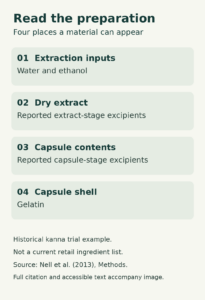
Kiody describes its capsules as approximately 500 mg of pure leaf powder per capsule. A capsule shell changes the delivery format, but it does not by itself prove that the contents are concentrated, extracted, enhanced, or synthetic.
The proposed notice, however, uses product-form language that deserves legal review. It lists “alternative dosage forms” and “pressed pills” in its further-processed category. A final order could clarify, preserve, or change this wording. Businesses should not assume that every capsule is automatically treated as raw botanical material, nor should they assume every pure-leaf capsule is automatically a concentrated product.
A capsule review should document at least the identity of the fill, absence of added extract or isolated alkaloid, fill weight, lot number, and a 7-OH result expressed in the legally relevant units.
Extracts and concentrates
Extraction changes the matrix and can increase alkaloid concentration. The proposal specifically identifies extracts and concentrates as further-processed forms. For the described alternative articles, either the concentration trigger or the more-than-1-mg-in-the-article trigger could matter.
An extract label that gives only mitragynine does not provide enough information to evaluate 7-OH. A percentage of “total alkaloids” also does not answer the proposed federal dry product or article tests unless the underlying numbers are shown.
Enhanced, fortified, and isolated-alkaloid products
“Enhanced” should never be treated as a harmless marketing adjective. It may mean leaf blended with extract, added alkaloids, or another potency-altering process. The actual formulation and manufacturing record matter more than the front-panel name.
Products with intentionally added or concentrated 7-OH are the focus of FDA enforcement and the proposed DEA threshold action. Products with intentionally added or concentrated MP, or with MGM-15 or MGM-16, are separately affected by the effective August 26 scheduling order.
Kiody does not sell concentrated 7-OH. A clear product-form policy protects botanical education from being confused with promotion of high-potency isolated or semi-synthetic products.
A seven-step COA check for the proposed federal threshold
Step 1: Match the lot
The lot or batch number on the COA should match the product. A beautiful report for a different lot is not evidence about the package in hand.
Step 2: Identify the tested matrix
The report should say whether the sample was leaf powder, capsule fill, an extract, a liquid, a gummy, a tablet, or another form. Matrix affects sample preparation, extraction recovery, calibration, and unit interpretation.
Step 3: Find the actual 7-OH result
Look for a numerical 7-OH result rather than a generic total-alkaloid claim. If the report says ND, determine the reporting limit. “Not detected” means the method did not detect the analyte at or above a stated decision level; it does not prove absolute zero.
Step 4: Confirm the units and denominator
Common units include percent by weight, mg/g, µg/g, mg/mL, and percent of total alkaloids. Convert only when the denominator and sample basis are clear.
Useful identities include:
- 1% by weight = 10 mg/g;
- 0.10% by weight = 1 mg/g;
- 0.050% by weight = 0.5 mg/g; and
- 1 µg/g = 0.001 mg/g.
For liquids, weight/volume and volume/volume expressions require the correct basis. Do not convert a percentage into milligrams per bottle without the product volume and the correct measurement convention. Density may also matter when moving between weight and volume.
Step 5: Compare the LOQ with the decision level
The limit of quantitation should be low enough to measure meaningfully near the proposed threshold. A laboratory cannot support a fine compliance decision if its reporting capability is too coarse.
For example, an assay that reports only “less than 0.10%” cannot demonstrate that a result is below 0.050%. The upper bound of the report is twice the proposed concentration threshold.
Step 6: Review uncertainty and rounding
A result near 0.050% should be evaluated using the laboratory’s validated precision, uncertainty, significant figures, and decision rule. If a report rounds to two decimal places, both 0.046% and 0.054% might appear as 0.05%, even though they fall on different sides of a “more than 0.050%” line.
The quality team should retain the unrounded result where available and document how it makes decisions near the threshold. Testing repeatedly until one result falls below the line is not a scientifically sound investigation strategy.
Step 7: Check for MP, MGM-15, and MGM-16 separately
A 7-OH result does not answer whether the sample contains one of the three substances scheduled on August 26. The names, standards, method scope, detection capability, and result for each compound should be reviewed separately.
MP deserves special care because DOJ’s incidental-trace enforcement policy provides no numerical safe harbor. A report of “trace” should identify the method, reporting level, and whether the finding was confirmed. It should not be rewritten as “federally legal.”
A practical product-review record
Kiody could use the following review fields before publishing any federal-threshold statement:
- Product name.
- Product form.
- Botanical, extracted, concentrated, enhanced, synthetic, or uncertain classification.
- Package size.
- Serving size, if stated.
- Lot number.
- Manufacturing or packaging date.
- Laboratory name.
- Laboratory accreditation and relevant scope.
- Test method identifier.
- Sample matrix.
- Sampling party and sampling date.
- 7-OH numerical result.
- 7-OH result unit.
- Dry-weight, weight/weight, weight/volume, volume/volume, or total-alkaloid basis.
- LOD and LOQ.
- Measurement uncertainty or precision information.
- Unrounded result, when available.
- Total 7-OH per article calculation, when applicable.
- Mitragynine result.
- Total-alkaloid result, if a state rule needs it.
- MP result and reporting limit.
- MGM-15 result and reporting limit.
- MGM-16 result and reporting limit.
- Applicable federal status date.
- Applicable state and local restrictions.
- Reviewer and review date.
- Decision and reason.
- Required follow-up.
- Approval record before any shipping or website change.
This record does not turn Kiody into a law firm or laboratory. It creates a repeatable trail showing what was checked and what remains uncertain.
What the proposal could mean for commerce if finalized as written
DEA’s notice says a future temporary order would apply Schedule I controls and sanctions to people who manufacture, distribute, import, export, research, analyze, or possess 7-OH above the specified threshold. If the order is issued as described, commercial handling of covered products would require the authorizations applicable to Schedule I controlled substances; ordinary consumer retail and direct shipping would not have a general exemption.
The notice also says the federal action would not preempt more restrictive state law. A product that falls below a future federal threshold could still be prohibited by a state or locality. State rules may use:
- a lower product-weight threshold;
- milligrams per gram or milliliter;
- milligrams per serving or container;
- a ratio of mitragynine to 7-OH;
- a percentage of total alkaloids;
- a synthetic or semi-synthetic prohibition;
- a blanket kratom ban; or
- licensing, labeling, registration, age-verification, or shipping requirements.
This is why a nationwide “legal” badge is risky. Compliance is a destination-specific, product-specific, lot-specific, and date-specific question.
What businesses should not say
Avoid claims such as:
- “All kratom is federally legal.”
- “DEA banned all kratom.”
- “Anything under 2% 7-OH is federally compliant.”
- “0.050% means 0.050% of total alkaloids.”
- “The federal rule is already effective for 7-OH.”
- “Trace MP is exempt.”
- “A COA proves a product is legal everywhere.”
- “FDA approval” when no such approval exists.
A more accurate educational statement is:
As of August 30, 2026, DEA’s threshold-based 7-OH action remains proposed. A separate temporary order placed mitragynine pseudoindoxyl, MGM-15, and MGM-16 in Schedule I effective August 26, 2026. FDA and state or local rules may independently restrict products.
Every dated statement should include a review date and a link to the controlling government source.
Responsible-use and safety context
This page explains regulation; it does not recommend using any product. FDA advises consumers to avoid 7-OH products and states that reported harmful effects include addiction, gastrointestinal distress, insomnia, seizures, and withdrawal symptoms. FDA distinguishes its concentrated-7-OH focus from trace 7-OH naturally occurring in kratom leaf, but it also maintains broader warnings about kratom.
Products should never be marketed as treating pain, anxiety, opioid withdrawal, substance use disorder, or another medical condition without an FDA-approved basis. People seeking treatment should speak with a licensed healthcare professional.
If someone is unresponsive or has difficulty breathing, call 911. In the United States, Poison Help is available at 1-800-222-1222. Adverse events can also be reported through FDA MedWatch. Keep the package, lot number, receipt, and remaining product when it is safe to do so; those details can help an investigation.
Keep all botanical and alkaloid products away from children and pets. Kiody’s educational content and sales policies are intended for adults 21 and older.
Frequently asked questions
Did DEA ban all kratom on August 26, 2026?
No. The August 26 temporary order names mitragynine pseudoindoxyl, MGM-15, and MGM-16. The separate threshold-based action for 7-OH remained proposed as of August 30. Neither document should be summarized as a federal scheduling order for every botanical kratom leaf product.
Is the federal 7-OH threshold currently effective?
Not as of this review date. DEA published a notice of intent describing the proposed threshold. HHS extended its threshold-focused information period through September 10, 2026. A future order must be checked directly in the Federal Register before treating the threshold as effective.
What is the proposed threshold for botanical leaf?
The notice describes botanical material containing more than 0.050% 7-OH on a dry-weight basis. That converts to more than 0.5 mg/g.
Is 0.050% the same as 2% of total alkaloids?
No. The federal proposal uses product-weight measurement expressions. A “2% of total alkaloids” rule uses the alkaloid fraction as its denominator. The same product can have very different numbers under those two calculations.
Does the proposed one-milligram trigger apply per serving?
The federal notice says more than 1.00 mg “in the article” for the described synthetic and further-processed alternative articles. It does not say “per serving” in that threshold sentence. Do not silently substitute serving, dose, package, tablet, or container for “article” without authoritative clarification.
Would 100 grams of leaf at 0.050% contain 50 mg of 7-OH?
Mathematically, yes: 0.5 mg/g multiplied by 100 g equals 50 mg. But the proposed botanical-material test is expressed as concentration on a dry-weight basis. The separate 1-mg article trigger is written for the described alternative articles, so the math should not be used to reclassify a product without legal analysis.
Are pure-leaf capsules concentrated products?
Not necessarily. A capsule can contain only ground leaf. But the proposed notice uses dosage-form language that requires careful product-specific review. Confirm the fill material, manufacturing process, and final rule rather than relying on the word “capsule.”
Are extracts covered by the proposal?
Yes. The proposed further-processed category expressly mentions extracts and concentrates. Both the concentration threshold and total-amount trigger may be relevant if a final order preserves the filed wording.
Are MP, MGM-15, and MGM-16 already controlled?
Yes. They entered federal Schedule I on August 26, 2026 under a separate temporary scheduling order.
Does DOJ’s trace-MP policy make trace MP legal?
No. DOJ expressly says its enforcement-discretion policy does not create a legal exemption and does not change MP’s Schedule I status. It also gives no numerical trace threshold.
Does the trace policy cover MGM-15 and MGM-16?
No. DOJ says it does not apply to MGM-15 or MGM-16.
Can a “not detected” result prove zero 7-OH or zero MP?
No. ND is tied to a method and reporting level. Review the analyte, method, LOD, LOQ, sample matrix, and confirmation process.
Can a supplier use one COA for every lot?
One lot’s report does not establish another lot’s composition. The COA should match the product’s lot number, and sampling should be representative.
Would a future federal threshold override state bans?
No. DEA’s notice says the proposed action does not preempt more restrictive state law. State and local restrictions must still be checked.
Does Kiody sell concentrated 7-OH?
No. Kiody does not sell concentrated 7-OH. Kiody focuses on adult botanical-product education and clearly separates ordinary leaf products from isolated, concentrated, enhanced, synthesized, and semi-synthesized products.
Where can someone read or comment on the proposal?
The official materials are in the Federal Register and HHS Docket HHS-OASH-2026-0232 on Regulations.gov. HHS’s extended deadline is September 10, 2026. Comments are public and should stay within the threshold and measurement questions described by HHS.
Primary and authoritative sources
- Drug Enforcement Administration, Proposed threshold-based 7-OH scheduling notice, Document 2026-13580, 91 FR 40917 (July 6, 2026)
- Department of Health and Human Services, Request for Information, Document 2026-13608, 91 FR 41049 (July 6, 2026)
- Department of Health and Human Services, Extension of comment period through September 10, 2026, Document 2026-17409, 91 FR 55104 (August 26, 2026)
- Regulations.gov, HHS-OASH-2026-0232 docket
- Drug Enforcement Administration, Temporary Schedule I order for MP, MGM-15, and MGM-16, Document 2026-17429, 91 FR 54948 (August 26, 2026)
- Department of Justice, Emergency scheduling announcement and incidental-trace MP enforcement policy (August 25, 2026)
- Food and Drug Administration, Hiding in Plain Sight: 7-OH Products
- Food and Drug Administration, Products Containing 7-OH Can Cause Serious Harm
- Food and Drug Administration, FDA Issues Warning Letters to Firms Marketing Products Containing 7-Hydroxymitragynine (July 15, 2025)
- Food and Drug Administration, FDA Seizes 7-OH Opioids to Protect American Consumers (December 2, 2025)
- Food and Drug Administration, FDA and Kratom