Last reviewed: August 30, 2026. Educational content for adults 21+. This is not medical or legal advice. Kiody does not sell concentrated 7-OH products.
“Does kratom contain allergens?” sounds like a yes-or-no question. A responsible answer starts by separating three different questions:
- Is Mitragyna speciosa itself one of the nine major food allergens defined in U.S. law?
- Does the finished product contain another ingredient derived from a major allergen?
- Could an allergen have entered unintentionally through shared equipment, utensils, storage, packaging, or handling?
Kratom is not one of the nine major food-allergen categories recognized under current federal law. That narrow legal fact does not prove that every kratom product is allergen-free, that no individual can react to kratom, or that a product made in a shared facility contains no unintended allergen residue.
The finished product matters. Plain leaf powder can have a different allergen profile from a capsule with a multi-ingredient shell, a flavored beverage, a gummy, or an extract made and packaged on shared equipment. A trustworthy answer therefore follows ingredients, suppliers, manufacturing records, cleaning controls, labels, and—when justified—product-specific testing.
This guide is educational, not medical advice. Anyone who may be experiencing a severe allergic reaction should seek emergency care. Kiody serves adults 21 and older and does not sell concentrated 7-hydroxymitragynine products.
The short answer
Plain Mitragyna speciosa leaf is not legally classified as one of the nine major U.S. food allergens. The nine categories are milk, egg, fish, Crustacean shellfish, tree nuts, peanuts, wheat, soybeans, and sesame.
But “kratom” can describe very different finished products. To evaluate one product, check:
- every ingredient, including capsule material, carrier, flavor, sweetener, coating, and processing aid;
- the food source of any ingredient derived from a major allergen;
- the facility’s shared-equipment and allergen-control records;
- the accuracy of the ingredient list and any “Contains” statement;
- whether a voluntary “free-from” claim has a defensible basis;
- whether testing, if used, targets the correct allergen and works for the actual matrix; and
- whether the package in hand matches the current formula and lot.
A generic “lab tested” badge does not answer these questions.
What “major food allergen” means
U.S. law uses “major food allergen” as a defined labeling category. FDA’s current list covers:
- Milk
- Egg
- Fish
- Crustacean shellfish
- Tree nuts
- Peanuts
- Wheat
- Soybeans
- Sesame
The Food Allergy Safety, Treatment, Education, and Research Act made sesame the ninth major food allergen, effective January 1, 2023. FDA’s 2025 allergen-labeling guidance also updated how the agency interprets some categories. For example, FDA explains that “milk” includes milk from domesticated ruminants such as cows, goats, and sheep, while “egg” includes eggs from domesticated fowl. FDA also revised which tree nuts it considers major allergens; coconut is no longer on that federal major-allergen list.
The list is not a claim that only nine substances can cause adverse reactions. It is a federal labeling framework for specified food sources. People may have allergies or sensitivities involving other substances. A product can also cause a non-allergic adverse response. Those possibilities should not be collapsed into one marketing term.
Four statements that mean different things
“Kratom is not a major food allergen”
This statement concerns the federal list. It does not describe every ingredient or every possible individual response.
“No major allergens are intentionally added”
This is a formulation statement. It should be supported by the complete bill of materials and current supplier documentation. It does not automatically address cross-contact.
“Made in a facility that also handles…”
This is an advisory disclosure about the manufacturing environment. It does not replace controls, and its wording should accurately reflect the facility and product.
“Free from” a named allergen
This is a product claim. It requires a stronger, product-specific basis than simply omitting the allergen from the recipe. Supplier controls, segregation, cleaning, change control, and sometimes analytical verification may all matter.
Using the terms interchangeably makes a label less informative.
Product form changes the allergen review
| Product form | Intentional-ingredient questions | Cross-contact questions |
|---|---|---|
| Plain leaf powder | Is the product truly single ingredient? Were any carriers, anticaking agents, or processing aids used? | What else was milled, blended, or packaged on the same equipment? |
| Pure-leaf capsules | What is the capsule shell made from? Are colorants, flow agents, or release agents used? | Were capsule equipment and fillers shared with products containing milk, soy, wheat, sesame, or other allergens? |
| Botanical extract | What extraction carriers and standardizing ingredients remain? | Were shared extraction, drying, or filling systems adequately controlled? |
| Flavored powder or beverage | Do flavors, creamers, sweeteners, emulsifiers, or stabilizers have allergen-derived components? | Are flavor and beverage lines shared with milk, soy, nut, or sesame products? |
| Gummy or confection-like format | What are the gelling agents, glazing agents, flavors, and processing aids? | Is the confectionery line shared with major allergens? |
| Enhanced or concentrated 7-OH product | What additional ingredients and manufacturing steps were used? | Does the finished-product evidence match the manufactured form rather than ordinary leaf? |
Kiody’s pure-leaf capsules are described as approximately 500 mg of leaf powder per capsule. That description still needs to be paired with accurate capsule-shell and other-ingredient information for the actual SKU and lot. “Pure leaf” should describe the capsule fill; it should not erase the shell from the ingredient review.
The ingredient list is the first control
An allergen review begins with the complete formula—not only the front label.
For each ingredient, quality personnel should know:
- its common or usual name;
- its source material;
- supplier and manufacturing site;
- grade and specification;
- subingredients;
- processing aids or carriers that remain relevant to labeling or risk assessment;
- allergen statement;
- change-notification agreement; and
- lot traceability.
Compound ingredients deserve special attention. A natural flavor, creamer, coating, color preparation, or premix may have its own subingredients. The finished-product manufacturer should not assume that a short commercial ingredient name reveals the complete allergen profile.
If a major allergen is intentionally present, federal labeling generally requires the food source to be declared in the ingredient list or in a “Contains” statement, subject to the detailed statutory and FDA guidance provisions. Fish, Crustacean shellfish, and tree nuts require source-specific identification, not only the broad category name.
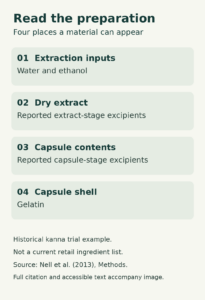
Capsule shells are part of the product
Consumers often see “pure-leaf capsule” and focus only on the powder inside. The shell is still an ingredient.
Common capsule systems may use gelatin or plant-derived polymers, along with water, colorants, opacifiers, or other processing ingredients. “Vegetable capsule” is not a full allergen specification. The manufacturer should retain the shell supplier’s current ingredient composition, allergen declaration, lot information, and change controls.
The same principle applies to flow aids used during encapsulation. If a formula includes an excipient, its source and allergen profile should be documented. A quality reviewer should not infer “nothing else added” merely from a short product title.
Cross-contact is not the same as an ingredient
FDA regulations define allergen cross-contact as the unintentional incorporation of a major food allergen into food. Examples can include:
- a scoop moving from a milk-containing powder to plain leaf;
- dust from a soy-containing product entering a nearby open blender;
- a capsule filler that was not adequately cleaned after a wheat-containing formula;
- rework placed into the wrong product;
- an incorrect label applied to an otherwise correctly made batch;
- an allergen-containing flavor stored above an open non-allergen ingredient;
- shared totes or liners that were not controlled; or
- employee gloves or outer garments carrying residue between work areas.
Cross-contact is a manufacturing-control issue, not merely a label-writing issue. FDA’s food-labeling compliance program expressly distinguishes unintended allergen presence from ordinary ingredient declaration and points to CGMP, preventive-control, or HACCP requirements as the applicable control systems.
Part 111 and Part 117 should not be mixed carelessly
Different FDA regulatory provisions can apply depending on the product and facility. Dietary-supplement manufacturing is addressed in 21 CFR Part 111. Part 117 contains broader food CGMP and preventive-control requirements. Under 21 CFR §117.5(e), certain Part 117 preventive-control subparts do not apply to a facility’s dietary-supplement operations when those operations comply with Part 111 and the dietary-supplement serious-adverse-event provisions.
That does not make allergen cross-contact irrelevant in a supplement facility. FDA’s current dietary-supplement compliance program tells investigators to evaluate contamination, allergen cross-contact, sanitation, employee hygiene, specifications, labels, and manufacturing records. Part 111 also requires specifications, quality-control operations, appropriate sanitation, accurate labels, and controls against contamination and mixups.
For Kiody content, these rules should be presented as quality and labeling frameworks. FDA currently states that kratom is not lawfully marketed as a dietary supplement and cannot lawfully be added to conventional food. Referring to Part 111 or Part 117 does not declare a kratom product federally lawful or FDA approved.
A practical allergen-control program
An effective program connects formulation, purchasing, storage, manufacturing, sanitation, labeling, and release.
1. Build a facility allergen map
List every major allergen intentionally handled at each facility and by each contract manufacturer. Record which rooms, mixers, mills, capsule fillers, liquid tanks, utensils, and packaging lines contact those materials.
The map should include ingredients, work-in-process materials, finished products, rework, samples, and employee food policies where relevant.
2. Approve ingredients before use
An approved supplier file should contain a current allergen statement and complete composition record. A checkbox reading “allergen free” is not enough when the supplier has not defined its scope or considered subingredients.
3. Segregate and identify
Controls can include designated storage zones, sealed containers, clear labels, dedicated utensils, spill procedures, and movement rules. Physical segregation is especially useful for fine powders capable of dispersing through air or on clothing.
4. Schedule production thoughtfully
Facilities sometimes run non-allergen products before allergen-containing products, followed by a validated cleaning procedure. Scheduling alone is not cleaning, but it can reduce risk when integrated into a complete program.
5. Use documented cleaning procedures
The procedure should identify equipment disassembly, tools, cleaning agents, time, temperature where relevant, rinse or removal steps, inspection points, and responsibility. Hard-to-clean gaskets, seams, screens, hoppers, transfer hoses, and dust-collection systems deserve specific attention.
6. Validate and verify cleaning
Validation asks whether the procedure can work under defined worst-case conditions. Routine verification asks whether it was performed correctly for the particular changeover.
Visual inspection is essential but may not be sufficient. Product-specific protein tests, allergen-specific ELISA swabs, rinse samples, or finished-product testing can be useful when scientifically appropriate. ATP or general-protein swabs may help verify general cleaning, but they are not automatically specific for a particular allergen. FDA’s cleaning guidance cautions that a method should be documented as fit for its intended purpose.
7. Control labels
The correct formula in the wrong package can create a serious undeclared-allergen problem. Label issuance, reconciliation, line clearance, barcode checks, and final examination should connect the label version to the batch record.
8. Investigate deviations
A missed cleaning step, damaged ingredient bag, dust event, incorrect label, or supplier formula change requires documented material review and disposition. Retesting should not be used to erase an unexplained event.
Advisory statements do not replace controls
Statements such as “may contain,” “processed in a facility,” or “made on shared equipment” are generally voluntary advisory language. They can convey useful information when accurate, but they should not be used instead of good manufacturing practices or required allergen declaration.
Three problems arise when advisory statements are treated as a shield:
- A broad statement can hide a facility’s failure to assess the actual product.
- A narrow statement can omit an allergen that the facility handles.
- A stale statement can become inaccurate after a supplier or manufacturing-site change.
The strongest public language is backed by a current facility- and product-specific assessment.
Testing can help, but there is no universal allergen panel
Food-allergen testing is analyte-specific and matrix-dependent. A laboratory does not run one generic test that proves the absence of every allergen.
ELISA
Enzyme-linked immunosorbent assays detect particular proteins using antibodies. FDA describes ELISA-based methods as widely used for food-allergen detection or measurement. Their performance depends on the target, extraction procedure, matrix, processing history, calibration, reporting limit, and potential interference.
PCR
Polymerase chain reaction methods detect selected genetic material rather than the allergenic protein itself. PCR may be helpful in some investigations, but the relationship between detected DNA and allergenic protein must be interpreted carefully.
General protein and ATP tests
These tools can support sanitation verification but are not automatically specific to milk, peanut, sesame, or another individual allergen. A clean-looking ATP result should not be presented as proof that a named allergen is absent unless the method and validation support that conclusion.
Finished-product versus surface testing
Surface swabs evaluate selected equipment locations. Rinse samples evaluate material removed during cleaning. Finished-product samples evaluate the particular units selected under a sampling plan. Each answers a different question.
A laboratory report should state the target allergen, method, sample matrix, result, unit, limit of detection, limit of quantitation or reporting limit, and any qualifiers. “Allergens: pass” is too vague.
Why “not detected” is not the same as zero
An ND result means the target was not detected under the method’s stated conditions and reporting convention in the sample tested. It does not prove absolute absence from every unit.
Review these details:
- Which allergen or marker was tested?
- Was the method validated or verified for leaf powder, capsule material, extract, gummy, or beverage?
- What was the reporting limit?
- Was the sample representative of the lot?
- Could processing reduce detectability?
- Were replicate samples used?
- Did the laboratory report matrix interference or recovery concerns?
Sampling matters because cross-contact can be uneven. A small amount of residue may appear in one part of a lot rather than distributing uniformly.
“Gluten-free” is a separate regulated claim
Gluten is not identical to the nine-allergen framework. Wheat is a major food allergen; gluten can also come from barley, rye, and their crossbred hybrids.
FDA’s “gluten-free,” “no gluten,” “free of gluten,” and “without gluten” rule applies to FDA-regulated foods, including dietary supplements. Among its conditions, unavoidable gluten in a food bearing the claim must be below 20 parts per million.
Important distinctions include:
- “No wheat ingredient” is not automatically the same as “gluten-free.”
- A “gluten-free” claim remains subject to the rule even if the label also carries a shared-facility advisory statement.
- FDA does not require a specific test for every product bearing the claim, but the company is responsible for compliance.
- Some methods have limitations in fermented or hydrolyzed matrices.
Kiody should not add a gluten-free claim to a product page based only on the natural source of leaf. The finished formula, suppliers, facility, packaging, and applicable analytical evidence must support it.
Worked product-review examples
Example 1: single-ingredient powder packed on a shared line
The formula lists only Mitragyna speciosa leaf. The contract packer also handles a powdered drink mix containing milk and soy on the same filler.
The leaf itself is not one of the nine major allergens, but the finished-product review is incomplete until Kiody evaluates scheduling, segregation, cleaning validation, changeover records, dust control, label accuracy, and any verification testing. “Single ingredient” does not answer cross-contact.
Example 2: pure-leaf capsule with an incomplete shell record
The fill contains approximately 500 mg of leaf powder, but the supplier document describes only a “vegetable capsule.”
The quality reviewer should obtain the capsule’s complete ingredient and allergen statement. The product should not be called free from every major allergen merely because the fill is pure leaf.
Example 3: flavored liquid with a compound natural flavor
The manufacturer receives a natural flavor under a commercial name. Its specification lists no allergens, but the formulation changed three months ago and no updated subingredient declaration is on file.
The lot should not be released on an outdated statement. Supplier change control and the current formulation are part of the allergen decision.
Example 4: milk test reports ND above the desired claim level
A finished product reports milk protein as ND with a reporting limit of 10 ppm. Kiody’s proposed internal claim specification is below 5 ppm.
The result cannot demonstrate that the product meets the proposed specification. The method must be sensitive enough for the decision being made.
Example 5: a generic COA attached to a concentrated tablet
The COA identifies ordinary leaf powder and contains a peanut result. The retail product is a multi-ingredient concentrated 7-OH tablet made elsewhere.
That report does not establish the tablet’s ingredients, cross-contact profile, composition, or legal status. Kiody does not sell concentrated 7-OH products.
How to review an allergen statement in 12 steps
- Confirm the exact product, size, formula revision, and lot.
- Read the complete ingredient list, not only the product title.
- Identify every compound ingredient and obtain its subingredients.
- Check the capsule shell, coating, carrier, flavor, color, and processing aids.
- Review supplier allergen statements and their effective dates.
- Identify all major allergens handled at the manufacturing and packaging sites.
- Map shared equipment, utensils, storage, and air or dust pathways.
- Review the approved cleaning procedure and its validation.
- Confirm the correct label version and any required “Contains” declaration.
- Evaluate advisory and “free-from” statements separately.
- Review any testing for target, method, matrix, sampling, and reporting limit.
- Document the quality decision, reviewer, and date.
Allergen-control red flags
Pause and investigate when you see:
- “Allergen free” with no defined allergen scope.
- “Lab tested” without a named allergen or method.
- A capsule product whose shell ingredients are missing.
- A supplier declaration with no issue date or formula identifier.
- A compound flavor without subingredient or allergen information.
- “Made in a shared facility” used as the entire control plan.
- A shared-equipment facility with no cleaning validation.
- ATP results presented as proof of absence of a named allergen.
- ND results with no reporting limit.
- A reporting limit higher than the claim specification.
- An ingredient or supplier change without label review.
- A finished-product claim supported only by a raw-material COA.
- A generic allergen COA reused for several different matrices.
- A “gluten-free” claim based only on the absence of wheat.
- A label that lists an allergen in one place but contradicts itself elsewhere.
- A “proprietary blend” used to avoid ingredient-source disclosure.
- No line-clearance or label-reconciliation record.
- A pass result obtained only after unexplained repeat testing.
A proposed 24-field Kiody allergen review record
Kiody could retain the following fields for every applicable SKU and formula revision:
- Product name and SKU.
- Product form.
- Formula revision and effective date.
- Complete ingredient list.
- Subingredients for compound ingredients.
- Capsule-shell or coating composition.
- Ingredient supplier and manufacturing site.
- Current supplier allergen statement.
- Supplier change-notification agreement.
- Major allergens intentionally present.
- Major allergens handled at the manufacturing site.
- Major allergens handled at the packaging site.
- Shared-equipment map.
- Production-scheduling control.
- Ingredient and utensil segregation controls.
- Cleaning procedure and revision.
- Cleaning-validation reference.
- Routine verification record.
- Testing target, method, matrix, and laboratory.
- Result, unit, LOD, LOQ, and reporting limit.
- Label version, ingredient declaration, and “Contains” review.
- Advisory or free-from claim rationale.
- Deviations, investigations, and corrective actions.
- Quality approval, reviewer, and date.
This is a proposed quality-literacy record, not a claim that every field is legally required for every product.
Responsible public language
Prefer specific statements such as:
- “Review the ingredient list and allergen declaration on the package for this lot.”
- “The capsule fill contains pure leaf powder; the capsule-shell ingredients are listed separately.”
- “No major food allergen is intentionally added to this formula,” when current records support that limited statement.
- “This lot was tested for the named allergen using the method and reporting limit shown on its COA.”
- “Contact Kiody with the product name and lot number if you need current manufacturing information.”
Avoid absolute or unsupported statements such as:
- “Kratom cannot cause allergies.”
- “Safe for everyone with food allergies.”
- “Zero allergens.”
- “Guaranteed cross-contact free.”
- “Gluten-free” without a documented claim assessment.
- “FDA approved” or “FDA certified.”
The goal is clarity, not reassurance beyond the evidence.
When a customer reports a possible reaction
Customer service should not diagnose the cause. A useful response focuses on immediate safety, product identification, and complete documentation.
For a report involving trouble breathing, throat or facial swelling, faintness, or another potentially severe reaction, advise the person to seek emergency medical help. Do not delay urgent care to complete a product questionnaire.
For quality follow-up, collect:
- reporter contact information;
- product name and form;
- lot or batch number;
- package photographs;
- purchase location and date;
- amount and timing described by the reporter;
- other foods or products used around the same time, if voluntarily provided;
- symptoms as described in the reporter’s own words;
- medical care reportedly sought; and
- whether product remains available for evaluation.
Quarantine any retained complaint sample appropriately. Review related complaints, reserve samples, supplier records, labels, production sequence, sanitation, deviations, and distribution. Serious-adverse-event reporting obligations require separate legal review.
Allergen testing does not answer 7-OH legal questions
An allergen result says nothing about mitragynine concentration, 7-OH content, botanical versus synthetic origin, or the presence of mitragynine pseudoindoxyl, MGM-15, or MGM-16.
As of August 30, 2026, DEA’s proposed federal threshold for 7-OH remains a proposal with comments due September 10, 2026. A separate temporary federal order placing mitragynine pseudoindoxyl, MGM-15, and MGM-16 in Schedule I took effect August 26, 2026. Product composition, legal status, allergen controls, microbiology, heavy metals, and other quality attributes require separate evidence.
Kiody is 21+ and does not sell concentrated 7-OH.
Frequently asked questions
Is kratom one of the nine major food allergens?
No. Mitragyna speciosa is not one of the nine categories in the current federal major-food-allergen definition. That fact does not establish that every finished product is free of major allergens or that no individual can react to kratom.
Can plain kratom powder contain an undeclared allergen?
It can if a major allergen enters through an ingredient, processing aid, cross-contact event, rework error, or incorrect label. The risk depends on the actual supply chain and manufacturing controls.
Are pure-leaf capsules allergen-free?
“Pure leaf” describes the fill when used accurately. Review the capsule shell, any flow agents, the manufacturing site, shared equipment, and the finished label before making a broader claim.
Does a vegetable capsule contain soy?
The phrase “vegetable capsule” does not answer that question. Obtain the specific shell composition and supplier allergen statement for the capsule used in the product.
Is coconut a major tree-nut allergen under current FDA guidance?
FDA’s revised 2025 guidance no longer treats coconut as a major tree nut for federal major-allergen labeling purposes. Coconut still must be declared as an ingredient when present, and an individual may still be allergic to it.
Is sesame now a major allergen?
Yes. Sesame became the ninth major U.S. food allergen effective January 1, 2023, and the applicable labeling and manufacturing requirements apply to it.
Does “made in a facility that processes nuts” mean the product contains nuts?
Not necessarily. It is an advisory statement about the facility. Ask what products and equipment are shared and what controls support the finished-product assessment.
Does “Contains: none” prove the absence of cross-contact?
No. A “Contains” statement is tied to intentionally added ingredients and the legal labeling framework. Cross-contact requires manufacturing controls.
Can one allergen panel test for all nine categories?
Do not assume so. Methods are target- and matrix-specific. The COA should name every analyte actually tested.
What does an ND allergen result mean?
It means the target was not detected under the method’s conditions and reporting convention in the tested sample. It does not mean absolute zero in every unit.
Is ATP testing an allergen test?
ATP testing can support general sanitation verification, but it is not automatically specific to a named allergen. Its use must match the validated purpose.
Is wheat-free the same as gluten-free?
No. Gluten can also come from barley, rye, and crossbred hybrids. A voluntary gluten-free claim must meet FDA’s specific conditions, including the less-than-20-ppm criterion for unavoidable gluten.
Does FDA require every gluten-free product to be tested?
FDA does not prescribe one mandatory test for every product, but the company is responsible for ensuring that a product bearing the claim complies with 21 CFR §101.91.
Can a raw-material allergen COA release a finished product?
Not by itself. Later ingredients, equipment, handling, packaging, and labels can change the finished-product allergen profile.
What should I provide when contacting Kiody about an allergen concern?
Provide the exact product name, package size, lot number, purchase date, and photographs of the ingredient and allergen statements. That information helps locate the correct formula and manufacturing records.
Can allergen testing prove a kratom product is legal?
No. Allergen controls do not determine federal, state, or local kratom legality, 7-OH thresholds, synthetic origin, or shipping eligibility.
Primary and authoritative sources
- U.S. Food and Drug Administration, Food Allergies, updated March 11, 2026: https://www.fda.gov/food/nutrition-food-labeling-and-critical-foods/food-allergies
- U.S. Food and Drug Administration, Questions and Answers Regarding Food Allergen Labeling, Edition 5, March 26, 2025: https://www.fda.gov/food/food-allergensgluten-free-guidance-documents-regulatory-information/frequently-asked-questions-food-allergen-labeling-guidance-industry
- U.S. Food and Drug Administration, Have Food Allergies? Read the Label: https://www.fda.gov/consumers/consumer-updates/have-food-allergies-read-label
- Electronic Code of Federal Regulations, 21 CFR Part 111 — Dietary Supplement CGMP: https://www.ecfr.gov/current/title-21/chapter-I/subchapter-B/part-111
- U.S. Food and Drug Administration, Compliance Program 7321.008 — Dietary Supplements, issued August 18, 2025: https://www.fda.gov/media/116340/download
- Electronic Code of Federal Regulations, 21 CFR Part 117 — Human Food CGMP and Preventive Controls: https://www.ecfr.gov/current/title-21/chapter-I/subchapter-B/part-117
- Electronic Code of Federal Regulations, 21 CFR §117.5 — Exemptions: https://www.ecfr.gov/current/title-21/chapter-I/subchapter-B/part-117/subpart-A/section-117.5
- U.S. Food and Drug Administration, Draft Guidance Chapter 11: Food Allergen Program: https://www.fda.gov/media/172318/download
- U.S. Food and Drug Administration, Appendix 10: Cleaning and Sanitation for the Control of Allergens: https://www.fda.gov/media/129671/download
- U.S. Food and Drug Administration, Major Food Allergen Labeling and Cross-Contact, CPG 555.250: https://www.fda.gov/media/168000/download
- U.S. Food and Drug Administration, Gluten-Free Labeling of Foods, updated March 17, 2026: https://www.fda.gov/food/nutrition-food-labeling-and-critical-foods/gluten-free-labeling-foods
- Electronic Code of Federal Regulations, 21 CFR §101.91 — Gluten-free labeling of food: https://www.ecfr.gov/current/title-21/chapter-I/subchapter-B/part-101/subpart-F/section-101.91
- U.S. Food and Drug Administration, Questions and Answers on the Gluten-Free Food Labeling Final Rule: https://www.fda.gov/food/nutrition-food-labeling-and-critical-foods/questions-and-answers-gluten-free-food-labeling-final-rule
- U.S. Food and Drug Administration, FDA and Kratom, updated December 2, 2025: https://www.fda.gov/news-events/public-health-focus/fda-and-kratom
- Drug Enforcement Administration, 7-Hydroxymitragynine Above a Specified Threshold; Extension of Comment Period, August 26, 2026: https://www.federalregister.gov/documents/2026/08/26/2026-17409/hydroxymitragynine-above-a-specified-threshold-in-schedule-i-extension-of-comment-period
- Drug Enforcement Administration, Temporary Placement of Mitragynine Pseudoindoxyl, MGM-15, and MGM-16 in Schedule I, effective August 26, 2026: https://www.federalregister.gov/documents/2026/08/26/2026-17429/schedules-of-controlled-substances-temporary-placement-of-mitragynine-pseudoindoxyl-mgm-15-and