Important: This article provides general educational information, not legal, investment, or medical advice. Patent ownership, licensing, enforceability, regulatory approval, and controlled-substance status are separate questions. A qualified attorney must evaluate the claims and current legal status of a particular patent.
The short answer
No reviewed record shows that one company owns the kratom plant, every kratom leaf, or the entire U.S. kratom market.
There are, however, real patents and licensing agreements involving mitragynine, 7-hydroxymitragynine (7-OH), modified kratom alkaloids, methods of making those compounds, pharmaceutical formulations, and proposed medical uses. A biotechnology company has also publicly documented its acquisition of a majority interest in a company developing a modified mitragynine drug candidate under an exclusive university license.
Both facts can be true at once:
- No single patent automatically creates ownership of all natural kratom.
- Specific intellectual-property rights around modified alkaloids and pharmaceutical development can be commercially valuable and potentially exclusive.
That distinction matters. “Pharma owns kratom” is broader than the records support. “Companies and research institutions hold or license patents covering particular mitragynine-related inventions” is documented.
Start with what a patent actually provides
The U.S. Patent and Trademark Office explains that a patent gives its owner a limited right to exclude others from making, using, offering for sale, selling, or importing the claimed invention in the United States. It does not automatically grant permission to market the invention. Other patents, federal laws, state laws, FDA requirements, and controlled-substance rules may still apply. USPTO: Managing a Patent
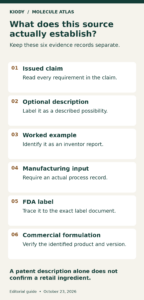
The word claimed is crucial. A patent document can contain hundreds of pages of background, examples, chemical structures, and possible applications. The enforceable boundary is determined by the patent’s claims, interpreted under patent law—not by every sentence in the description and not by a headline about the patent.
The USPTO describes patent claims as the language that puts the public on notice of the scope of the owner’s right to exclude. USPTO Manual of Patent Examining Procedure: Claims and Scope
In practical terms, a patent relating to one modified mitragynine molecule does not automatically cover:
- every Mitragyna speciosa tree;
- every dried kratom leaf;
- every ordinary leaf-powder product;
- every extract;
- every method of producing an extract;
- every product containing naturally occurring mitragynine; or
- every future kratom-related medicine.
The actual claims must be read before reaching any conclusion.
Five different things people may mean by “kratom rights”
Online discussions often combine several distinct legal or commercial concepts. Separating them makes the evidence easier to evaluate.
| Type of right or status | What it may cover | What it does not automatically mean |
|---|---|---|
| Patent | A claimed molecule, analog, method, formulation, composition, device, or use | Ownership of all kratom or permission to sell a drug |
| Exclusive patent license | Contractual rights to practice defined patents or technical information in an agreed field or territory | Transfer of ownership of every plant or every unrelated patent |
| Company acquisition | Ownership of shares or assets of a business | Government approval of the company’s scientific or policy claims |
| FDA approval | Authorization to market a particular drug for specified conditions under approved labeling | Patent ownership, approval of botanical kratom generally, or permission to ignore controlled-substance law |
| Controlled-substance registration | Authorization for defined handling activities under controlled-substance requirements | Consumer retail approval or ownership of the underlying compound |
The documents must show which category applies. A press release about an acquisition is not a patent. A patent is not an approved drug. A government restriction is not proof that a private company caused it.
What has actually been documented
1. Columbia University holds a granted mitragynine-alkaloid patent
U.S. Patent No. 10,961,244, titled “Mitragynine alkaloids as opioid receptor modulators,” lists the Trustees of Columbia University in the City of New York as the assignee. The patent record identifies a March 25, 2016 priority date and a March 30, 2021 grant date. Its materials concern specified alkaloids, analogs, compositions, and related uses and methods. Patent record: US10961244B2
This is a real intellectual-property interest. It should not be rewritten as “Columbia owns kratom.” The patent’s legal reach depends on its claims.
2. Kures received an exclusive Columbia license
An agreement filed with the U.S. Securities and Exchange Commission states that Columbia and Kures, Inc. entered into an exclusive license agreement effective June 8, 2020. The agreement defines covered mitragynine patents and technical information and grants Kures rights to discover, develop, manufacture, use, sell, import, export, and distribute covered products within the agreement’s field and territory, subject to its terms. SEC-filed Columbia–Kures exclusive license agreement
The same document is also a reminder not to overstate the arrangement. It defines particular patents, products, materials, and technical information. It does not say that Kures owns every kratom tree or every form of natural leaf.
3. Atai acquired a majority stake in Kures
Atai Life Sciences announced on July 9, 2020 that it had acquired a majority stake in Kures. The announcement identified KUR-101 as a derivative of mitragynine and stated that Kures held an exclusive Columbia University license to develop small molecules discovered in university research. Atai announcement: acquisition of Kures
Later SEC filings described KUR-101 as an oral formulation of deuterated mitragynine under development for opioid use disorder. “Deuterated” refers to a deliberate molecular modification; KUR-101 is not simply a pouch of ordinary leaf powder. The reported development history does not establish current FDA approval, and readers should not infer current program status from an older filing. Atai 2022 Form 10-K
This is the strongest documented basis for statements that a biotechnology company acquired commercial interests connected to kratom-derived pharmaceutical research. The accurate statement is about an acquisition, a licensed patent portfolio, and a modified drug candidate—not ownership of kratom itself.
4. Memorial Sloan Kettering holds a separate analog patent
U.S. Patent No. 11,046,692, titled “Mitragynine analogs and uses thereof,” lists Memorial Sloan Kettering Cancer Center as the assignee. The public record identifies an April 30, 2015 priority date and a June 29, 2021 grant date. It concerns claimed mitragynine-related analogs, compositions, and uses. Patent record: US11046692B2
The record also shows a confirmatory license to the U.S. government associated with federally supported research. That does not mean the federal government owns every kratom product; it reflects rights associated with the identified patented research.
5. Individuals hold a newer 7-OH conversion-method patent
U.S. Patent No. 12,492,201, titled “Method of converting mitragynine to 7-hydroxymitragynine,” describes claimed methods for converting mitragynine material into 7-OH. The public record lists Haywood Max Mitchell, Cecil Page, and Joseph William Merino as inventors and displayed “Individual” in its assignee field when reviewed on August 28, 2026. Patent assignments can change, so readers should use the official USPTO Patent Assignment Search for a current ownership check. Its priority date is May 15, 2024, and the patent was granted December 9, 2025. Patent record: US12492201B1 USPTO Patent Assignment Search
This record supports a narrower factual point: methods exist for converting mitragynine-containing material into 7-OH, and intellectual property can cover a particular method. It does not prove that pharmaceutical companies control all supplies of kratom leaf or that every producer using a different method infringes the patent.
Does pharmaceutical development require kratom leaf?
Kratom leaf is a natural source of mitragynine. Extracting mitragynine from leaf can therefore provide starting material for research, purification, or further chemical modification. The conversion-method patent above expressly discusses mitragynine extract as a starting material in claimed processes.
But that does not establish that every pharmaceutical research program must purchase finished retail leaf or rely on the same supply chain used by botanical sellers. A program may work with purified material, contracted botanical sources, licensed manufacturing, chemical intermediates, or other production approaches permitted by its technical plan and applicable law.
The evidence supports saying leaf can be a source of mitragynine. It does not support saying a retail ban exists so a company can take the leaf unless documents, communications, financial records, or other reliable evidence demonstrate that motive and transfer.
Why regulation and patents are easy to confuse
The current legal environment makes the concern understandable. Regulators are restricting some kratom-related consumer products while researchers and companies continue to investigate modified alkaloids as potential drug candidates. That can look like one coordinated event even when the records document separate legal processes.
Three systems are operating at the same time:
- Consumer-product enforcement: FDA has stated that kratom and 7-OH products are not lawfully marketed as dietary supplements or conventional-food ingredients and has taken action against unapproved medical claims and certain products. FDA and Kratom
- Controlled-substance scheduling: DEA and state authorities may restrict possession, manufacturing, distribution, or sale of specified compounds or broader kratom categories.
- Drug research and approval: A sponsor may study a defined compound under research rules and seek FDA approval for a particular drug, indication, manufacturing process, and label.
A compound can be controlled while still being available to properly registered researchers. That is not unique to kratom-related science. Likewise, the ability to conduct authorized research does not prove that a drug will work, receive FDA approval, or become commercially successful.
The current federal line: 7-OH versus three related compounds
As of August 28, 2026, the federal status requires careful wording.
DEA’s July 6, 2026 action concerning 7-OH above specified thresholds is a notice of intent and proposed amendment, not a final temporary scheduling order. The proposal describes a threshold above 0.050% 7-OH by dry weight for botanical Mitragyna speciosa material. For other covered synthetic-method or processed articles, it proposes coverage above 0.050% by weight or volume, or more than 1.00 milligram of 7-OH in the article. HHS extended the public-comment deadline to September 10, 2026. DEA proposed 7-OH threshold action HHS comment-period extension
A separate DEA order took effect August 26, 2026 and temporarily placed mitragynine pseudoindoxyl, MGM-15, and MGM-16 in Schedule I. It applies to those three substances without the proposed 7-OH threshold framework. Unauthorized retail sale and possession are prohibited under federal controlled-substance law. DEA final temporary order
Neither action grants a pharmaceutical company ownership of kratom. Scheduling determines legal controls; patents concern claimed inventions.
Massachusetts demonstrates why botanical leaf must be separated from federal 7-OH policy
Massachusetts adopted a broader state approach. An emergency order signed August 13, 2026 and effective August 28, 2026 temporarily places kratom, as defined by that order, in Schedule I under state law. Official implementation materials state that possession, distribution, and sale are unlawful without a Massachusetts Controlled Substances Registration and that municipal enforcement may include cease-and-desist action, citations, and license consequences. The order is not limited to concentrated 7-OH and reaches ordinary botanical kratom within its definition. Massachusetts DPH: Kratom Official municipal implementation notice
That policy can fairly be questioned and debated. But a broad restriction is not, by itself, proof of a private patent-transfer plan. Evidence of motive requires more than timing or commercial benefit.
How to investigate a “pharma bought the rights” claim
An adult reader can test the claim without accepting or dismissing it reflexively.
Step 1: Ask which right
Does the claim involve a patent, patent application, exclusive license, company acquisition, trademark, supply contract, FDA exclusivity, or controlled-substance registration? If the speaker cannot identify the type of right, the claim is not yet specific enough to verify.
Step 2: Ask which exact subject
Is the subject natural leaf, mitragynine, 7-OH, a deuterated analog, mitragynine pseudoindoxyl, a manufacturing method, a formulation, or a proposed medical use? These are not interchangeable.
Step 3: Find the number
A serious patent claim should identify a patent or application number. A licensing claim should identify the parties and, when public, the agreement or filing. A company acquisition should have an announcement or corporate record.
Step 4: Read the claims and status
Confirm whether the filing is pending, granted, active, expired, abandoned, or assigned. Then read the independent claims—the broad numbered claims that do not refer back to another claim—before making a scope statement.
Step 5: Separate documented fact from inference
“Company A licensed Patent B” is a fact if the agreement says so. “The government acted to benefit Company A” is a claim about motive and requires separate evidence.
Step 6: Check the date
Corporate ownership, patent status, research programs, and regulations change. A 2020 acquisition announcement does not prove that the same program remains active in 2026. Use dated language.
Frequently asked questions
Can someone patent the kratom plant?
Patent questions depend on the exact claims and facts. A patent involving a particular plant variety, engineered trait, compound, method, formulation, or use is different from ownership of an existing species as a whole. No reviewed record supports saying one company owns every Mitragyna speciosa plant.
Can someone patent mitragynine or 7-OH?
Patents exist involving mitragynine-related analogs, compositions, uses, and production methods. Whether a patent covers a specific product or activity depends on its claims, validity, enforceability, jurisdiction, and the facts of the activity.
Did Atai buy rights connected with kratom research?
Yes, in a defined sense. Atai announced that it acquired a majority stake in Kures in 2020. Kures had an exclusive license from Columbia covering identified patents and technical information for mitragynine-related drug development. That is not the same as buying ownership of natural kratom.
Does a pharmaceutical patent mean FDA approved the product?
No. The USPTO evaluates patent applications. FDA evaluates whether a particular drug may be marketed under federal drug law. A granted patent can exist without an approved drug, and an approved drug may be covered by more than one patent or by none.
Does Schedule I placement make a patent disappear?
No. Patent status and controlled-substance status are separate. Scheduling can restrict how a substance is manufactured, possessed, distributed, or researched. Patent rights may remain in force even when practicing the invention requires regulatory authorization.
Does a state kratom ban give leaf supplies to pharmaceutical companies?
Not by itself. A ban restricts conduct within the state according to its terms. Proof of a supply transfer or preferential arrangement would require additional records such as contracts, procurement documents, licenses, or official communications.
Is natural leaf required to manufacture every mitragynine-derived medicine?
Leaf is one possible source of mitragynine, but public patent and development records describe different molecules and methods. It is not accurate to assume that every program depends on the same retail leaf supply chain.
Why should consumers care about these patents?
They show where research and commercial interest are developing. They may also affect competition around particular inventions. But consumers should not confuse that interest with proof of safety, FDA approval, or a universal claim over botanical products.
How can I tell whether a social-media patent claim is reliable?
Look for a patent number, named owner or licensee, status, filing date, and the relevant claims. Treat screenshots, cropped abstracts, and unsourced statements as leads—not conclusions.
A responsible transparency standard
Kratom policy deserves scrutiny. Consumers can reasonably ask why some jurisdictions restrict botanical products broadly while institutions continue researching individual alkaloids and derivatives. Businesses can reasonably ask whether enforcement distinctions are clear, scientifically supported, and applied consistently.
The strongest public argument is the one that survives fact-checking. Document the patents. Document the licenses. Document the corporate acquisition. Document the exact regulatory action. Then label conclusions as conclusions and unanswered questions as unanswered questions.
That approach protects the public conversation from two opposite errors: pretending pharmaceutical interest does not exist, and claiming a proven conspiracy where the available records show only patents, licenses, research, regulation, and commercial incentives.
Primary sources
- USPTO: Managing a Patent.
- USPTO Manual of Patent Examining Procedure § 2173.
- Patent record: US10961244B2, Mitragynine alkaloids as opioid receptor modulators.
- SEC-filed Columbia–Kures exclusive license agreement, effective June 8, 2020.
- Atai announcement concerning its acquisition of a majority stake in Kures, July 9, 2020.
- Atai 2022 Form 10-K.
- Patent record: US11046692B2, Mitragynine analogs and uses thereof.
- Patent record: US12492201B1, Method of converting mitragynine to 7-hydroxymitragynine.
- FDA and Kratom.
- DEA proposed 7-OH threshold action.
- HHS extension of the 7-OH comment period.
- DEA final temporary order covering mitragynine pseudoindoxyl, MGM-15, and MGM-16.
- Massachusetts DPH: Kratom and official municipal implementation notice.