Important: This page is educational and is not medical, dosing, or legal advice. It does not recommend that anyone use kratom or tell anyone how many capsules to take. Kratom laws and product requirements vary by destination and can change. The U.S. Food and Drug Administration states that no FDA-approved drug contains kratom or its alkaloids and advises consumers not to use kratom or concentrated 7-OH products. Always review the finished package, the matching batch report, and current local rules.
The quick answer
When a capsule label describes the fill as approximately 500 milligrams per capsule, the number refers to the nominal weight of botanical leaf powder placed inside each capsule. Five hundred milligrams equals one-half gram. It does not mean that the capsule contains 500 milligrams of mitragynine, 7-hydroxymitragynine, total alkaloids, or any isolated active compound. It is also not a promise of a standardized effect.
“Approximately” matters because filling botanical powder into individual capsule shells is a manufacturing process, not a claim that every finished unit contains an atom-for-atom identical quantity. The finished package should state the quantity basis clearly, and the seller should verify the actual product specification before using that wording.
A pure-leaf capsule is simply a delivery format for powdered Mitragyna speciosa leaf. It should not be confused with an extract capsule, an enhanced capsule, an isolated-alkaloid tablet, or a concentrated 7-OH product. Those forms can differ materially in ingredients, concentration, labeling, laboratory interpretation, and legal treatment.
What “pure leaf” should mean on a product page
“Pure leaf” should be used as a precise product-form description, not as a vague quality slogan. For a capsule to be described this way, the fill should consist of botanical kratom leaf powder rather than a concentrated extract, isolated alkaloid, or leaf powder fortified with added alkaloids. The capsule shell itself must still be disclosed in the ingredient statement.
The phrase does not mean “FDA approved,” “risk-free,” “free of every contaminant,” or “chemically identical from harvest to harvest.” It also does not prove quality by itself. Quality claims require supporting controls: traceable lots, accurate packaging, suitable laboratory testing, documented specifications, and a certificate of analysis that matches the batch offered for sale.
A clear product page should answer five questions without making the customer decode marketing language:
- Is this botanical leaf, an extract, an enhanced product, or an isolated-alkaloid product?
- What ingredient is inside the shell, and what is the shell made from?
- What does the stated milligram quantity measure?
- Which lot or batch does the package belong to, and where is its laboratory report?
- Are there destination restrictions, age requirements, or other warnings the buyer needs to review?
If a page cannot answer the first three questions, it is not ready to rely on as a product specification.
What 500 mg measures—and what it does not
A milligram is a unit of mass. One thousand milligrams equal one gram, so 500 milligrams equal 0.5 gram. On a correctly described pure-leaf capsule page, “approximately 500 mg per capsule” should refer to the nominal mass of leaf powder inside one capsule.
That number does not automatically include the capsule shell. Sellers must distinguish fill weight from finished-capsule weight. If the manufacturing specification measures only the botanical powder, the page should say “approximately 500 mg of leaf powder per capsule.” If the number instead represents the entire filled capsule, including the shell, it should not be presented as 500 mg of leaf. That distinction should be resolved from the product specification before a buyer relies on the statement.
The number also does not tell a buyer:
- how much mitragynine is present;
- how much 7-OH is present;
- the percentage of total alkaloids;
- whether the product passed heavy-metal or microbiological specifications;
- whether every capsule is chemically identical;
- how an individual will respond; or
- what amount anyone should use.
Leaf mass and alkaloid mass are different measurements. A capsule holding approximately 500 mg of plant material cannot honestly be described as containing 500 mg of mitragynine or 500 mg of 7-OH. Quantitative alkaloid information must come from suitable analysis and must use clear units and a clear denominator, such as a result per gram or per labeled serving.
Four product forms that should never be blended together
| Product form | What it generally contains | What a weight statement may describe | What the buyer still needs to verify |
|---|---|---|---|
| Pure-leaf capsule | Powdered botanical kratom leaf inside a capsule shell | Nominal leaf-powder fill per capsule | Ingredients, shell material, lot, COA, package count, warnings, and destination rules |
| Extract capsule | A concentrated preparation rather than only leaf powder | Extract mass, carrier-plus-extract mass, or another formulation measurement | Extraction description, quantitative alkaloids, ingredients, serving basis, and batch report |
| Enhanced leaf capsule | Leaf powder with an added extract or added/concentrated alkaloid component | Total blend mass, which may conceal very different component amounts | Full formula, amount of enhancement, alkaloid quantities, and legal status |
| Concentrated or isolated 7-OH product | Elevated 7-OH or an isolated/concentrated alkaloid preparation | Often milligrams of 7-OH per unit, serving, or package | Exact chemical identity, amount basis, ingredients, current law, warnings, and matching COA |
The front of a package may use the same general word—“kratom”—for all four. That does not make the products interchangeable. A responsible catalog places the product form in the title, short description, ingredient section, specifications, and structured product data.
Why capsule size is not a potency scale
Capsule shells come in multiple sizes, but shell size alone does not establish fill weight, ingredient identity, alkaloid content, or strength. Powders can differ in density and flow. Manufacturing equipment, fill settings, and product specifications also matter. A larger-looking capsule is not proof of more leaf, and two capsules of similar appearance are not proof of equal contents.
Color is also unreliable as a chemical measurement. The appearance of the shell may come from the shell material or colorant, while the shade of the botanical powder can be affected by raw material and processing. Neither visual cue replaces an ingredient statement or batch analysis.
This is why Kiody product pages should use measured specifications instead of phrases such as “strong capsule,” “maximum strength,” or “potent size.” Those phrases invite customers to infer a standardized effect that a nominal leaf-fill weight does not establish.
The capsule shell is part of the ingredient story
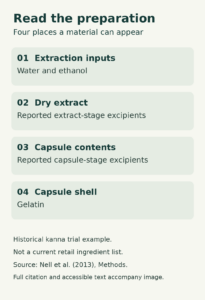
Even when the fill is a single botanical ingredient, the finished capsule is not literally made only of leaf. The shell must come from something. Common shell materials may be gelatin-based or plant-derived, and some finished products may contain processing aids or other ingredients.
A responsible seller should list the actual shell material used for each SKU and batch family rather than assume one statement applies to every capsule. That information matters to customers who evaluate dietary preferences, allergies, or ingredient restrictions. The product page, physical label, and internal specification should agree.
If the shell supplier or formulation changes, the website should be updated before the new version is offered. A customer should not have to compare a bottle in hand against an obsolete online ingredient list.
Capsule count, net contents, and per-capsule fill answer different questions
A complete capsule listing may display several quantities:
- the number of capsules in the package;
- the approximate leaf-powder fill per capsule;
- the total declared net contents or other required net-quantity statement;
- the manufacturer’s labeled serving information, where applicable; and
- separately measured alkaloid results, if presented.
These numbers should not be collapsed into one. “60 capsules” is a count. “Approximately 500 mg of leaf powder per capsule” is a nominal unit-fill statement. A total net-weight declaration describes the package as a whole. A laboratory result for mitragynine or 7-OH is an analytical measurement with its own unit and basis.
A responsible seller should avoid doing customer-use arithmetic on the product page. The useful trust-building step is to label each number accurately, show where it applies, and keep the package, specifications, and COA aligned.
What a complete pure-leaf capsule page should disclose
Every Kiody pure-leaf capsule listing should follow the same information order. Consistency helps customers compare products and helps the catalog team notice missing data.
1. Exact product identity
Use a title such as “Green Bali Pure-Leaf Kratom Capsules” rather than a shortened name that leaves the form unclear. The word “capsules” should not force the customer to guess whether the contents are leaf or extract.
2. Plain product-form statement
State that the capsules contain botanical Mitragyna speciosa leaf powder and are not extract or enhanced 7-OH capsules—but only when the formulation and finished label support that statement.
3. Approximate fill statement
Use: “Approximately 500 mg of leaf powder per capsule.” Do not shorten this to “500 mg strength,” because “strength” can imply an alkaloid concentration or effect that has not been established by the fill weight.
4. Full ingredient statement
Name the leaf powder and the actual capsule-shell material. Include any other ingredient that is present. Do not use “pure” to hide the shell or another component.
5. Package quantity
Display the verified capsule count for the selected size. If customers can choose among counts, the selector should update the correct price and availability without changing the product-form statement.
6. Lot or batch identification
Explain where the lot appears on the package and provide a direct path to the matching laboratory report. A generic COA is not a substitute for a batch match.
7. Testing scope
Tell customers which panels are available. Alkaloids, heavy metals, and microbiology are different categories. “Lab tested” should not imply that every possible contaminant or property was tested.
8. Warnings and restrictions
Display the verified age statement, storage language, package cautions, and destination restrictions. Do not claim nationwide legality. Local rules may differ or change.
9. No medical promises
Keep descriptions focused on identity, form, sourcing documentation, packaging, testing literacy, and customer verification. Do not promise pain relief, anxiety relief, withdrawal treatment, energy, sleep, mood changes, or any other medical or physiological result.
Color and variety names are catalog identifiers, not chemical guarantees
Kiody’s capsule catalog may use green, red, and white families together with variety names such as Maeng Da, Bali, Hulu, Ketapang, Vietnam, and Malay. Those names help organize the catalog and identify the labeled product a customer selected. They do not, by themselves, define a legally standardized composition or guarantee a particular effect.
A customer should therefore compare the actual lot, ingredient statement, and laboratory results—not assume that every product sold under the same market name by different sellers is chemically identical. A responsible seller should also avoid turning common marketplace descriptions into promises such as “red always does X” or “white always does Y.” Without product-specific substantiation, those statements are not responsible product education.
For the 18 color-and-variety combinations, the reliable information architecture is:
- Green Maeng Da, Green Bali, Green Hulu, Green Ketapang, Green Vietnam, and Green Malay;
- Red Maeng Da, Red Bali, Red Hulu, Red Ketapang, Red Vietnam, and Red Malay; and
- White Maeng Da, White Bali, White Hulu, White Ketapang, White Vietnam, and White Malay.
Each listing can have unique, natural-language copy about its catalog identity, but the core product facts should use one verified template: botanical leaf form, approximate fill, real shell ingredients, selectable package counts, lot traceability, COA access, warnings, and restrictions. Search engines benefit more from accurate, useful pages than from 18 near-duplicate blocks filled with unsupported adjectives.
How to match capsule packaging to a COA
A certificate of analysis is most useful when it describes the batch the customer will actually receive. Start with the lot or batch number printed on the bottle, pouch, seal, or label. The identifier on the COA should match exactly.
Then check:
- Sample identity: The report should describe capsules or the specific leaf powder used for that capsule lot, not an unrelated extract, gummy, or older product.
- Dates: Review the sample-received, analysis, and report dates. A current sales page should not silently rely on an obsolete report.
- Laboratory identity: The full report should identify the laboratory, not only show a cropped result table.
- Units: A percentage, milligrams per gram, and milligrams per capsule are not interchangeable.
- Testing panels: An alkaloid panel does not establish microbiological or heavy-metal results.
- Specifications: Where the report states acceptance limits, make sure the pass/fail conclusion agrees with the numbers and units.
If a product page displays one lot while fulfillment is shipping another, the website and fulfillment process are out of sync. The correct response is to fix the batch association, not to relabel an old report as “representative.”
Why contaminant testing belongs on a capsule page
Encapsulation does not remove the need to evaluate the leaf powder. The FDA reported finding significant levels of lead and nickel in some of 30 kratom products it analyzed. The agency also investigated a multistate Salmonella outbreak linked to kratom products in 2018, and a firm recalled a specific lot of kratom powder and capsules because of potential Salmonella contamination. These findings do not prove that every kratom product is contaminated. They show why batch identification, heavy-metal testing, microbiological testing, and recall traceability matter. FDA laboratory analysis of kratom products for heavy metals FDA Salmonella investigation FDA recall notice involving kratom powder and capsules
Customers should be able to tell whether a report includes, at minimum, the named analytes or organisms, results, units, reporting limits where relevant, and a batch identifier. “ND” generally means not detected above the laboratory method’s stated limit; it does not necessarily mean absolute zero.
Pure-leaf capsules versus concentrated 7-OH: the current federal distinction
The FDA has publicly distinguished naturally occurring constituents in botanical kratom leaf from concentrated 7-OH products. Its July 2025 announcement said the agency’s requested scheduling action targeted concentrated 7-OH products and not natural kratom leaf. That distinction is important, but it is not permission to make medical claims or ignore state law. FDA announcement on concentrated 7-OH
As of August 28, 2026, the federal action specifically addressing 7-OH above stated thresholds remains a notice of intent and proposed amendment, not an effective final scheduling order. The proposal describes a threshold above 0.050% 7-OH by dry weight for botanical Mitragyna speciosa material. For certain processed or synthetic-method articles, it proposes coverage above 0.050% by weight, volume, or weight-to-volume, or more than 1.00 milligram of 7-OH in the article. The public-comment period was extended through September 10, 2026. Federal Register: proposed 7-OH threshold action Federal Register: comment-period extension
A separate DEA temporary scheduling order took effect August 26, 2026 for mitragynine pseudoindoxyl, MGM-15, and MGM-16. It remains effective through August 26, 2028 unless extended or replaced under federal law. That final order is not the same as the pending 7-OH threshold proposal, and those named substances should not be conflated with ordinary pure-leaf capsules. Federal Register: temporary scheduling of mitragynine pseudoindoxyl, MGM-15, and MGM-16
The practical catalog rule is straightforward: describe the actual formulation. Do not use a botanical-leaf description for an enhanced or concentrated product, and do not imply that a pending federal proposal is already effective law.
State rules may require more
There is no single product-page sentence that resolves every state and local requirement. Colorado illustrates how specific a state framework can be. Colorado’s SB25-072 took effect May 29, 2025. Among other provisions, it prohibits sales to people under 21, products containing synthesized or semi-synthesized kratom alkaloids, and products in which 7-OH exceeds 2% of the product’s total alkaloid composition. It also requires specified label information, including company identification, ingredients, warnings, directions, serving information, and quantitative mitragynine and 7-OH amounts per serving. Colorado General Assembly: SB25-072 Colorado Session Law, Chapter 283
Those requirements are a Colorado example, not a nationwide standard. A responsible seller should check current official sources for each destination and keep product eligibility separate from generalized marketing copy. A product’s availability on a website does not establish that it may be lawfully sold, possessed, or shipped to every address.
What to do if a capsule package is damaged or does not match the page
Do not ignore a broken seal, leaking powder, missing lot code, unexpected capsule appearance, incorrect count, or disagreement between the package and website. Preserve the package, photograph the issue, record the order and lot information, and contact the seller before using the product.
A good customer-support process should be able to identify the SKU and lot, compare the physical label with the current specification, find the matching COA, and explain the resolution. It should not ask the customer to rely on a report from an unrelated batch.
Store the unopened or remaining product according to its label, away from children and pets. If someone may be experiencing poisoning or a serious unexpected reaction in the United States, contact Poison Help at 1-800-222-1222. Call 911 if the person is unresponsive or has trouble breathing. Adverse events can also be reported through FDA MedWatch.
A responsible buyer’s capsule checklist
Before purchasing, confirm:
- The title says whether the capsules contain pure leaf, extract, enhanced material, or another form.
- “Approximately 500 mg” is clearly identified as leaf-powder fill per capsule, if that is the verified specification.
- The ingredient list includes the capsule shell and every other ingredient.
- The selected package count, price, and availability update correctly.
- The lot or batch number can be matched to a full laboratory report.
- The report identifies the sample, laboratory, dates, results, and units.
- Alkaloid, heavy-metal, and microbiological panels are described separately.
- The page makes no FDA-approval, disease-treatment, or guaranteed-effect claims.
- Age limits, warnings, storage information, and destination restrictions are visible.
- The physical package agrees with the product page when the order arrives.
No single check proves safety or legality. Together, they make the product easier to identify, compare, and question responsibly.
Frequently asked questions
Does “500 mg kratom capsule” mean 500 mg of mitragynine?
No. On a pure-leaf capsule listing, approximately 500 mg should describe the nominal weight of leaf powder inside the capsule. Mitragynine is one constituent of the botanical material and must be measured and reported separately with clear units.
Does it mean 500 mg of 7-OH?
No. A pure-leaf fill-weight statement is not a 7-OH declaration. A claim of 500 mg of 7-OH would describe a fundamentally different and highly concentrated product, not an ordinary half-gram leaf capsule.
Is the capsule shell included in the 500 mg?
The product specification must answer that. Clear wording such as “approximately 500 mg of leaf powder per capsule” means the number refers to the fill, not the shell. The finished label and product specification should verify that basis.
Why does the page say “approximately” 500 mg?
It identifies a nominal manufacturing fill rather than claiming that every unit contains an absolutely identical mass. The finished product still needs appropriate manufacturing controls and accurate net-quantity labeling.
Is a pure-leaf capsule the same as an extract capsule?
No. A pure-leaf capsule contains powdered botanical leaf. An extract capsule contains a concentrated preparation and may require different quantitative information to be understood. The product title and ingredients should make the difference unmistakable.
Are pure-leaf capsules the same as concentrated 7-OH products?
No. Concentrated or enhanced 7-OH products are distinct from ordinary botanical leaf capsules. Product form, composition, risk communication, and legal treatment may differ.
Do green, red, and white capsules have standardized effects?
No nationwide legal or scientific standard makes every product with the same color name chemically identical or guarantees a specific effect. Treat color and variety as catalog identifiers and review the actual batch documentation.
What does “lab tested” mean?
By itself, very little. The buyer should be able to see what was tested, which batch was sampled, which laboratory performed the work, the result and unit, and whether the report includes alkaloids, heavy metals, microbiology, or other panels.
Does a COA prove a capsule is safe?
No. A COA reports results for the sample and tests shown. It does not prove the product is risk-free, suitable for an individual, stored correctly after testing, or lawful everywhere.
Are kratom capsules FDA approved?
No FDA-approved drug contains kratom or its alkaloids. The FDA also states that kratom is not lawfully marketed in the United States as a dietary supplement or as an additive in conventional food. Do not use an FDA-style seal or approval claim on a Kiody page. FDA and Kratom
How many 500 mg capsules should someone take?
This page does not provide dosing advice. Leaf fill weight does not determine an appropriate amount for an individual, and kratom products are not FDA-approved medicines. Questions about health, medications, pregnancy, substance use, or unexpected reactions should be directed to a qualified healthcare professional.
What should a customer do when the lot number has no matching COA?
Pause and ask Kiody for the report tied to that exact lot. The company should correct the batch association instead of directing the customer to a generic or unrelated report.
Primary sources
- U.S. Food and Drug Administration, “FDA and Kratom,” updated December 2, 2025: https://www.fda.gov/news-events/public-health-focus/fda-and-kratom
- U.S. Food and Drug Administration, “FDA Takes Steps to Restrict 7-OH Opioid Products Threatening American Consumers,” July 29, 2025: https://www.fda.gov/news-events/press-announcements/fda-takes-steps-restrict-7-oh-opioid-products-threatening-american-consumers
- U.S. Drug Enforcement Administration, notice of intent and proposed amendment concerning 7-OH above a specified threshold, published July 6, 2026: https://www.federalregister.gov/documents/2026/07/06/2026-13580/schedules-of-controlled-substance-temporary-placement-of-7-hydroxymitragynine-above-a-specified
- U.S. Department of Health and Human Services, extension of the 7-OH comment period through September 10, 2026, published August 26, 2026: https://www.federalregister.gov/documents/2026/08/26/2026-17409/hydroxymitragynine-above-a-specified-threshold-in-schedule-i-extension-of-comment-period
- U.S. Drug Enforcement Administration, temporary Schedule I order for mitragynine pseudoindoxyl, MGM-15, and MGM-16, effective August 26, 2026: https://www.federalregister.gov/documents/2026/08/26/2026-17429/schedules-of-controlled-substances-temporary-placement-of-mitragynine-pseudoindoxyl-mgm-15-and
- U.S. Food and Drug Administration, “Laboratory Analysis of Kratom Products for Heavy Metals”: https://www.fda.gov/news-events/public-health-focus/laboratory-analysis-kratom-products-heavy-metals
- U.S. Food and Drug Administration, 2018 multistate Salmonella investigation involving reported kratom products: https://www.fda.gov/food/hfp-constituent-updates/fda-investigates-multistate-outbreak-salmonella-infections-linked-products-reported-contain-kratom
- U.S. Food and Drug Administration, recall notice for a specific lot of kratom powder and capsules: https://www.fda.gov/safety/recalls-market-withdrawals-safety-alerts/blissful-remedies-issues-voluntary-nationwide-recall-certain-kratom-powder-capsule
- Colorado General Assembly, SB25-072 and enacted session law, effective May 29, 2025: https://leg.colorado.gov/bills/SB25-072 and https://leg.colorado.gov/laws/session-laws/SB25-072/283/download