Mesembrine is one of the best-known alkaloids associated with Kanna, but it is not a synonym for the plant. Kanna material can contain mesembrine alongside mesembrenone, mesembrenol, Δ7-mesembrenone, mesembranol and other compounds, and their proportions vary with genetics, plant material, processing and storage. An isolated molecule, a fermented botanical preparation and a standardized extract therefore cannot share one evidence label.
This guide examines what researchers have actually measured: mesembrine’s chemical identity, serotonin-transporter assays, weaker phosphodiesterase-4 findings, metabolism in rat and human-liver systems, analytical testing, preparation-dependent variability and the limits of current human evidence. It is educational, nonmedical and intended for adults 21 and older. It does not provide a serving recommendation or tell anyone to start, stop or replace a medicine.
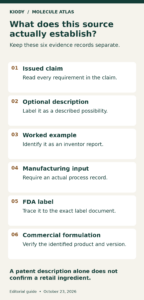
The central evidence boundary: researchers have studied purified mesembrine in laboratory assays, but the small living-human studies discussed below used multi-constituent Kanna extracts—not isolated mesembrine. Extract findings cannot be reassigned to the molecule.
Mesembrine in one minute
- Mesembrine is a nitrogen-containing alkaloid with molecular formula C17H23NO3.
- It is one member of a chemically related Kanna alkaloid family, not the whole plant and not every product’s dominant compound.
- In a 2011 laboratory study, isolated mesembrine showed high affinity for the serotonin transporter, or SERT. That assay did not test clinical benefit.
- In the same research, mesembrenone—not mesembrine—was the stronger phosphodiesterase-4 inhibitor among the isolated alkaloids tested.
- The most detailed metabolism paper used rat urine, pooled human-liver preparations and recombinant enzymes. It was not a human plasma pharmacokinetic trial.
- Controlled human studies have examined particular standardized Kanna extracts. They do not establish the effects, exposure or safety of isolated mesembrine.
- Published processing studies disagree about whether fermentation raises or lowers mesembrine, showing that “fermented” is not one standardized chemistry.
What is mesembrine?
Mesembrine is a plant alkaloid historically isolated from Kanna species. Current botanical nomenclature matters here: the Royal Botanic Gardens, Kew accepts Mesembryanthemum tortuosum L. and records Sceletium tortuosum (L.) N.E.Br. as a synonym. Scientific papers commonly use the older Sceletium name, which is why both names appear in the literature.
The molecule is assigned molecular formula C17H23NO3 and a molar mass of about 289.4 g/mol. It contains a tertiary amine, an aromatic methoxy group and a bicyclic ring system with defined stereochemistry. That three-dimensional arrangement is part of its identity: changing the position or orientation of groups can create a different compound even when formulas look similar.
Mesembrine is frequently described as an “active ingredient,” but that phrase can hide important uncertainty. A botanical sample is a chemical mixture. Its observed activity can reflect multiple alkaloids, non-alkaloid constituents, ratios among them, extraction efficiency and metabolism. Finding mesembrine in a sample does not prove that every observed property came from mesembrine alone.
Identity sources: PubChem’s mesembrine record and Kew’s accepted botanical record.
Mesembrine is not the same object as Kanna
| Research object | What it contains | What its evidence can support | What it cannot establish |
|---|---|---|---|
| Authenticated plant material | A variable botanical mixture | Chemistry of the sampled species, plant part and batch | Composition of every Kanna product |
| Fermented kougoed | Plant material changed by a defined process | Process-specific before-and-after chemistry | One universal fermented profile |
| Standardized extract | Multiple constituents within a target specification | Results for that tested extract | Effects of isolated mesembrine |
| High-mesembrine proprietary extract | A selected multi-constituent profile enriched in mesembrine | Results for that named material and assay | That all Kanna releases monoamines |
| Isolated mesembrine | One purified, stereochemically defined molecule | Compound-specific binding, enzyme and metabolism findings | Whole-plant clinical effects |
This separation prevents a common reasoning error. If purified mesembrine binds SERT in a test system, that does not mean a gram of botanical material has the same effective concentration. Conversely, if a standardized extract produces a signal in a human imaging study, that signal cannot be assigned solely to mesembrine unless the study design isolates that causal question.
For the broader mixture-level map, see Kiody’s Kanna alkaloids, SERT and PDE4 guide. Readers new to the botanical can begin with what Kanna is.
Mesembrine and related Kanna alkaloids are not interchangeable
The name “mesembrine-type alkaloids” describes a family, not one compound. Related molecules differ by oxidation, unsaturation and stereochemistry. Those differences can alter chromatographic retention, mass-spectral fragments, target affinity, metabolism and stability.
| Alkaloid | Molecular formula | Chemical distinction | Evidence boundary |
|---|---|---|---|
| Mesembrine | C17H23NO3 | Methoxy-containing bicyclic alkaloid with defined stereochemistry | Strongest SERT-affinity result among three isolated alkaloids in one 2011 assay set |
| Mesembrenone | C17H21NO3 | Unsaturated ketone; two fewer hydrogens | Stronger PDE4 inhibition than mesembrine in that same assay set |
| Mesembrenol | C17H23NO3 | Shares a formula with mesembrine but has a different structure | Its SERT result cannot be substituted for mesembrine’s |
| Δ7-mesembrenone | C17H21NO3 | Positional isomer of mesembrenone | Important in processing research; not a synonym for mesembrenone |
| Mesembranol | C17H25NO3 | More hydrogenated member of the family | Detection does not establish mesembrine exposure |
A validated high-performance liquid chromatography method separated and quantified four major alkaloids in plant material and products. That work illustrates why a single “total alkaloids” number is incomplete: a total can remain similar while individual compounds shift. It also cannot distinguish every stereoisomer unless the method and reference standards are capable of doing so.
Primary method source: Patnala and Kanfer’s HPLC analysis.
How much mesembrine occurs in Kanna?
There is no defensible universal percentage. Shikanga and colleagues analyzed 151 wild specimens from 31 South African localities plus eight commercial formulations using gas chromatography–mass spectrometry. They reported five broad chemical clusters: one without detected mesembrine-type alkaloids and others characterized by different dominant alkaloids, including mesembrine, mesembrenone or mesembrenol. Total measured alkaloids in the wild specimens ranged from 0.11% to 1.99% of dry weight.
That range is informative but not a specification for a modern retail lot. The study sampled particular material, locations and analytical conditions. A finished product may use another species, plant part, growing condition, fermentation process, extract ratio or standardization target. A label may also state an extract amount without identifying the mesembrine amount.
The scientific conclusion is narrower and more useful: mesembrine can be prominent, minor or not detected in different authenticated samples. “Kanna contains mesembrine” is a botanical generalization; “this batch contains this concentration of mesembrine” requires batch-specific analytical evidence.
Primary source: Shikanga et al., 2012.
What does mesembrine do at the serotonin transporter?
SERT is a membrane transporter that returns serotonin from the extracellular space to the presynaptic cell. Inhibiting transport can slow serotonin clearance in a laboratory system. It does not mean the compound “creates serotonin,” and it does not by itself establish an antidepressant effect.
Harvey and colleagues tested a standardized Sceletium extract and three purified alkaloids in laboratory assays. Mesembrine had the highest reported affinity for SERT, with an inhibition constant, or Ki, of 1.4 nM. Mesembrenone and mesembrenol were reported at 27 nM and 63 nM. The multi-constituent extract inhibited serotonin uptake with an IC50 of 4.3 micrograms/mL.
Ki and IC50 are not interchangeable. Ki is a model-based estimate of binding affinity under defined conditions; IC50 is the concentration that produces half-maximal inhibition in a particular assay. Neither is a human blood level, clinical-response threshold, serving, or safety limit.
The careful conclusion is that isolated mesembrine interacted strongly with SERT in the reported test systems. The study did not randomize patients, diagnose a disorder, measure long-term outcomes or establish how much unbound mesembrine reaches human brain tissue after any botanical preparation.
Primary source: Harvey et al., 2011.
Is mesembrine an SSRI?
Calling mesembrine “an SSRI” is an imprecise shortcut. It is reasonable to say that purified mesembrine inhibited or bound the serotonin transporter in specified preclinical assays. “SSRI,” however, is also a pharmaceutical class built around approved products with defined formulations, indications, dose ranges, pharmacokinetics, manufacturing controls and clinical safety data.
Fluoxetine, for example, has a regulatory label based on a characterized drug product and extensive human evidence. Mesembrine has no comparable isolated-compound clinical dossier. Sharing one molecular target does not establish equal selectivity, brain exposure, duration, clinical effect, adverse-event profile or interaction magnitude.
The phrase also obscures Kanna’s mixture chemistry. A Kanna extract can contain compounds with different relative SERT and PDE4 activities, and a high-mesembrine extract produced another monoamine-related laboratory signal described below. A product cannot be classified from mesembrine’s isolated assay alone.
Mesembrine is not the principal PDE4 story
Phosphodiesterase-4, or PDE4, enzymes break down cyclic adenosine monophosphate, an intracellular signaling messenger. In the 2011 experiments, the standardized extract inhibited PDE4, but the isolated-alkaloid result was not led by mesembrine. Mesembrenone was the most active of the three isolated alkaloids tested, with an IC50 around 470 nM; mesembrine and mesembrenol were substantially weaker.
This distinction matters for both science and search language. A mesembrine-dominant material cannot be assumed to have the same PDE4 profile as a mesembrenone-rich material. Nor does a PDE4 result in an enzyme assay prove better cognition, reduced anxiety or treatment of any condition.
What did the high-mesembrine extract study find?
Coetzee, López and Smith studied Trimesemine, a proprietary high-mesembrine Sceletium extract, in cellular systems. The researchers reported monoamine-releasing behavior and interpreted the findings as involving vesicular monoamine transporter 2, or VMAT2, rather than simple SERT inhibition alone.
That result belongs to the tested extract. Trimesemine was not pure mesembrine, and the experiments did not show that every Kanna plant, tea, powder or extract behaves the same way. They also did not quantify a corresponding effect in living humans. Describing this as “mesembrine releases dopamine” would erase both the tested material and the study design.
Primary source: Coetzee et al., 2016.
How is mesembrine metabolized?
The most detailed published metabolism study did not administer isolated mesembrine to a human pharmacokinetic cohort. Meyer and colleagues isolated mesembrine and mesembrenone from plant material, confirmed identity by nuclear magnetic resonance, then investigated metabolites in rat urine and pooled human-liver preparations using GC–MS, LC–MSn, high-resolution LC–MSn and related methods.
Mesembrine underwent combinations of O-demethylation, N-demethylation, reduction, hydroxylation and conjugation. Phenolic metabolites were partly present as glucuronides or sulfates. Many phase-I metabolites observed in rat urine were also detected in the human-liver preparations, but that cross-system overlap does not make the rat exposure profile a human pharmacokinetic curve.
In recombinant-enzyme experiments, mesembrine O-demethylation involved CYP1A2, CYP2B6, CYP2C19 and CYP2D6. N-demethylation involved those enzymes plus CYP3A4 and CYP3A5. These are candidate metabolic routes under the experiment’s conditions. They do not establish which enzyme dominates in an individual, whether Kanna clinically inhibits those enzymes or the size of an interaction with a medicine.
The paper also proposed urinary markers for toxicological detection. Detecting a metabolite can support exposure to mesembrine or a mesembrine-containing material; it does not identify the original product, plant part, preparation, amount, timing or clinical cause by itself.
Primary source: Meyer et al., 2015.
Do human pharmacokinetic data exist for isolated mesembrine?
This review did not locate a controlled study that administered purified mesembrine to people and reported a validated plasma concentration–time profile with standard pharmacokinetic outputs such as Cmax, Tmax, half-life, area under the curve, clearance and bioavailability. That is a major evidence gap.
The absence matters because an in-vitro affinity value cannot reveal human exposure. Absorption, protein binding, first-pass metabolism, active metabolites, tissue distribution and elimination all influence whether and for how long a molecular target is engaged. Until those data exist, human claims about isolated mesembrine’s onset, duration, potency or interaction magnitude are speculative.
What human studies actually tested
Small controlled studies have tested particular standardized Kanna extracts. These are relevant to the botanical evidence base but do not become mesembrine trials simply because the extracts contain mesembrine-type alkaloids.
| Study | Design and sample | Tested material | What it supports | Main limitation |
|---|---|---|---|---|
| Harvey et al., 2011 | Laboratory transporter and enzyme assays | Standardized extract plus purified mesembrine, mesembrenone and mesembrenol | Assay-specific SERT and PDE4 findings | No living-human outcome or PK data |
| Meyer et al., 2015 | Rat urine, pooled human-liver preparations and recombinant enzymes | Isolated mesembrine and mesembrenone | Candidate metabolites, CYP routes and analytical markers | Not a human dosing or plasma PK study |
| Coetzee et al., 2016 | Cellular monoamine and transporter experiments | Proprietary high-mesembrine extract | Monoamine-release behavior for that extract in vitro | Not pure mesembrine and not a human trial |
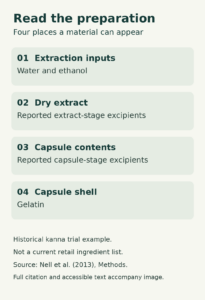
| Nell et al., 2013 | Randomized, double-blind, placebo-controlled; 37 healthy adults; three months | Two amounts of one standardized extract | Short-term tolerability observations for that product | Groups of 12, 12 and 13; no efficacy endpoint; rare events not measurable |
| Terburg et al., 2013 | Double-blind crossover pharmaco-fMRI; 16 healthy students aged 18–21 | One standardized-extract capsule and placebo on separate visits | Acute BOLD and connectivity findings for that extract | Small healthy sample; imaging signal is not treatment benefit |
Nell and colleagues reported that both tested extract groups were generally well tolerated over three months. The trial included 37 healthy adults divided into groups of 12, 12 and 13 and assessed tolerability rather than effectiveness. It cannot establish rare-event safety, long-term safety, pregnancy safety, interaction safety or the safety of unrelated products. The publication is indexed as non-U.S. government-supported research.
Terburg and colleagues used a randomized, double-blind, placebo-controlled crossover design in 16 medication-free healthy students. The paper reported lower amygdala reactivity under one fearful-face condition and a connectivity difference after the standardized extract, with no general subjective mood effect. BOLD is a blood-oxygenation signal, not a direct measure of serotonin and not proof that the extract treats an anxiety disorder. The study received support from H.L. Hall and Sons and a Netherlands research grant; one author was an officer of the company that developed the extract. Those disclosures do not invalidate the findings, but they belong in interpretation.
Human sources: Nell et al., 2013 and Terburg et al., 2013.
Does fermentation always reduce mesembrine?
No universal direction has been demonstrated. Patnala and Kanfer simulated kougoed preparation with aerial plant material and also tested purified mesembrine hydrochloride. In one experiment, mesembrine decreased markedly while Δ7-mesembrenone appeared. They also documented mesembrine instability under light, heat, water and fermentation conditions.
A later controlled study by Chen and Viljoen found the opposite headline direction in its samples: measured mesembrine increased after fermentation while mesembrenone decreased. More recent work has linked time-dependent chemical changes with a changing microbial community. These studies do not cancel one another; they show that starting chemistry, moisture, temperature, duration, microorganisms and analytical timing can produce different outcomes.
Therefore “fermented Kanna” is a process description, not a mesembrine specification. A quantitative claim needs the exact batch, preparation, method, reference standard, unit and result.
Processing sources: Patnala and Kanfer, 2009, Chen and Viljoen, 2019, and Koroleva et al., 2024.
How laboratories identify mesembrine
A credible identity result depends on separation and confirmation, not only a label claim. HPLC or ultra-high-performance liquid chromatography can separate mesembrine from related alkaloids before ultraviolet or mass-spectrometric detection. Tandem mass spectrometry adds fragment information; high-resolution mass spectrometry improves exact-mass discrimination; nuclear magnetic resonance can help confirm a purified reference compound’s structure.
Method validation should address selectivity, calibration, accuracy, precision, recovery, stability, carryover, matrix effects and detection or quantification limits as relevant. Reference standards need documented identity and purity. Closely related alkaloids can share formulas or fragments, so retention time or one nominal mass alone may not be enough.
A useful certificate of analysis identifies the lot and matrix, reports individual alkaloids rather than only “total alkaloids,” names the method and units, and distinguishes not detected from zero. It should also make clear whether results are reported per gram of plant material, per gram of extract, per unit or as a percentage on a defined basis.
Mesembrine, medicines and interaction uncertainty
Mesembrine’s SERT activity creates a biologically plausible reason for caution with serotonergic medicines and other serotonergic substances. The high-mesembrine extract’s monoamine-release result adds a separate mechanistic question. But direct controlled human interaction studies quantifying Kanna or mesembrine with SSRIs, SNRIs, MAO inhibitors, tramadol, dextromethorphan, linezolid, lithium or stimulant combinations were not located in this review.
That evidence gap supports neither “the combination is proven safe” nor “the combination will cause serotonin syndrome.” Product composition, amount, timing, individual metabolism and co-exposures matter. Someone taking a serotonergic medicine should discuss Kanna with the prescribing clinician or pharmacist instead of changing medication independently.
Possible severe serotonin-toxicity signs—such as high fever, marked agitation or confusion, muscle rigidity, repeated clonus, seizure, collapse, breathing difficulty or inability to wake—require emergency care. This is recognition guidance, not a home-treatment protocol.
What the evidence does and does not show
| Claim | Evidence-based reading |
|---|---|
| “Mesembrine is Kanna.” | Incorrect. Mesembrine is one possible constituent in a variable botanical mixture. |
| “Mesembrine is a natural SSRI.” | Too broad. Purified mesembrine showed strong SERT affinity in defined laboratory assays; it lacks an SSRI medicine’s clinical and regulatory dossier. |
| “Mesembrine is Kanna’s main PDE4 inhibitor.” | Not in the principal comparative assay. Mesembrenone was substantially more active at PDE4. |
| “Fermentation converts mesembrine in one predictable direction.” | Unsupported. Controlled studies reported different directions under different processes. |
| “Human studies prove what isolated mesembrine does.” | Incorrect. The identified living-human studies tested standardized multi-constituent extracts. |
| “CYP metabolism proves a drug interaction.” | Incorrect. Candidate metabolic routes do not quantify clinical inhibition, induction or interaction magnitude. |
| “A mesembrine detection identifies the consumed product.” | Incorrect. Detection supports exposure but does not establish product type, composition, amount or causation. |
Important evidence gaps
- Validated human plasma pharmacokinetics for isolated mesembrine.
- Human receptor occupancy or target-engagement measurements.
- Controlled dose–response studies of isolated mesembrine.
- Direct human interaction studies with serotonergic medicines and major CYP substrates.
- Comparative studies across authenticated unfermented plant material, fermented material and chemically standardized extracts.
- Long-duration, adequately powered safety surveillance with analytically verified products.
- Independent replication of proprietary-extract findings.
- Methods capable of consistently distinguishing relevant isomers across complex product matrices.
These gaps do not mean mesembrine has no pharmacology. They define the distance between a promising assay result and a reliable human conclusion.
Frequently asked questions
Is mesembrine the same as Kanna?
No. Mesembrine is one alkaloid that can occur in Kanna. The plant and its preparations contain multiple constituents, and some authenticated specimens were not mesembrine-dominant.
Is mesembrine an SSRI?
Purified mesembrine showed strong SERT affinity and serotonin-uptake inhibition in laboratory research. Calling it an SSRI can misleadingly equate that target result with approved pharmaceutical products that have defined clinical evidence, formulations and labels.
Does every Kanna product contain the same mesembrine amount?
No. Genetics, species identity, plant part, growing conditions, fermentation, extraction, standardization and storage can all change the measured profile. Only batch-specific testing can support a quantitative claim.
Does fermentation always reduce mesembrine?
No. One controlled study reported a decrease, while another reported an increase under different conditions. “Fermented” does not specify one universal chemical outcome.
Has isolated mesembrine been studied in humans?
The human studies identified in this review used standardized multi-constituent extracts. A controlled living-human pharmacokinetic or outcome study of purified mesembrine was not located.
Does mesembrine inhibit PDE4?
Mesembrine was relatively weak in the key comparative PDE4 assay. Mesembrenone was the substantially stronger PDE4 inhibitor among the three isolated alkaloids tested. Neither result proves a clinical effect.
Can Kanna or mesembrine be combined with antidepressants?
Direct controlled interaction data are inadequate. Because mesembrine and certain extracts affect monoamine-related targets in vitro, overlapping serotonergic mechanisms are a plausible concern. A clinician or pharmacist should review the specific medicine and product; medication should not be changed without medical guidance.
What should a mesembrine certificate of analysis show?
It should identify the batch and sample matrix, name the analytical method and units, report individual alkaloids with appropriate detection or quantification information, and document the reference standards. A “total alkaloids” number alone cannot establish the mesembrine concentration.
Bottom line
Mesembrine is a distinct Kanna alkaloid with strong serotonin-transporter activity in preclinical assays and a metabolism map built mainly from rat urine, pooled human-liver preparations and recombinant enzymes. It is not interchangeable with mesembrenone, not synonymous with Kanna and not clinically characterized like an approved SSRI.
The best human studies so far belong to particular standardized extracts, not isolated mesembrine. Good interpretation keeps those objects separate, reports preparation and assay details, discloses small samples and commercial relationships, and treats missing human pharmacokinetic and interaction data as genuine uncertainty.
Educational content for adults 21+. This article does not diagnose, treat, cure or prevent disease and does not provide dosing or medication-switching advice.
Primary sources and further reading
- Royal Botanic Gardens, Kew. Mesembryanthemum tortuosum accepted name.
- National Library of Medicine. PubChem: mesembrine.
- Patnala S, Kanfer I. HPLC analysis of mesembrine-type alkaloids in Sceletium plant material and products. 2010.
- Shikanga EA, et al. Chemotypic variation of Sceletium tortuosum alkaloids and commercial formulations. 2012.
- Patnala S, Kanfer I. Phytochemical content following preparation of kougoed by fermentation. 2009.
- Chen W, Viljoen AM. To ferment or not to ferment Sceletium tortuosum. 2019.
- Koroleva E, et al. Revisiting the fermentation of Sceletium tortuosum. 2024.
- Harvey AL, et al. Pharmacological actions of Sceletium tortuosum and its principal alkaloids. 2011.
- Coetzee DD, López V, Smith C. High-mesembrine Sceletium extract as a monoamine-releasing agent in vitro. 2016.
- Meyer GMJ, et al. Metabolism and toxicological detection of mesembrine and mesembrenone. 2015.
- Nell H, et al. Randomized placebo-controlled tolerability trial of standardized Sceletium extract. 2013.
- Terburg D, et al. Acute effects of standardized Sceletium extract in the human amygdala and its connection to the hypothalamus. 2013.