
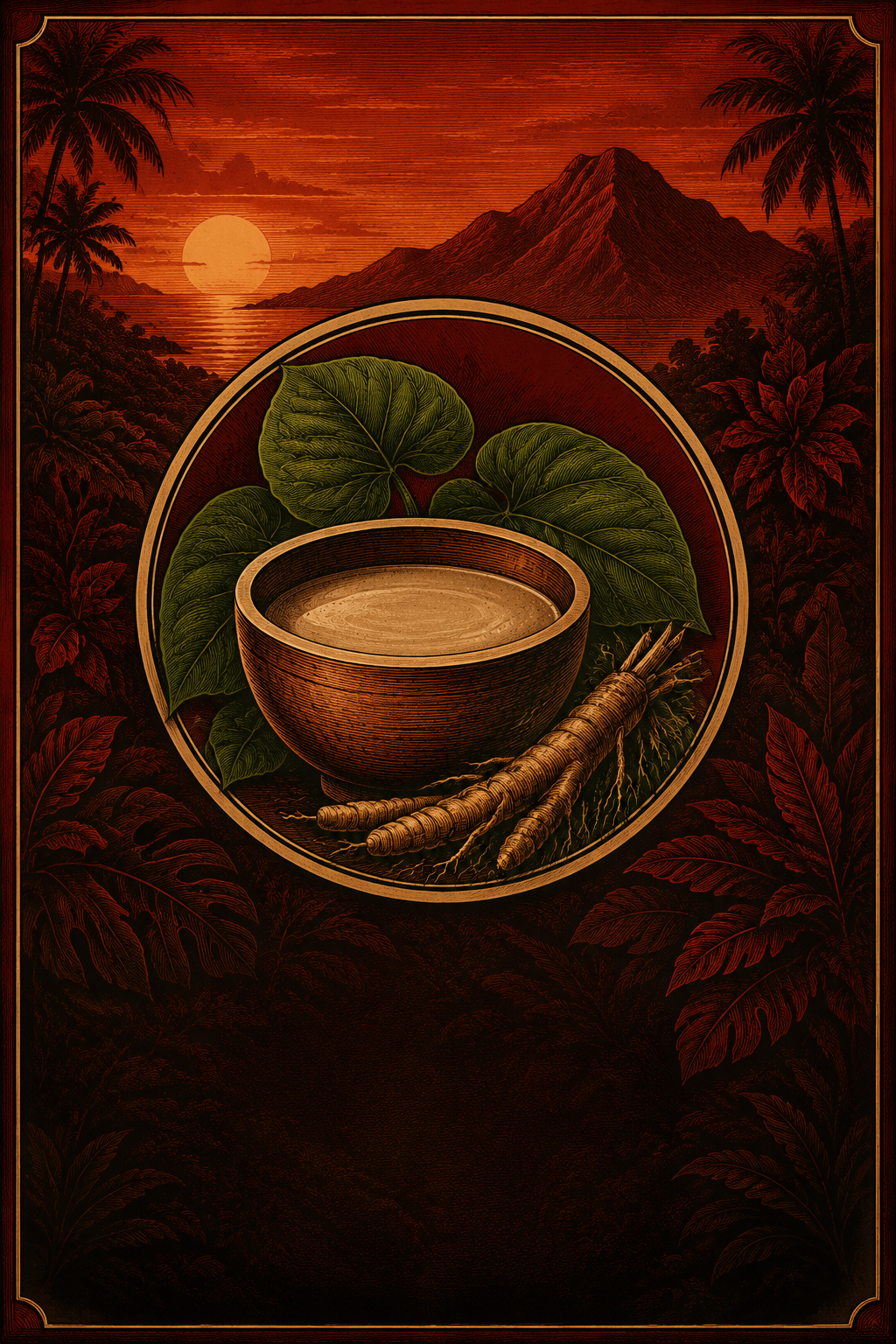
Botanical identity
Kava is the common name for Piper methysticum G.Forst., a perennial plant in the pepper family, Piperaceae. Royal Botanic Gardens, Kew accepts this scientific name and records the plant as native from the Santa Cruz Islands to Vanuatu, with introductions across a wider group of Pacific islands.
Labels may also use regional common names such as ʻawa or ava. A common name can provide cultural or marketplace context, but the scientific name is the clearest botanical identifier.
Origin and traditional context
Kava has a long cultural history in Pacific communities, including use in social and ceremonial beverage traditions. Practices, plant selections, and preparation methods differ among communities and islands. That history deserves accurate attribution, and it should not be treated as proof that a modern retail product provides a medical result.
Evidence boundary: Traditional context explains where terminology and practices developed. It does not guarantee the composition, quality, or effect of a packaged powder, instant product, capsule, or extract.
Common terminology
Root, rhizome, and lateral root
These terms identify underground plant structures that may be named on kava labels. Because plant part can influence product specifications, the label or documentation should state what material is represented rather than relying on the word “kava” alone.
Cultivar
A cultivar is a cultivated plant selection. When a seller makes a specific cultivar claim, look for traceable sourcing and identity information rather than assuming the name is standardized across every supplier.
Kavalactones
Kavalactones are a group of naturally occurring constituents used in kava research and product specifications. A total-kavalactone percentage is a measured composition statement only when the test method, units, sample, and batch are identified.
Traditional grind, micronized, instant, and extract
These are processing or format terms. “Traditional grind” generally describes milled plant material intended for straining. “Micronized” refers to smaller particle size. “Instant” may describe a product prepared to disperse directly. “Extract” means selected constituents have been concentrated. Sellers should define their terminology because manufacturing methods vary.
Common product formats
- Traditional-grind powder: milled kava material commonly described for straining in water.
- Micronized powder: finer material marketed for different preparation methods; the exact processing should be explained.
- Instant kava: a preparation intended to disperse more directly, which may be produced by different methods.
- Capsules: a packaged format that should list the botanical, plant part, ingredients, and contents.
- Liquid or dry extracts: concentrated formats that require clear constituent and concentration language.
Format words do not establish quality on their own. Use the label, batch details, and supporting documentation to understand what is actually in the package.
How to read a product label
Start with identity and plant part. Then review the complete ingredient statement, net contents, responsible business, lot number, and storage information. For products labeled as dietary supplements, FDA guidance describes required label elements such as the statement of identity, net quantity, nutrition labeling where applicable, ingredient list, and the manufacturer, packer, or distributor’s name and place of business.
- Look for Piper methysticum and the named plant part.
- Identify whether the product is traditional grind, micronized, instant, capsule, or extract.
- Read all other ingredients and flavoring statements.
- Check how any kavalactone or extract claim is defined.
- Find the batch or lot number and compare it with available documentation.
- Confirm the label includes responsible-company and storage information.
How to review batch details, laboratory reports, and COAs
Begin by matching the product and lot number. Then determine which questions the report actually addresses. A single assay may report selected constituents while a different panel addresses identity or contaminants. Do not interpret a general “tested” statement as evidence that every possible analyte was examined.
- Match the package lot to the report’s sample identifier.
- Review the lab name, report number, receipt date, and testing date.
- Identify the reported plant or product name and sample matrix.
- Read the method reference, result units, and reporting limits.
- Check whether a stated specification is shown beside the result.
- When accreditation is claimed, confirm that the lab’s accredited scope is relevant to the test.
ISO/IEC 17025 sets international requirements for the competence, impartiality, and consistent operation of testing and calibration laboratories. It supports confidence in laboratory work, but it does not replace the need to match a report to the correct product and batch.
Questions to consider before purchasing
- Does the label identify Piper methysticum and the plant part?
- Is the format defined in plain language?
- If a cultivar is named, is the sourcing or identity claim traceable?
- Are any constituent percentages tied to a batch-specific test?
- Can you locate complete ingredients, net contents, and responsible-company details?
- Is a current COA available, and does its lot number match?
- Are age restrictions and storage directions clear?
Storage and responsible handling
Follow the package directions. Keep kava in its original labeled container, close it securely, and protect it from excess heat, moisture, and direct light. Store it away from children and pets. Do not mix batches in one container because doing so breaks the link between the product and its lot documentation.
Adults 21+: Kiody educational and shopping content is intended for adults age 21 and older. This guide does not provide serving, treatment, or interaction instructions. People with health questions should consult a qualified health professional.
Frequently asked questions
Are all kava powders the same format?
No. Traditional grind, micronized, instant, and extract describe different processing or preparation categories. Read the seller’s definition and the product label.
What does a kavalactone percentage tell me?
It is meaningful only with context: the sample, batch, units, analytical method, and what the stated percentage represents. It does not replace the rest of the label or COA.
Does traditional use prove a modern product’s effectiveness?
No. Traditional history is cultural and historical context. It does not establish that a particular modern product produces a medical outcome.